4.9
Conversational commerce that completes the sale
AI assistants connected to your catalog and order data, ready to answer product questions and take the order in the same conversation.
.svg)


Trusted by 700+ leading brands worldwide


Trusted by 700+ leading brands worldwide
.png)
What is conversational commerce?
Conversational commerce is selling through a chat interface: the customer types or speaks a question, and an AI chatbot answers with product recommendations, stock and delivery facts, order updates, or a finished checkout. It runs where the customer already is – your storefront, WhatsApp, Messenger, Instagram – instead of leaving them to browse the catalog alone.
Rule-based chatbots follow a decision tree and break the moment a shopper phrases something unexpectedly. A conversational commerce build connects a language model to your catalog, pricing, inventory, and customer records, so every answer is grounded in what the store actually holds right now.
Built by an eCommerce agency, secured to enterprise standards
.svg)

scandiweb has built eCommerce for over two decades. The assistant is designed by the same engineers who work on your catalog and checkout, which is what lets it quote a real price and place a real order.
Customer conversations carry personal data and order history, so the build is covered by the same certifications as the rest of our delivery work – ISO 9001, ISO 27001, ISO 27017, and PCI DSS. Consent rules and data retention are agreed before the assistant goes live.
Where store chat stops short of a sale
Most stores have a chat widget that answers delivery questions, then hands the customer back to the catalog they were already struggling with. The sale still depends on them working it out alone.

No way to close the order
The widget explains the returns policy, then cannot check live stock or place an order against the customer's own account pricing.
The conversation restarts
A customer asks about a product in WhatsApp on Monday and opens the site on Thursday, where nothing about that exchange is available.
Sales questions become tickets
Pre-purchase questions go into the support queue behind delivery chasers, and get answered hours after the customer has bought elsewhere.
What a conversational commerce build includes
Conversational commerce is selling inside a conversation the customer is already having. An AI assistant answers product questions and completes the order in the same thread, using live stock and pricing from your store. One team handles the design work and the system connections.

Assistant design and training
We define what the assistant sells and where it hands over to a person, then train it on your product data and tone.

Catalog and pricing connection
Live stock and customer-specific pricing read straight from your store, so what the assistant quotes in chat matches the checkout.

Order and account actions
The assistant places orders and starts returns against the customer's real account, with the same rules your checkout applies.

Channel rollout
Launch on the site first, then add WhatsApp or SMS once the assistant is performing, keeping one conversation history across them.

Handover to your agents
Conversations pass to a live agent with the full thread attached, into the helpdesk your support team already works in.

Multi-language and market rules
One assistant covers several markets, with the language, tax and delivery rules configured separately for each storefront.
How Chat to Buy is made
The core stays maintained and shared across every deployment, which is what allows a first launch in weeks.
Foundation – core platform and AI
Features – your business logic
Interface – the customer touchpoints

Results from AI chatbots in production
Both builds shipped to a production storefront, handled real customer traffic, and were measured on the same commercial numbers the retail team already reports every month.
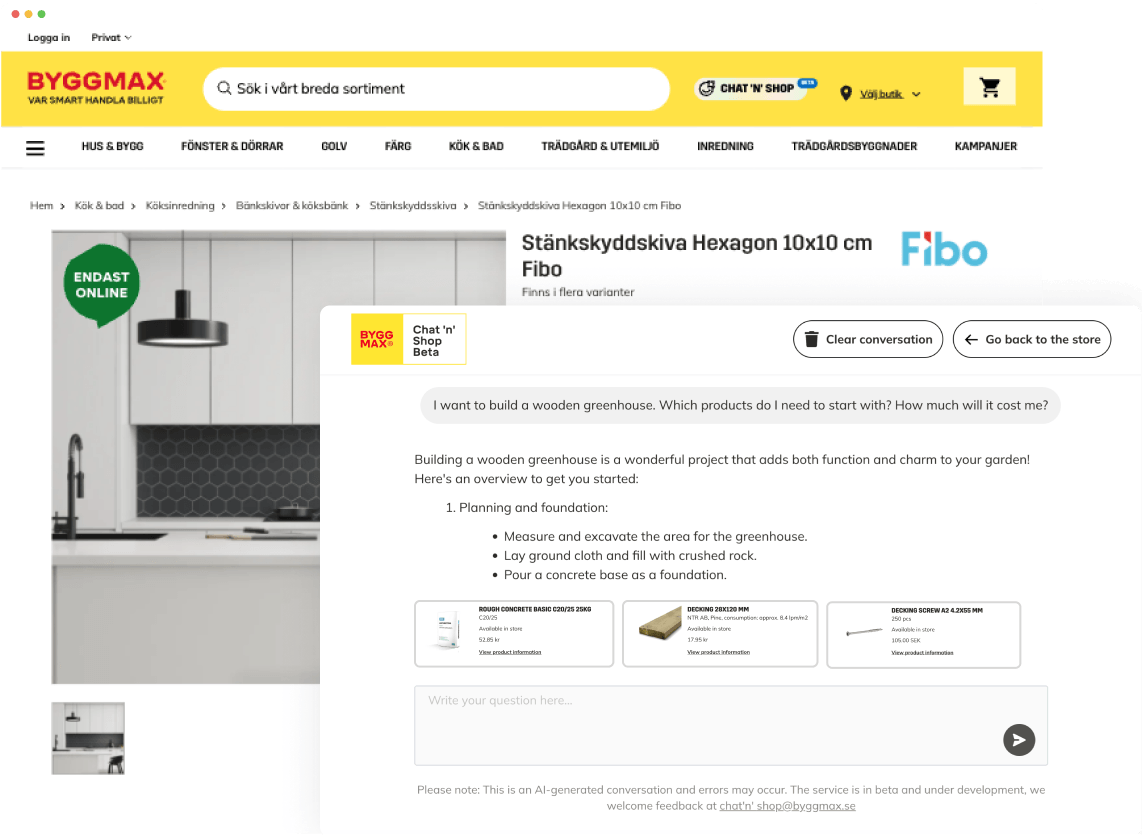

An AI assistant that plans the DIY project, then picks every SKU for it
AI assistant trained on DIY projects helps customers plan step-by-step, recommends exact SKUs and sizes, and increases basket value while reducing reliance on seasonal staff.
5x
Longer engagement
Higher
CR & AOV
Less
Staff dependency
Learn more
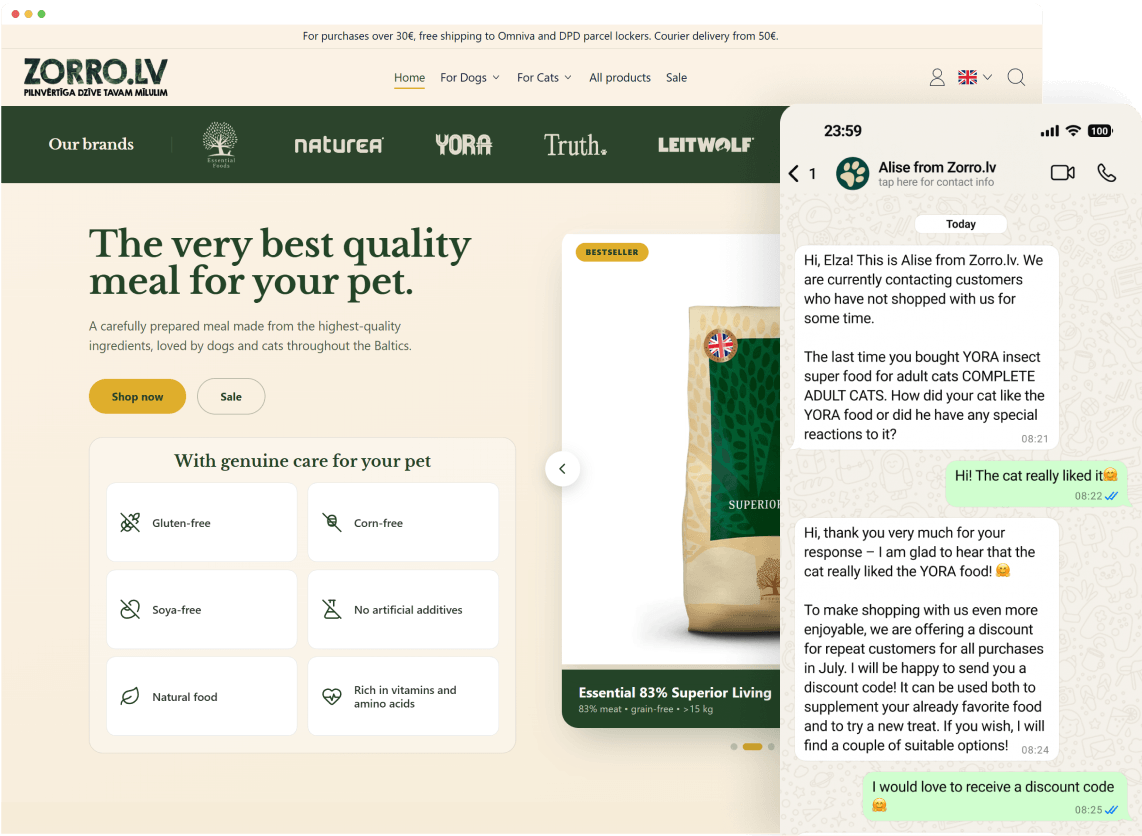
%201%201.png)
Lapsed customers brought back inside WhatsApp, without a new app to install
AI concierge in WhatsApp connects purchase history with CDP data to re-engage churned customers, restart conversations, and grow repeat purchases at scale.
32%
Churned customers reactivated
2 weeks
Time to implementation
Repeat
Purchases grown at scale
Learn more
What you get from a commerce team

The assistant sees real data
We connect it to your catalog and order systems ourselves, since the same team already maintains those integrations for your store.

A product, already built
Chat to Buy is a working platform with an existing architecture, so a deployment configures and connects what already exists.

Priced against conversations
A one-time integration fee covers the build, then a monthly platform fee scales with conversation volume and covers LLM usage.

Compliance agreed up front
Consent capture and data retention are settled before launch, under the ISO and PCI DSS certifications that cover our delivery work.

Built around how people buy
The assistant asks the clarifying questions a good salesperson asks, because the flows are designed by people who build storefronts.

Improved in conversations
Conversation analytics come with the platform fee, and the flows are adjusted against what customers actually ask once volume builds.
What clients say about working with scandiweb

.webp)





.png)


Conversational commerce questions and answers
How is this different from a support chatbot?

A support chatbot answers questions from a help article. A conversational commerce assistant is connected to your catalog and order systems, so it can quote the price that customer would actually pay and place the order in the same thread. The difference is integration depth, and that is where most of the build effort goes.
What does conversational commerce cost?
Pricing has two parts. A one-time integration fee covers connecting your systems and deploying the assistant. After that, a monthly platform fee scales with conversation volume and covers platform access, analytics, LLM usage, and unlimited users. We quote both after reviewing your systems and expected volume.
Do you build on our platform or replace it?
The assistant is added to your existing store. We support Adobe Commerce, Shopify, BigCommerce, commercetools, Salesforce Commerce, and SAP Commerce, and connect to the CRM and order systems behind them. No replatforming is involved, and your checkout stays where it is.
How long does a first deployment take?
A first channel is usually live within a few weeks. The timeline depends on how much of your product and customer data is already reachable through an API, which we check before quoting. Adding a second channel afterwards is faster, because the assistant and its connections already exist.
Which channels can the assistant cover?
Who handles data protection and consent?
We do, as part of the build. Consent capture and retention periods are agreed before launch, and the work is covered by the ISO 9001, ISO 27001, ISO 27017, and PCI DSS certifications behind our delivery. Where the EU AI Act applies to your use case, our EU AI compliance team scopes the obligations.

Talk to the team that built Chat to Buy
Tell us which channels your customers already use and which systems hold your product and order data. We will come back with the scope, the integration work involved, and what it would cost to launch.

Prefer to talk now? Book a call straight away, or email us at: [email protected]

Related AI services
See what a chat assistant would sell for your store
We will map your channels and the systems the assistant would need to reach, then explain the build.