4.9
Salesforce integration services for eCommerce
Connect Salesforce to the ERP and storefront your business already uses, so orders and customer records stay in sync without manual exports. Built by an official Salesforce partner.
.svg)

Trusted by 700+ leading brands worldwide


Trusted by 700+ leading brands worldwide
What Salesforce integration services fix
Before
With scandiweb

What our Salesforce integration services cover
The connection is the easy part. Salesforce integration work goes wrong at the data model, where two systems exchange records cleanly and still disagree about what a customer is. We agree field ownership before anything is built.

Salesforce to your ERP
Orders and stock connected to the ERP your finance team already uses, on a sync schedule and direction your operations team approves.

Salesforce to your storefront
Product data and pricing kept consistent between Salesforce and the storefront, so shoppers and support staff always see the same information.

Data Cloud and CDP work
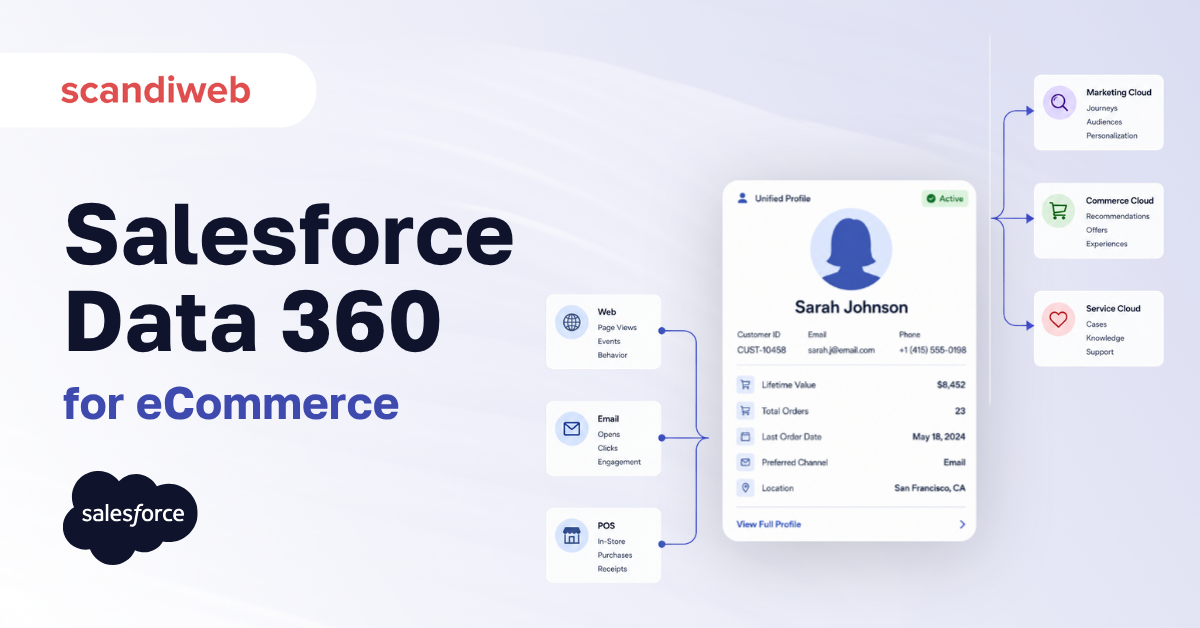
Customer profiles unified across the systems that create them. Your team edits the matching rules, called identity resolution, without a support ticket.

Marketing Cloud connections
When a customer abandons a cart or places an order, Marketing Cloud receives the event, and audience lists stop being rebuilt by hand.

Custom APIs and middleware
Because no connector fits every stack, we build the middleware layer, with error handling that alerts a person the moment a record fails.

Legacy and PIM systems
Older systems and PIM platforms connected into Salesforce through a mapped data layer
See what your integration would take
Systems we connect to Salesforce
Most of these connections already exist as maintained connectors, listed by vendor in our Salesforce connector directory. Whether one drops in unchanged depends on how far your Salesforce org has moved from the standard object model.
ERP and finance
SAP, NetSuite, Microsoft Dynamics 365, and QuickBooks are the systems we connect most often, for order write-back and invoice reconciliation.
PIM and product data
Customer data and CDP
Segment, mParticle, Treasure Data, and Bloomreach feeding Data Cloud, with the profile matching rules written down rather than buried in a connector.
Marketing and messaging
Klaviyo, Braze, Mailchimp, and Dotdigital receiving order and cart events directly, alongside whatever Marketing Cloud already sends.
Payments and tax
Logistics and marketplaces
ShipStation, parcelLab, AfterShip, and Mirakl joined to fulfillment and returns, so tracking reaches the customer without a manual export.
Built by an official Salesforce partner, ISO and PCI DSS certified


scandiweb is an official Salesforce partner, certified to ISO 27001, ISO 27017, ISO 9001, and PCI DSS. Those certifications matter more for integration work than for a one-off build: once a connection is live, your order, stock, and customer records move between systems every day, under the same controls.
ISO 27001 sets who on our side can reach your production data. ISO 27017 covers the cloud layer a Salesforce data integration runs on. PCI DSS applies wherever a connection carries payment data. ISO 9001 is why every change to a live connection is documented before it ships.
Who our Salesforce integration services are for
Three situations account for most of the Salesforce integration work we take on. If one of them is yours, the first conversation is a short one.
Brands on Salesforce and a separate ERP
Your finance system and your storefront hold different versions of the same order. We connect them so the ERP stays the system of record.
Teams on Commerce and Marketing Cloud
Campaign data arrives late or gets exported by hand. We connect the clouds so purchase events reach Marketing Cloud as they happen.
Brands replacing a legacy CDP
Your current platform cannot resolve identities the way you now need. We handle the migration and the rules behind it afterwards.
scandiweb's integration practice
How a Salesforce integration project is delivered
The first deliverable is a written data map: every record type moving between systems, the system that owns each field, and what happens when a sync fails. Scope and price are fixed against that map, so the number you approve is the number you pay.

Mapping and discovery

We list every system that reads or writes the data, then settle the ownership questions that usually surface late. We document the failure cases alongside. You keep the map whether or not the project continues.

Scope and fixed price
The map becomes a scoped statement of work with a fixed price and a delivery date. Salesforce integration consulting stops here if that is all you wanted, and the document is yours either way.

Build and testing
We build against a Salesforce sandbox and your test ERP environment, then push every record type through end to end, including the failure paths, before anything reaches production.

Go live and support
Cutover runs in a window you approve, with monitoring on every connection from day one. Your team receives the runbook and repository access, so you can make a change without us.

Find out what connecting Salesforce would actually take
Send us your system list and we come back with a scoped plan and a fixed price, usually within the week.


Salesforce Data Cloud for a New York fashion house
A luxury womenswear brand in New York had outgrown its customer data platform. Changing one identity resolution rule needed outside help. scandiweb connected Salesforce Data Cloud to Marketing Cloud and the brand's Magento storefront, with the warehouse layer on AWS. Five years on, hundreds of hours of monthly reporting happen automatically.
Why brands pick scandiweb to integrate Salesforce

Top-3 Akeneo implementation, 2020
Our Akeneo work placed top three at the 2020 Akeneo summit awards. Product data integration is judged there on delivery, and this team has been measured against it.

Pimcore Platinum Partner
Platinum is Pimcore's top partner tier, awarded on delivered work. Data modeling is where Salesforce integration goes wrong most often, and it is what the tier covers.

29 certified data specialists
Twenty-nine certified data and integration specialists are on staff here. The person who reviews your field mapping is the same one who is there at go-live.

AWS Partner Network member
Salesforce data work usually sits beside a warehouse and a transformation layer. Because the cloud infrastructure is in-house, one team owns the whole pipeline.

PIM practice since 2016
We have operated a dedicated PIM and data integration practice for a decade, separate from storefront delivery. The people scoping your project do this work continuously.

Connectors we built ourselves
Our own Akeneo and Pimcore integration layers are live on client stores today. When a pairing has no connector, we start from code this team wrote and owns.
What our clients say

.webp)







Frequently asked questions about Salesforce integration services
What do Salesforce integration services include?
Salesforce integration services connect Salesforce to the other systems a business uses, so records reach them without manual work. A typical project covers the data map, the build, testing against real record types, cutover, and monitoring afterwards. Scope depends on which systems are involved and how much of your data model is already agreed.
How much does a Salesforce integration cost?
Cost depends on how many systems and record types are involved, and whether a connector already exists for the pairing. A single well-defined connection is a small fixed-price project. A multi-system data layer with a warehouse behind it is considerably larger. We quote a fixed price against the data map, so the figure you approve is the figure you pay.
Do you offer Salesforce integration consulting on its own?
Yes. Salesforce integration consulting can be bought separately from the build. The deliverable is the data map: every record type moving between systems, the owning system per field, the failure cases, and a scoped estimate. Clients who take it to an internal team or another vendor keep the document. It is written to be handed over.
How do you choose a Salesforce integration partner?
Ask three things. Does the partner produce a written data map before quoting? Does it handle sync failures explicitly? And does the integration code end up in your repository? Salesforce integration partners who dodge that last question have made you dependent on them, and the same test applies to any Salesforce integration company you shortlist.
Can you work alongside our existing Salesforce partner?
Yes, and it is a common arrangement. Larger organizations often keep a Salesforce partner for CRM and Sales Cloud work while bringing us in for the commerce and data side. We scope the boundary during mapping, so neither team writes over the other's records. Joint delivery does not change the fixed price.
What are the different types of Salesforce integration?
Three patterns cover most Salesforce integration work. Point-to-point connects two systems directly and suits a single stable pairing. Middleware routes records through a central layer and scales better across several systems. API-led integration exposes reusable services other teams consume later. We pick the pattern during mapping, because it drives cost more than anything else.
How long does a Salesforce integration take?
A single connection between Salesforce and one other system usually takes 4 to 8 weeks from mapping to go-live. A data layer connecting several systems, with identity resolution and a warehouse, takes 4 to 12 months. The mapping stage takes 1 to 3 weeks on its own and is what makes the rest of the estimate reliable.
Can you connect Salesforce to our ERP?
Yes. Salesforce ERP integration is the most common request we handle, covering orders, invoices, stock, and customer records. The work is the same whichever ERP you use: agree who owns each field, then build the sync and the failure handling together. We have connected Salesforce to ERPs including SAP, Sage, and Microsoft Dynamics.
Which Salesforce products do you integrate?
Commerce Cloud, Marketing Cloud, Service Cloud, and Data Cloud, including the Salesforce data integration work that unifies customer profiles across them. Which products are in scope depends on where your records live today. For a specific pre-built connector, our Salesforce Commerce Cloud integrations directory lists what is ready to deploy.
What happens after the integration goes live?
Every connection is monitored from day one, with alerts routed to a named person. Support is available as a retainer, and it is optional: your team receives the runbook and repository access at handover. If the work turns out to need a platform team as well, our Salesforce Commerce Cloud agency practice covers that in-house.

Get your Salesforce integration plan
Tell us which systems you use and what is not reaching Salesforce today. A senior specialist replies with a scope shape. If the work sits closer to platform delivery, our Commerce Cloud team covers it in-house.
Book a call straight away or email us at: [email protected]


Related services
Get a scope for your Salesforce integration services
Send your system list today and get the scope back this week, read by the specialist who would deliver it.