4.9
Shopify speed optimization service, measured in revenue
We find what makes your Shopify store slow and fix it in the theme code and the app stack. Every gain is proven in Core Web Vitals field data, by the team that builds the Satoshi theme.
Trusted by 700+ leading brands worldwide


Trusted by 700+ leading brands worldwide
Who runs your Shopify speed optimization
700+
Clients from all over the globe
150+
Shopify projects delivered
$4B+
Processed for clients per year



Inside our Shopify speed optimization service
A Shopify speed optimization service is engineering work on what sits on top of the platform: the theme, the apps, and the media. The platform itself is rarely the problem. scandiweb fixes the causes at the code level, starting with whichever template costs you the most revenue.

Sitewide speed audit
Template-by-template profiling of your Core Web Vitals, delivered as a ranked fix list with the projected gain for each item, biggest first.

Theme and Liquid optimization
Render-blocking code and oversized bundles rewritten inside your existing theme. The design your customers know stays exactly as it is.

App and script cleanup
Scripts left behind by uninstalled apps come out, and the apps you keep are loaded only on the templates that actually use them.

Image and media delivery
Shopify page speed optimization often comes down to media: images, fonts, and video served at the right size, lazy-loaded where it belongs.

Checkout and cart speed
The pages closest to purchase stop being the slowest: payment scripts such as Klarna load deferred, and cart requests are streamlined.

Post-fix speed monitoring
Monitoring stays on after launch and catches regressions as the store changes. Our Shopify support and maintenance team can carry it long term.
What a slow Shopify store is costing you
Most Shopify stores load in 3.2 to 5.1 seconds, above the Core Web Vitals threshold. Google's 2025 CrUX data shows only 43% of Shopify stores pass all three vitals.

Paid traffic converts worse
You pay per click whether the page loads in two seconds or five. On a slow-loading store, the same ad budget buys fewer completed orders.

Mobile shoppers leave first
Mobile shoppers browse on slower connections, and many leave before a heavy page finishes loading. Shopify store speed optimization starts on the phone.

Rankings and AI answers favor fast stores
Google's ranking systems use Core Web Vitals, and AI answers read the same page. Our eCommerce SEO services team sees slow pages hold back healthy stores.
The five steps of a Shopify speed project
Shopify site speed optimization fails when fixes ship without a diagnosis, which is why the audit comes first and scopes the work. Nothing is rebuilt on a guess, and the engineers who ran the audit make the fixes.

Speed audit and CWV profiling

A Shopify speed optimization expert profiles LCP, INP, and CLS across your templates and measures what every app and third-party script adds to load time.

Fix plan you approve
The findings become a plan: what gets fixed, in what order, and what each fix is expected to return. You approve the scope before any build starts, and the work stays inside it.

Fix sprints on theme and apps
The theme code gets rewritten first, because that is usually the largest cause. App scripts and media follow, with each change tested before it rolls out.

Validation in field data
Lab scores move first. What counts is Core Web Vitals field data, the measurements Google gathers from your real visitors, and those numbers have to move before the work is called done.

Monitoring that holds the gains
The store keeps changing after handoff, so live monitoring through NewRelic and WebPageTest stays on. A regression gets corrected while it is still small.

Speed results we can document
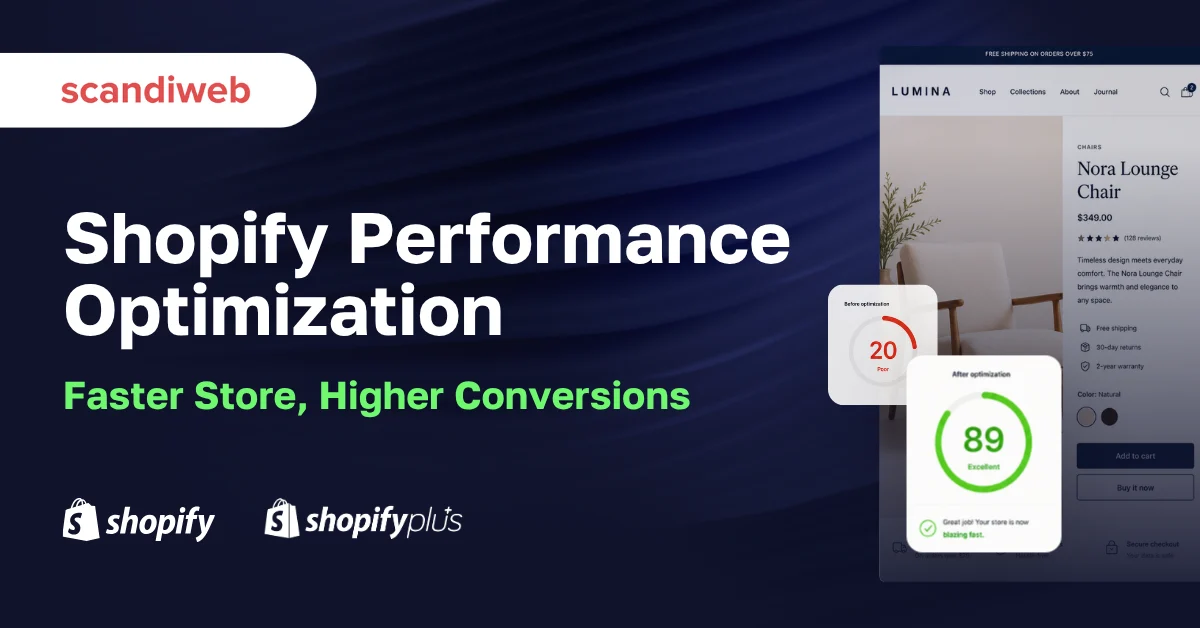
On a recent scandiweb Shopify launch, a store that arrived with a mobile PageSpeed score of 20 reached 89, and add-to-cart climbed 14% within 30 days. scandiweb applies the same speed engineering to Adobe Commerce, Magento, and Shopify performance optimization.


A luxury chocolatier went all green on Core Web Vitals
+47.8%
conversions
+39%
revenue
93
Homepage and PDP desktop PageSpeed
Learn more


Faster pages across a DIY giant's 6 Nordic stores
85 → 99
PLP PageSpeed score
70 → 87
PDP PageSpeed score
30%
faster page load
Learn more


A furniture retailer's speed work lifted transactions 43.8%
+242.8%
Time to Interactive improvement
+76.6%
PageSpeed score
+20.1%
checkout conversion rate
Learn more

We build our own high-speed Shopify theme
Satoshi, the storefront theme scandiweb built, is listed on the Shopify Theme Store and scores at the top of Google PageSpeed and Core Web Vitals. scandiweb is a Shopify Plus Partner, and Shopify performance optimization is daily work for the team behind the theme.
We bring that standard to the theme you already run, no re-theme required.
Is speed work the right fix for your store?
This is a website speed optimization service built specifically for Shopify, and the fixes land in Liquid, theme architecture, and app scripts. Fit matters: the work pays back fastest on stores already spending real money on traffic.
This fits if

Not the right fit if

.png)
How Shopify speed optimization is priced
The work is priced as one fixed scope after the audit: you know the full cost and the expected gains before you commit. What moves the price is the state of the theme and how many apps and templates the work covers.
The findings are yours to keep, whatever you decide about the fix work.
Your store is losing speed somewhere. One audit maps every cause.
Stores usually hire a Shopify speed optimization agency after months of app-by-app guessing. The guessing is the expensive part.

What our clients say

.webp)



Frequently asked questions about Shopify speed optimization
What does a Shopify speed optimization service include?
Theme code and Liquid, app and third-party scripts, images and fonts, and the cart and checkout flow. Those four areas carry almost all of the load time on a typical Shopify store. The work ends with monitoring, so the store stays fast after launch.
How long does it take to speed up a Shopify store?
The audit itself takes days. Fix work is scoped in sprints: a focused theme and app cleanup can improve Shopify site speed within weeks, and deeper engineering across templates and checkout takes longer. Google's field data collects over a 28-day window, so plan for verified movement within one to two months of starting.
How do you improve Core Web Vitals on a Shopify store?
Shopify Core Web Vitals come down to three numbers: LCP under 2.5 seconds, INP under 200 milliseconds, and CLS under 0.1. LCP usually breaks on render-blocking theme code and oversized hero media. INP goes wrong when third-party app scripts hold the main thread. CLS comes from unsized images and banners that inject after the page loads. Each is fixed in a different place, so a single score never tells you which one to work on.
Does site speed affect Shopify conversion and rankings?
Yes, if it is an established Shopify or Shopify Plus store. The everyday work is Online Store 2.0 storefronts with heavy media and a theme that has been customized for years. The team doing that work also builds the Satoshi theme, which luxury jewelry retailer J.R. Dunn runs its storefront on. Send the store URL and the findings come back on your own templates.
Have you done this for a store like mine?
Yes, if it is an established Shopify or Shopify Plus store. The everyday work is Online Store 2.0 storefronts with heavy media and a theme that has been customized for years. The team doing that work also builds the Satoshi theme, which luxury jewelry retailer J.R. Dunn runs its storefront on. Send the store URL and the findings come back on your own templates.
How much does Shopify speed optimization cost?
There is no flat rate, because the work scales with engineering time. Cheap fixed-price Shopify speed optimization services exist, and on a store with years of app history they rarely change what real visitors experience. What you are buying here is engineers rewriting theme code and app loading, so the quote follows the scope of the fix list.
Can a speed optimization app do the same thing?
A Shopify speed optimization app compresses images or lazy-loads scripts, and that helps at the margin. It cannot rewrite slow theme code or remove what uninstalled apps left behind, because that is engineering work inside the theme. If an app alone could make a loaded store fast, the store would already be fast.
Will the gains last after new apps or theme updates?
Yes, when the fixes land in the theme code. Any Core Web Vitals optimization service can show a good week, because a caching layer improves a lab score without changing what the browser has to do. Rewritten theme code changes that. The store stays light as new apps and campaigns ship, and the gains hold.
Do you optimize Shopify Plus stores and large catalogs?
Yes. Large catalogs and B2B pricing logic are everyday cases. Plus-specific work such as Scripts and checkout extensibility is scoped before the fix sprints start, and on Shopify Plus stores the cart and checkout templates get profiled alongside the storefront, because that is where the payment and tax scripts land.
Will the work break my store or take it offline?
No. Changes are built and tested on a duplicate theme outside production, then published template by template. Zero-downtime deployment is standing practice across scandiweb's Shopify optimization services, and every change can be rolled back. The store keeps selling while the work ships.




Related Shopify services
Request a Shopify speed audit for your store
The Shopify speed optimization service starts with your store URL. The written audit comes back within days, scoped and priced.

Prefer to talk now? Book a call straight away, or email us at: [email protected]