4.9
Salesforce Commerce Cloud migration services
Replatform onto Salesforce Commerce Cloud with your order history and search rankings intact, planned and delivered by an official Salesforce partner.
You see the full scope and a price range before committing to anything.
.svg)

Trusted by 700+ leading brands worldwide


Trusted by 700+ leading brands worldwide
Salesforce Commerce Cloud migration challenges most plans miss
The estimate you get for a Salesforce Commerce Cloud migration is only as good as what the agency read before writing it. Three specific things decide the number, and each one is discoverable in an afternoon by someone who knows where to look.

The cartridge path sets the cost
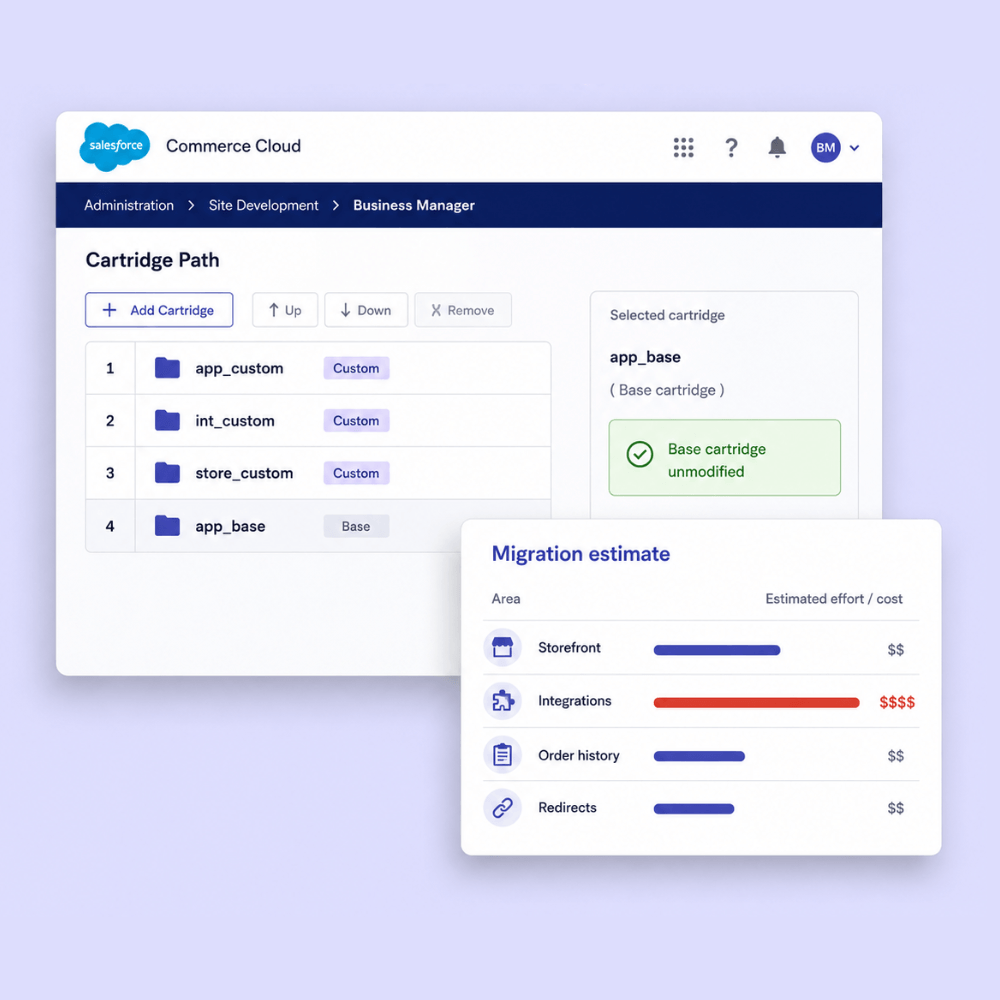
Customization sits in overlay cartridges resolved left to right. We audit that stack first, because a modified base cartridge breaks clean upgrades.
OCAPI reached end of life
Salesforce deprecated OCAPI in April 2026 and now requires SCAPI for new work. Arrive on the deprecated API and you pay for the same integration twice.
Business Manager sits outside your code
Business Manager holds site preferences and job schedules outside your codebase. When those are not tracked as migration work, they go missing at go-live.
What our Salesforce Commerce Cloud migration services include
scandiweb quotes these workstreams as one fixed scope, including historical order reconciliation, which is the item that most often becomes a mid-project change request on an enterprise replatform. Anything the cartridge audit finds is inside the quoted number.

Catalog and customer data migration
Products and customer records are mapped onto the Salesforce data model, then counted against your current store before sign-off.

Order history migration
When order history migrates, every single record is reconciled against the source system before cutover is approved.

SEO and redirect mapping
Every existing URL is mapped to its Salesforce Commerce Cloud address ahead of launch, so earned rankings survive.

Storefront build on SFRA
Your storefront is rebuilt as overlay cartridges above SFRA, which keeps customization intact through platform releases.

Integration reconnection on SCAPI
Because SCAPI is now mandatory for new work, connections are rebuilt there and tested against real order flows.

Business Manager configuration
Site preferences and Page Designer components become tracked deliverables. Job schedules are inventoried during discovery.
Know the number before you commit the budget
An official Salesforce partner, certified to ISO and PCI DSS standards


scandiweb has worked in eCommerce since 2003 and has delivered 2,100+ projects for 700+ brands, with clients rating the work at 95 NPS. As an official Salesforce partner, scandiweb runs Salesforce Commerce Cloud migrations under the certifications shown here.
ISO 27001 covers information security management and ISO 27017 extends those controls to cloud infrastructure, which is what your catalog, customer records and order history move through during a migration. PCI DSS applies wherever cardholder data is in scope, and ISO 9001 is the quality standard behind the delivery process itself.
Where a Salesforce Commerce Cloud migration usually starts
Most stores arriving on Salesforce Commerce Cloud are leaving something they outgrew, and the origin platform changes the work more than the destination does. The mapping effort between two data models is what the estimate mostly measures.

Storefronts still on SiteGenesis
Your SFRA rebuild happens cartridge by cartridge, which means the current storefront stays online for the whole project.
Estates on Magento or SAP Hybris
Because the data models differ sharply, mapping is agreed before development, and attribute structures are validated against a real export.
Multi-brand and multi-market groups
Each site migrates on its own schedule, while a single redirect map and one shared data model cover the entire group.
How a migration to Salesforce Commerce Cloud works
Discovery produces the cartridge audit and the redirect map before any build starts, so the two things that most often expand an SFCC replatform are priced at the beginning. One Delivery Manager owns the project from that audit through the first month live.

Discovery and cartridge audit

We read the existing storefront cartridge by cartridge and separate genuine customization from base modification. Every integration is inventoried with its authentication method, which is what produces your scope and your price.

Data mapping and migration plan
Catalog and order structures are mapped onto the Salesforce data model, and the redirect plan is written and signed off before development begins.

Storefront build and integration work
Your storefront is rebuilt as overlay cartridges on SFRA while connections are re-established through SCAPI, many of them already documented in scandiweb's Salesforce Commerce Cloud integrations directory.

Rehearsal and validation
We rehearse the migration against a sandbox loaded with production data and fix the runbook there. Record counts are reconciled until the numbers match the source exactly.

Cutover and first month live
Cutover happens in a maintenance window you approve, with your current store available as the rollback target. From month two, Salesforce Commerce Cloud development and support continue on the same platform.

Replatforms delivered with the data and the rankings intact
scandiweb measures every migration after go-live, against the store's own traffic before the change.


A legacy publishing platform retired, and 1,631 new keywords earned
+36.75%
Sessions after migration
+52%
Users after migration
21,000+
Redirects mapped
Learn more


Organic traffic doubled within a month of a legacy replatform
+227%
YoY organic traffic
5
Store views migrated
2
Domains consolidated
Learn more
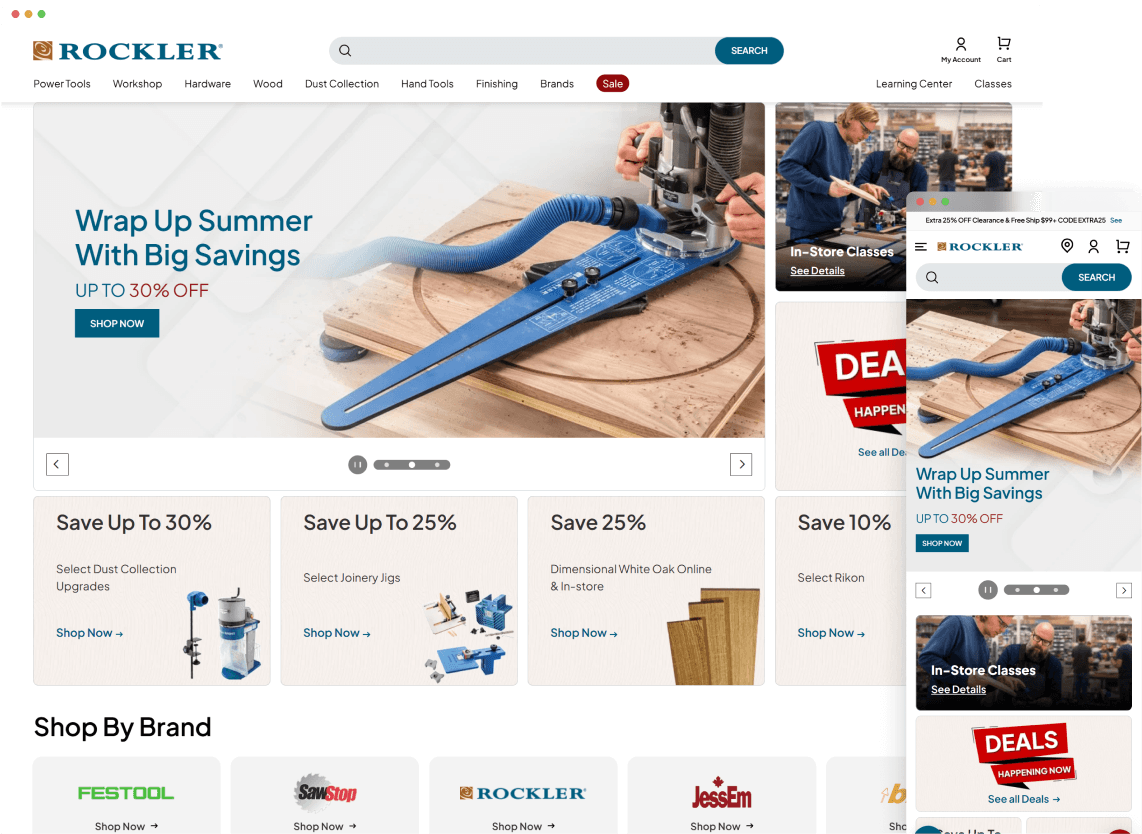

5,980 homepage clicks from a store rebuilt with its customization kept
+33,932
Keywords ranking higher
1,117
Keywords in the top 3
5,522
Keywords in the top 10
Learn more
Get a Salesforce Commerce Cloud migration estimate
Send us your storefront and integration list, and the written scope comes back with a price attached.

What a Salesforce Commerce Cloud migration costs
Four things set the price of a Salesforce Commerce Cloud migration. Two are architectural: how much of the storefront was built against the base cartridge, and how many integrations still authenticate through OCAPI. Two are volume-based: the order history being reconciled and the size of the redirect surface.
scandiweb quotes the migration as a fixed scope once discovery has read the storefront, and that figure holds for the work it describes. Change requests are priced separately and agreed before anyone starts them.
SFRA or the Composable Storefront
Migrating onto Salesforce Commerce Cloud means choosing a storefront architecture, and that choice is harder to reverse than the migration itself. We recommend one against your catalog and your team, and we say so when the simpler option is the right one.
SFRA fits when
The Composable Storefront fits when
Why enterprise brands choose scandiweb for the migration

Official Salesforce partner
scandiweb is an official Salesforce partner, and the specialists who scope your migration are the ones who deliver it.

In eCommerce since 2003
Every failure mode on your project has been priced on someone else's project first, across two decades of replatform work.

600+ in-house specialists
Engineers and architects are employed in-house, so your migration is never staffed by subcontractors you did not meet.

$4B+ processed a year
Our clients process more than $4 billion a year. The order volumes your reconciliation must survive are already familiar here.

Only the top talent
Roughly one applicant in 250 joins scandiweb, which is why the seniority quoted in the estimate is the seniority you get.

One accountable Delivery Manager
When two teams disagree, your Delivery Manager settles it. You are never the person chasing the same answer twice.
scandiweb by the numbers



What our clients say

.webp)








Frequently asked questions about Salesforce Commerce Cloud migration
What is Salesforce Commerce Cloud called now?
Salesforce renamed Commerce Cloud to Agentforce Commerce, and its own site now reads "Agentforce Commerce (formerly Commerce Cloud)". The underlying products are unchanged: B2C Commerce is the platform acquired as Demandware in 2016, and B2B Commerce came from CloudCraze in 2018. Most buyers and most documentation still say Salesforce Commerce Cloud, and both names refer to the same platform.
How much does a Salesforce Commerce Cloud migration cost?
scandiweb prices each migration after a discovery cartridge audit, so the figure is grounded in your own codebase. The two variables that move it most are the depth of frontend customization and the number of integrations still on the deprecated API. Salesforce licensing is contracted directly with Salesforce and sits outside this price.
Does migrating mean replacing OCAPI with SCAPI?
Yes, for anything new. Salesforce marked OCAPI deprecated in April 2026 and states that all new implementations must use SCAPI exclusively. Existing OCAPI calls still function in maintenance mode, and SLAS lets one authentication token cover both API sets, which makes a phased cutover possible.
How do you handle a heavily customized SiteGenesis storefront?
SiteGenesis and SFRA controllers are recognized as equals by the platform, so both architectures can be live in one cartridge path at the same time. That allows a cartridge-by-cartridge migration on a schedule you control. The exception is the OnRequest and OnSession handlers, which SFRA does not use and which are rewritten during the migration.
How long does a Salesforce Commerce Cloud migration take?
Published industry ranges put an enterprise replatform at four to nine months. Heavily customized legacy storefronts extend past twelve, because effort tracks the depth of frontend customization, which has little to do with catalog size. scandiweb commits to a launch window in writing as soon as discovery has read the storefront.
Will our search rankings survive the migration to Salesforce Commerce Cloud?
Rankings hold when the redirect plan is approved before development begins. scandiweb builds the full redirect map during the data-mapping stage, signs it off with your team, then monitors rankings daily through the first month after go-live. Enterprise redirect surfaces reach tens of thousands of URLs, which is why it is scheduled work with a named owner.
Should we migrate onto SFRA or the Composable Storefront?
SFRA is the reference architecture and suits merchandising teams who build campaigns in Page Designer and Business Manager. The Composable Storefront suits teams already employing frontend engineers who will own that codebase after launch. The deciding factor is which team maintains the frontend in year two, and we recommend one during discovery.
What happens to Business Manager settings and Page Designer content?
Both are treated as their own workstream. Business Manager configuration lives outside your repository, so it is captured during discovery and rebuilt with explicit sign-off. Page Designer is different again: its content is component-instance data bound to developer-defined component types, which means the component library has to exist before any content migrates.

Get your Salesforce Commerce Cloud migration estimate
Tell us what your storefront is built on today and which systems it connects to. The specialists who scope the migration on that call are the engineers who deliver it. When a project also needs platform support after launch, our Salesforce teams take it on in-house.
Prefer to talk now? Book a call straight away, or email us at: [email protected]
Resources on replatforming and Salesforce Commerce Cloud



Related services
Start planning your Salesforce Commerce Cloud migration
We price the migration from your storefront's real customization depth, measured in discovery.