
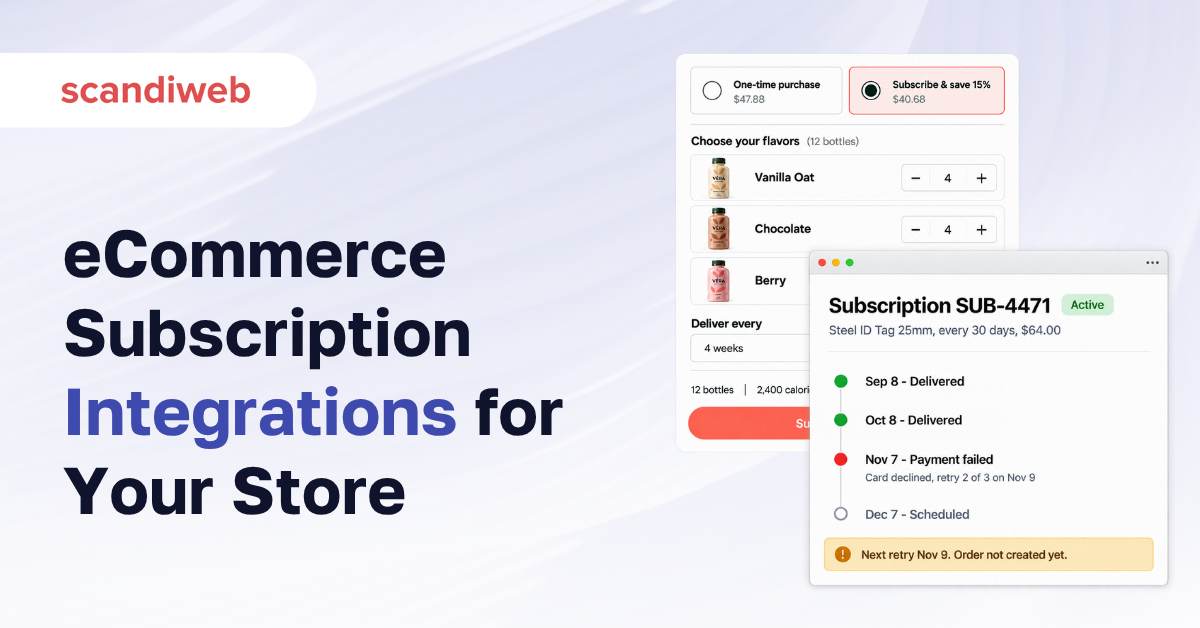
A subscription is the only order your store places on behalf of the customer, months after they last thought about you, using a card that may no longer work.
eCommerce subscription integration connects your store to the system that holds recurring plans, takes repeat payments, and generates the orders that follow, so renewals become real orders with real stock, real tax, and real fulfillment. The selling is the easy part. Everything downstream of the second payment is where the work is.
What is eCommerce subscription integration?
eCommerce subscription integration is the connection between a storefront and a recurring billing system, covering how a customer signs up, how the plan is stored, how repeat payments are attempted, and how each successful payment becomes an order your warehouse can pick. It runs on a platform-native subscription feature, a dedicated subscription app, or a billing platform built for recurring revenue, and the right choice depends on whether you are selling replenishment, membership, or licensed access.
Most merchants underestimate the same thing. A subscription is not a product. It is a standing instruction that creates products on a schedule, and every system downstream of it has to understand orders that nobody placed today.
Our wider guide to Magento integrations covers the other systems a store connects to. Every billing platform named here has a page of its own in our integration directory, documented separately for each platform.
🚀 Quick takeaway
The question that sizes the project is not how many subscribers you expect. It is what has to happen automatically on the day a renewal fails.
Three subscription models, three different projects
The word covers several businesses that share almost no technical requirements.
Replenishment. The customer buys the same physical product repeatedly, such as coffee, supplements, or pet food. Stock is consumed on every cycle, so inventory, picking, and shipping all run on the renewal schedule. This is the model that stresses operations hardest, because a renewal is a real order with a real parcel.
Membership and access. The customer pays for a tier, a discount, or free delivery rather than for goods. No stock moves, but entitlements have to be enforced at checkout, which means the storefront needs to know the membership state on every request.
Curation and boxes. The customer pays a recurring amount and receives a changing selection. Hardest of the three on merchandising, because what ships is decided per cycle, not at sign-up, and the catalog logic sits outside the normal product model entirely.
B2B contracts and licensed access. Less often discussed and increasingly common. A business customer holds an agreement with negotiated pricing, seat counts, or usage allowances, billed on terms rather than by card. Invoicing, purchase orders, and approval chains replace the consumer checkout entirely, and the requirements look far more like finance software than like a storefront.
A platform that handles one of these well often handles another poorly. Establish which you are before the shortlist, because demos rarely distinguish them, and a product built for consumer replenishment will not gracefully learn to issue invoices on thirty-day terms.
🚀 Quick takeaway
Replenishment stresses operations, membership stresses the storefront, and curation stresses merchandising. Buying for the wrong one is the most expensive mistake in this category.
Native, app, or billing platform
Use the platform’s native subscriptions when the model is simple. One or two plans, a single market, no complex entitlements. Shopify and Adobe Commerce both offer workable recurring functionality, and for a straightforward replenishment product it is often enough.
Use a subscription app when retention mechanics matter. Pause, skip, swap, and reschedule are the features that reduce churn, and they are the ones native implementations usually lack. If subscribers leave because they have too much product and no way to delay a delivery, this is the layer that fixes it.
Use a billing platform when the money is complicated. Usage-based pricing, proration, multi-currency, revenue recognition, dunning strategy, or B2B invoicing. Platforms such as those covered on the Shopify Chargebee integration and the Magento Zuora integration pages exist because finance teams need things the storefront was never designed to do.
The cost shape differs sharply. Native is included. An app is usually a monthly fee plus a percentage of subscription revenue, which gets expensive precisely as the programme succeeds. A billing platform is an enterprise contract that is cheap relative to the revenue it manages and expensive relative to a small programme.
🚀 Quick takeaway
If a percentage of recurring revenue is in the pricing, model it at your target subscriber count rather than today’s. That line grows with your success.
Which subscription systems connect to which platform
| System | Best for | Integration notes |
|---|---|---|
| Recharge | Replenishment on Shopify and beyond, strong retention tooling | The most common choice for DTC replenishment. See the Magento Recharge integration |
| Chargebee | Subscription billing with real finance requirements | Proration, dunning, revenue recognition. See the Shopify Chargebee integration and the Magento Chargebee integration |
| Zuora | Enterprise recurring revenue, usage-based and hybrid pricing | Heaviest of the set and the most capable on complex monetization. See the Magento Zuora integration |
| Stripe Billing | Teams already standardized on Stripe for payments | Keeps billing and payment in one place, which simplifies reconciliation. See the Magento Stripe Billing integration |
Your platform changes the work as much as the vendor does. The same billing system on Adobe Commerce and on Shopify differs in where the plan is stored and which system owns the customer record, which is why each combination is documented separately. The Shopify Recharge integration and the BigCommerce Chargebee integration are not the same build as their Magento equivalents.
🚀 Quick takeaway
Decide which system is the source of truth for the customer record. If both the store and the billing platform think they own it, reporting will never reconcile.
What recurring billing breaks
None of these appear in a demo, because a demo has one subscriber, one cycle, and a card that works.
Failed payments are a business process, not an error
Cards expire, get replaced after fraud, and bounce on insufficient funds. Dunning is the sequence of retries and messages that follows, and it recovers a meaningful share of revenue that would otherwise be lost silently. The decisions are commercial rather than technical. How many retries, over how many days, with what messaging, and at what point the subscription is cancelled rather than paused. Nobody owns this by default, and the default settings are rarely right for your category.
Retry timing matters more than retry count. Attempting the same card three times in an hour achieves nothing except issuer irritation, while spacing attempts across a payday cycle recovers a materially different number. Low-value replenishment and high-value membership also deserve different sequences, because the cost of annoying a subscriber is proportional to what you lose if they go. Write the sequence down, including what the customer sees at each step, and treat it as a commercial document rather than a configuration screen.
Inventory does not know about future orders
A replenishment programme has a largely predictable demand curve, and most stores ignore it. If a thousand subscriptions renew on the first of the month, those units are committed before anyone places an order, but the stock system has no idea until the orders land. Either the subscription system forecasts into inventory, or somebody holds buffer stock manually. Where that stock figure comes from is usually the ERP, which is why this often lands in the same project as eCommerce ERP integration.
Tax has to be recalculated at every renewal
A subscription started two years ago may now be taxed differently, because rates change, thresholds are crossed, and the customer may have moved. Tax calculated at sign-up and reused on every renewal is a compliance problem waiting for an audit. The tax engine has to be called on each cycle, with the address as it is now.
Payment methods expire mid-relationship
Card updater services exist because this is common enough to be a category. If your billing system does not support automatic updates from the networks, you need a proactive expiry flow that reaches the customer before the failure, not after. The difference in recovered revenue between the two approaches is large.
Discounts and entitlements drift
A launch discount applied to a plan may be intended for three cycles and quietly persist for thirty. Membership tiers that grant free delivery have to be checked at checkout on every order, including the automatic ones. Entitlement logic tends to be written once at launch and never revisited, which is how stores end up giving away margin they stopped intending to give years earlier.
Cancellation is a flow, not a button
Where a customer cancels determines what you can do about it. If cancellation happens inside the billing platform, your store may not learn about it until the next sync, and any entitlement tied to the plan stays active in the meantime. If it happens in the storefront, the billing platform needs telling. Either way, decide what cancellation means operationally. Does access end immediately or at the end of the paid period, does a pending order get pulled from the warehouse, and does the customer record keep the subscription history for a later win-back. Stores that treat cancellation as a single flag discover all three questions in production.
🚀 Quick takeaway
Ask any vendor exactly what happens on a failed payment, in sequence, with timings. The quality of that answer tells you more than the feature list.
Fulfillment is where subscriptions become operations
Every successful renewal in a replenishment programme produces a parcel, and parcels are where the cost sits. Renewal dates cluster, which means warehouse load clusters, and a programme that bills everyone on the first of the month creates a peak that nothing else in the business creates.
Spreading renewal dates across the month is usually possible and almost always worth it. So is deciding whether subscription orders are picked differently from one-off orders, since they are predictable, repeatable, and often identical, which makes them a candidate for batching. These decisions belong to the same conversation as eCommerce shipping integration, because the carrier and warehouse side has to absorb whatever pattern the billing side creates.
Address changes are the quiet one. A one-off order captures an address at checkout and uses it once. A subscription uses an address repeatedly, often for years, and the customer may update it in an account page that the billing system never reads. Deciding which system holds the authoritative delivery address, and making sure a change in one reaches the other before the next renewal, prevents a category of failure where the payment succeeds, the parcel ships, and it goes to a flat the customer moved out of eighteen months ago.
🚀 Quick takeaway
Renewal date clustering is a warehouse problem disguised as a billing setting. Spread the dates before launch, not after the first peak.
How to scope a subscription integration
- Name the model. Replenishment, membership, or curation. Everything else follows from this
- Write the dunning sequence before choosing a vendor. Retries, timings, messages, and the cancellation rule
- Decide who owns the customer record. The store or the billing platform, not both
- Confirm tax is recalculated per cycle, against the current address, by whichever engine you already use
- Model the warehouse peak that your renewal schedule will create, and spread the dates if it is sharp
What to gather before scoping
- Your expected subscriber count at twelve months, not at launch
- The plans you intend to offer, including any introductory pricing and when it should end
- Which markets, and whether tax treatment differs between them
- Your current card failure rate on one-off orders, as a baseline
🚀 Quick takeaway
A dunning sequence written down before vendor selection is the single most useful artifact you can bring to this project.
Frequently asked questions about eCommerce subscription integration
What is the difference between a subscription app and a billing platform?
An app manages the subscriber experience, including pause, skip, swap, and the storefront flows that reduce churn. A billing platform manages money, including proration, usage-based pricing, revenue recognition, and invoicing. Smaller programmes need the first. Programmes with complex pricing or finance requirements need the second, and some need both.
Do subscriptions work with my existing payment provider?
Usually, but check for stored credentials and off-session payments specifically. Taking a payment when the customer is present is a different technical flow from taking one months later when they are not, and not every provider or payment method supports the second. Local wallets and bank transfer methods are the usual gaps.
How do we handle a customer who needs to skip a delivery?
Give them a way to do it themselves. Skip, pause, and reschedule are the features most associated with lower churn, because the alternative a customer reaches for is cancellation. If the only route is contacting support, a proportion will simply cancel instead.
Can subscription orders use the same fulfillment process as normal orders?
They can, and at low volume they should. At higher volume they are worth treating differently, because they are predictable and often identical, which makes them suitable for batching and for forecasting into stock in a way that one-off orders are not.
Should subscribers get a discount?
Usually, and the size matters less than the structure. A permanent discount on every cycle is simple and costs margin forever. A larger first-cycle discount acquires more subscribers and attracts people who cancel after one delivery. Many programmes settle on a modest ongoing discount plus a non-price benefit such as free delivery or early access, because the second is cheaper to give and harder to compare against competitors.
How do we migrate subscribers from an existing system?
Carefully, and the payment credentials are the hard part. Subscriber lists and plan details export easily. Stored card tokens generally do not, because they belong to the payment provider rather than to the subscription tool. If the new system uses a different provider, subscribers may have to re-enter payment details, and a proportion will not. Confirm whether tokens can be migrated before committing, since that single answer can decide the whole project.
What happens to a subscription when we discontinue a product?
Somebody has to decide, and it is better decided in advance. The options are substituting a successor product, pausing the plans, or cancelling with notice. All three are defensible, and the failure mode is having no policy, which results in renewals attempting to ship something that no longer exists.
How long does a subscription integration take?
Timelines follow the model and the money rather than the subscriber count. A single-market replenishment programme on a native feature is short. Multi-currency billing with usage-based pricing, per-cycle tax, and warehouse forecasting is substantially longer, and most of the time goes into the failure paths rather than the happy one.
Getting eCommerce subscription integration right
Subscriptions change the shape of a business before they change the technology. Orders arrive without anyone placing them, stock is committed before it is ordered, and revenue depends on payments taken from people who are not present.
Name the model first. Write the dunning sequence second. Decide who owns the customer record third. Those three answers determine most of the scope, and all three can be settled before a single vendor demo.
If the programme is simple, the native feature will take you further than vendors suggest. If retention is the constraint, an app earns its fee. If finance needs proration, usage pricing, or revenue recognition, a billing platform is the honest answer, and the earlier that is accepted, the cheaper it is.
One last thing worth saying plainly. Subscription programmes are usually judged on acquisition in their first year and on retention forever afterwards, but the integration decisions that govern retention are all made before launch. Pause and skip, dunning timing, address synchronization, and a cancellation flow that keeps the history are not features you add once churn becomes a problem. They are the reason churn does or does not become a problem, and retrofitting them into a live programme with thousands of active plans is considerably harder than building them at the start.
Planning a subscription or recurring billing integration and want a scope you can defend? Talk to our integration team.