
Most Adyen vs Stripe comparisons start with the rate card: 1.5% + €0.25 on one side, “interchange++” on the other, and a spreadsheet that tries to pick a winner. The rate card decides less than you’d think. The same €100 order can cost you under €1 or close to €3 in fees, depending on where the shopper’s card was issued and how your PSP passes on the bank’s share.
Card origin also explains most of the gap in approval rates between countries, which is usually the second question on the table once the fee invoices come in. Your platform matters as much as the price: on Shopify, the choice is close to made for you, while on Magento (Adobe Commerce) or a headless stack both providers are open. scandiweb builds integrations for both, so this guide doesn’t lean toward either one.
Adyen vs Stripe at a glance
Adyen vs Stripe comes down to pricing model and operating fit. Adyen prices cards at interchange++, which passes the bank and card-scheme fees through and adds its own markup, and it is built for enterprise retailers selling across many countries and channels. Stripe offers a flat blended rate by default, with interchange-plus available on custom pricing, and it is faster to start with for mid-market and fast-growing stores.
| Adyen | Stripe | |
|---|---|---|
| Default card pricing | Interchange++ plus markup | Blended rate per card type |
| Interchange-plus option | Default | Custom pricing only |
| Monthly or setup fee | No (minimum invoice may apply) | No |
| Typical fit | Enterprise, many markets, online plus stores | Startups to enterprise, fast setup |
| Magento (Adobe Commerce) | Official open-source plugin | Official Payments, Billing, and Tax plugin |
| Shopify | Adyen payment app, approval required | Through Shopify Payments, powered by Stripe |
| Fraud tooling | Risk management, priced separately | Radar, pay per screened transaction |
| Token migration | Free import, usually 10 days or more | Import within 10 business days of correct data |
Pricing models compared: interchange++ vs blended
Interchange++ pricing charges you the actual interchange fee the card issuer sets, the card scheme’s fee, and the provider’s own markup, each shown separately. Blended pricing rolls all three into one percentage plus a fixed amount per card type. Interchange++ costs less when interchange is low, as with European consumer cards. A blended rate is easier to forecast and can work out cheaper on expensive premium and commercial cards.
How Adyen prices a transaction
Adyen’s public price list charges “a fixed processing fee + a fee determined by the payment method.” The processing fee is $0.13 per transaction. For Visa and Mastercard, the payment method fee is interchange++ plus 0.60%. Local methods carry their own fixed fees, for example €0.22 for iDEAL and €0.27 for SEPA Direct Debit on top of the processing fee.
There are no setup, monthly, integration, or closure fees, but Adyen states a minimum invoice “depending on industry or business model.” Risk management and other products are priced separately. At enterprise volume, every line of this price list is open to negotiation, so treat it as a ceiling.
How Stripe prices a transaction
Stripe’s standard EEA pricing is 1.5% + €0.25 for standard European cards and 2.8% + €0.25 for premium ones. UK cards cost 2.5% + €0.25, and cards from outside Europe cost 3.15% + €0.25, plus 2% if currency conversion is needed. In the UK, standard UK cards cost 1.5% + 20p. In the US, the standard rate is 2.9% + 30¢ for domestic cards, plus 1.5% for international cards and 1% for currency conversion.
Stripe also offers interchange-plus, volume discounts, and country-specific rates, but only on custom pricing, which you negotiate with its sales team. Standard pricing has no setup or monthly fees.
🚀 Quick takeaway
Ask both providers to price your last three months of real transactions, split by card country and card type. A quote based on one headline rate hides where most of your fees come from.
Why the same order costs more in some countries
Interchange is set by regulation in some markets and left to the card networks in others. The EU caps interchange on consumer debit cards at 0.2% and on consumer credit cards at 0.3%. Since Brexit, Visa and Mastercard charge 1.15% on debit and 1.5% on credit when a UK card buys from an EU store online, or the other way round. The UK Payment Systems Regulator won the legal right to cap those fees in January 2026, but no cap level has been set yet. US credit card interchange has no cap at all.
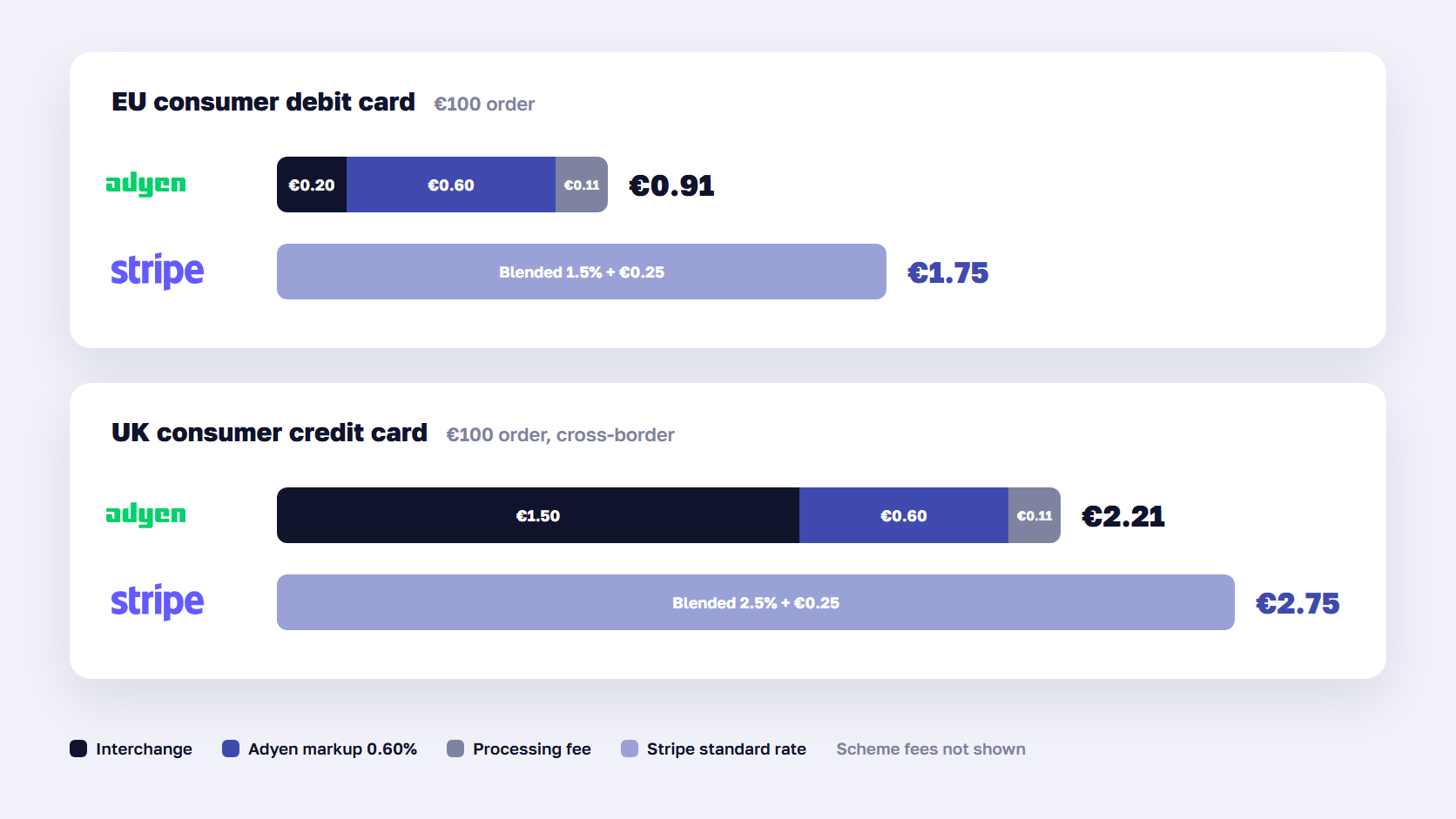
Here is one €100 order from an EU store, priced on Adyen’s and Stripe’s public rates. Adyen’s figure excludes scheme fees, which vary by network and add a little more.
| Card used on a €100 EU order | Adyen (interchange + 0.60% + ~€0.11) | Stripe standard EEA rate |
|---|---|---|
| EU consumer debit card | About €0.91 | €1.75 |
| EU premium consumer credit card | About €1.01 | €3.05 |
| UK consumer debit card | About €1.86 | €2.75 |
| UK consumer credit card | About €2.21 | €2.75 |
Interchange++ shows its advantage on regulated European cards. The gap narrows on UK cards, where cross-border interchange takes most of the fee whichever provider you use. The table also shows why a UK expansion can raise your average fee even if your PSP and contract stay the same.
Local payment methods by market
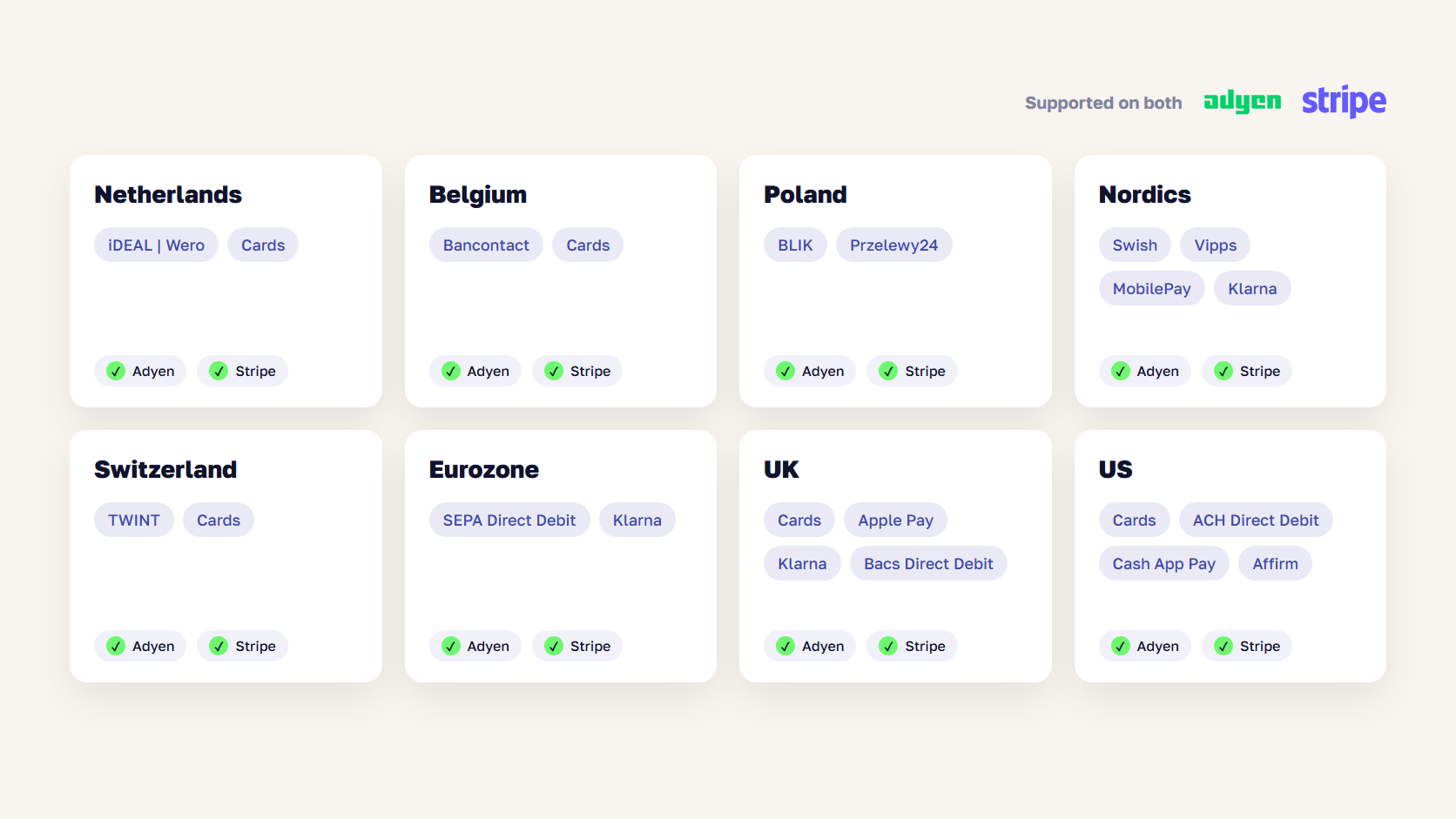
Both Adyen and Stripe support the local payment methods most European, UK, and US shoppers expect, so coverage rarely decides the choice. What differs is the fee per method and whether the method works in your platform’s checkout. Check the methods your top three markets use against each provider’s documentation and your platform plugin, because the plugin often supports fewer than the API.
| Market | Methods shoppers expect | Adyen | Stripe |
|---|---|---|---|
| Netherlands | iDEAL (becoming iDEAL Wero) | Yes | Yes |
| Belgium | Bancontact | Yes | Yes |
| Poland | BLIK, Przelewy24 | Yes | Yes |
| Nordics | Swish, Vipps, MobilePay, Klarna | Yes | Yes |
| Switzerland | TWINT | Yes | Yes |
| Eurozone | SEPA Direct Debit, Klarna | Yes | Yes |
| UK | Cards, Apple Pay, Klarna, Bacs Direct Debit | Yes | Yes |
| US | Cards, ACH Direct Debit, Cash App Pay, Affirm | Yes | Yes |
The Netherlands needs attention in the next year. iDEAL is moving to the European wallet Wero: merchants had to show the co-branded “iDEAL | Wero” name by March 31, 2026, Dutch shoppers can start paying with Wero from Q4 2026, and the banks plan to finish the move by the end of 2027. Ask your provider how and when its checkout switches over.
Which methods to offer in each country is its own question. Our guide to eCommerce payment methods in Europe, the UK, and the US has the market-by-market numbers.
🚀 Quick takeaway
A provider can support a payment method that its plugin for your platform doesn’t offer yet. Confirm each method in the plugin you’ll actually install before you count it in the comparison.
Platform integrations: Magento, Shopify, and headless
Your eCommerce platform narrows the Adyen vs Stripe choice more than any feature list. On Magento (Adobe Commerce), both providers maintain official plugins. On Shopify, Stripe arrives through Shopify Payments, while Adyen requires an approved enterprise account and its own payment app. On a headless storefront, both offer drop-in UI components and APIs, so the deciding factor is the work your team takes on.
Magento (Adobe Commerce)
Adyen builds and maintains its Adobe Commerce plugin, and the code is open source on GitHub. Version 10 supports Adobe Commerce 2.4.8 and version 11 covers 2.4.8 and later. It supports saved cards (tokenization), Pay by Link, and in-store payments through the same integration. Stripe offers a Payments, Billing, and Tax plugin for both Adobe Commerce and Magento Open Source, which suits stores that also want Stripe subscriptions and tax calculation.
Both work out of the box for a standard checkout. The integration work goes into custom checkouts and B2B payment terms, and into multi-store setups where each store view needs its own currencies and methods. See our pages on Magento and Adyen and Magento and Stripe for what a typical build includes, and our list of the best Magento payment gateways if you’re comparing more than two.
Shopify and Shopify Plus
Stripe powers Shopify Payments through its partnership with Shopify, so on Shopify you get Stripe’s processing through Shopify Payments and its rates, without a separate Stripe contract. Adyen connects through its own payment apps, which require Shopify Checkout and an existing Adyen approval. Adyen and Shopify announced the partnership for enterprise merchants in June 2023.
Shopify adds a third-party transaction fee when you process through a provider other than Shopify Payments: 2% on Basic, 1% on Grow, 0.6% on Advanced, and 0.2% on Plus. That fee makes Adyen on Shopify a Plus decision in practice. Our Shopify and Adyen integration page covers the setup, and Shopify vs Shopify Plus covers when the upgrade pays for itself.
Headless and composable storefronts
On a headless build, both providers give you prebuilt payment UI (Adyen’s Drop-in and Components, Stripe’s Payment Element) plus APIs for everything else. On commercetools, the Adyen connector is built by commercetools itself and the Stripe connector comes from a third party, which matters for who fixes it when an API changes. Both are covered in our commercetools and Adyen and commercetools and Stripe pages.
Headless checkouts also have to work with everything else at the payment step. When Rockler, a woodworking retailer, moved its Magento storefront to ScandiPWA, Adyen had to work alongside AvaTax address validation in the new PWA checkout. Making the payment and tax extensions run together was one of the main parts of the migration.
Read more: Case Study: PWA Migration of a Constantly Evolving eCommerce Store with Complex Customizations

Fraud tools and approval rates
Both providers screen every card payment with machine-learning fraud models and offer tools that raise approval rates, but neither publishes a like-for-like approval rate you can compare. Stripe Radar charges per screened transaction on standard pricing. Adyen prices its risk management separately. The figures each vendor publishes come from its own customers, so the only reliable comparison is a test on your own traffic.
Stripe says its Authorization Boost product raises acceptance rates by 3.8% on average and that Radar cuts fraud by 32% on average. Radar costs from €0.05 (£0.04 in the UK) per screened transaction, or a monthly plan. Adyen says merchants in the pilot of its Uplift product, 60 enterprise businesses, raised payment conversion by up to 6% against their previous setups.
These numbers measure different things: acceptance rate, fraud rate, and payment conversion. To compare fairly, track the issuer authorization rate (approved payments out of those sent to the bank) by card country and card type, and track fraud-model blocks separately. Our guide to Magento fraud prevention covers the store-side rules that work with either provider.
Why are approval rates different by country?
Approval rates differ by country because the bank that issued the card decides, and banks judge risk differently. A card used with a merchant in another country is more likely to be declined than the same card used at home, so providers that process through local acquirers in each market tend to see fewer declines. In the EEA and the UK, Strong Customer Authentication adds 3D Secure steps that some shoppers fail or abandon.
Ask about local acquiring before you ask about fraud models. If most of your sales are in five countries, ask each provider whether it processes those cards locally and what share of your volume would count as domestic.
🚀 Quick takeaway
A lower fee can still cost you money if approvals drop. A one-point fall in authorization rate on €10 million in card sales is €100,000 in orders that never go through.
How to switch PSP with minimal risk
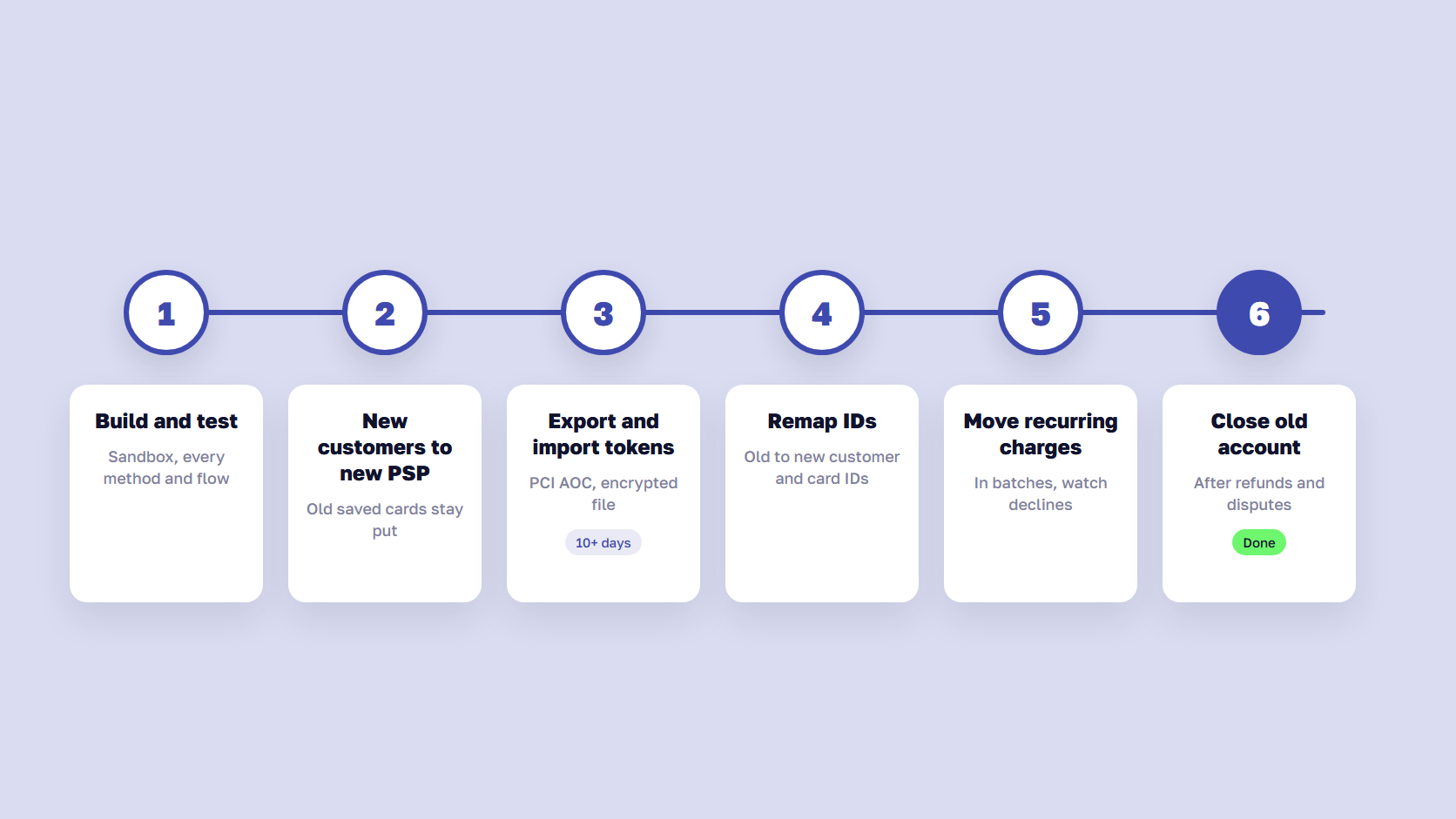
Switching payment service provider safely means running both providers side by side, moving saved cards through a PCI-compliant token migration between the two PSPs, and moving traffic in stages. Adyen and Stripe both document the process, and Adyen states it doesn’t charge for importing card data. Plan for at least several weeks, because the old provider sets the pace of the export.
- Build and test the new integration first, in sandbox, for every payment method and checkout flow you run
- Send new customers and new saved cards to the new provider while existing customers stay on the old one
- Ask your current provider for a card data export. The receiving provider usually needs a formal request, a PCI Attestation of Compliance, and an encrypted file transfer
- Import the data: Adyen says migration usually takes 10 days or more, and Stripe imports within 10 business days of receiving correct data
- Update your platform with the mapping file that links old customer and card IDs to the new ones
- Move recurring and saved-card charges in batches, marked correctly as merchant-initiated, and watch decline codes daily
- Keep the old account open until refunds, disputes, and chargebacks on old orders have closed
Customers who update a card during the transfer window are the most common gap. Stripe’s documentation recommends saving those updates on the new provider straight away, so they don’t get lost between export and import. If you sell subscriptions, read our guide to subscription integrations before you plan the cutover.
Many merchants don’t switch fully. Running Adyen in some markets and Stripe in others, or keeping one as a backup, is common, and platforms like commercetools support two PSPs in one checkout.
🚀 Quick takeaway
Never retry thousands of imported cards on day one. Issuers can read a burst of retries from a new merchant account as fraud, so move recurring charges over in batches.
Who is bigger, Adyen or Stripe?
Stripe is bigger by payment volume. Stripe reported $1.9 trillion in total volume for 2025, up 34%. Adyen processed €1,394.3 billion in 2025, up 8%, or 21% excluding one large customer. For a mid-market or enterprise retailer, either one is big enough, so the choice comes back to fees and platform fit in your markets.
How to choose between Adyen and Stripe
Choose Adyen if you’re an enterprise retailer selling in many countries, through online and physical stores, with enough volume to negotiate interchange++ pricing. Choose Stripe if you want to go live quickly on transparent standard rates, run subscriptions and billing on the same platform, or sell on Shopify, where Stripe already powers Shopify Payments.
Choose Adyen if:
- You process enough volume to negotiate interchange++ rates and a markup
- Most of your card sales come from regulated European cards
- You sell in stores and online and want one provider for both
- You run Magento (Adobe Commerce) or a headless stack across several countries
- You’re on Shopify Plus with an approved Adyen account
Choose Stripe if:
- You want to start on standard pricing without a sales negotiation
- You need subscriptions and tax calculation from the same provider
- You’re on Shopify and Shopify Payments covers your markets
- Your developers want to build a custom checkout quickly against well-documented APIs
- Your volume is still growing toward the level where custom pricing makes sense
Frequently asked questions about Adyen vs Stripe
Is Adyen cheaper than Stripe?
In a Stripe vs Adyen fee comparison, Adyen is usually cheaper on European consumer cards, because interchange++ passes through the EU’s 0.2% and 0.3% interchange caps. Stripe’s standard 1.5% + €0.25 rate costs more on those cards. On UK and other cross-border cards the gap narrows, and Stripe offers interchange-plus on custom pricing, so compare quotes on your own transaction mix.
Does Shopify support Adyen?
Yes, Shopify supports Adyen through Adyen’s payment apps, but only for organizations with an existing Adyen approval, and the store must use Shopify Checkout. Shopify charges a third-party transaction fee on top, 0.2% on Shopify Plus and up to 2% on Basic, so Adyen on Shopify usually makes sense for Plus merchants with enterprise volume.
Can you use Adyen and Stripe at the same time?
Yes, you can run Adyen and Stripe at the same time. Merchants often route each market to the provider with better local acquiring, or keep a second provider as a backup during outages. Your platform has to support two PSPs in checkout, and saved cards stay with the provider that tokenized them unless you migrate them.
How long does it take to switch payment providers?
Switching payment providers usually takes several weeks to a few months end to end. The card data transfer alone takes 10 days or more on Adyen and up to 10 business days on Stripe once the data arrives. Building and testing the new integration and moving recurring charges in batches account for the rest.
Does Adyen have a minimum monthly fee?
Adyen doesn’t charge monthly, setup, integration, or closure fees, but it sets a minimum invoice that depends on your industry and business model. Its sales team quotes the amount. Stripe’s standard pricing has no minimum and no monthly fee, which makes it easier for smaller or newer stores to start.
What is the best payment gateway for eCommerce?
The best payment gateway for eCommerce is the one that gives your markets the lowest cost per approved order. For enterprise retailers selling across Europe, that is often Adyen on interchange++ pricing. For subscription businesses and most Shopify merchants, Stripe is usually the simpler choice. Compare both on your own transaction data.
Choose the provider that fits your markets
The Adyen vs Stripe decision depends mostly on where your shoppers’ cards come from and which platform runs your checkout. Price a real month of transactions on both, split by card country, and check every local method your top markets need in the plugin you’d install. Plan the token migration before you sign anything. If the two quotes come out close, pick the provider your platform supports best, because that’s where the ongoing maintenance work will be.
Comparing PSP quotes for a multi-country store? Talk to our integration team, and we'll show you what each one would cost and take to integrate on your platform.