Teams on Magento Open Source, the free edition of Magento, and on Adobe Commerce running on their own servers read every Adobe AI announcement with the same question: will this work on our store? Adobe Commerce AI features have arrived quickly since Adobe Summit, Adobe’s yearly conference, in April 2026, and the announcements say much more about what each feature does than about which edition or license it needs.
Each feature below was checked on Adobe’s own pages on November 2, 2026, in Experience League (Adobe’s documentation site) and on Adobe’s blog. Where Adobe names an edition or a price, we quote it. Where Adobe doesn’t say, we say that too, instead of guessing.
Adobe Commerce AI features at a glance
Adobe Commerce AI features fall into four groups: AI search and recommendations that come with the license, features in beta, AI that runs on other Adobe products, and agents and tools for developers. Adobe’s setup guide says Live Search and Product Recommendations require Adobe Commerce and aren’t available for Magento Open Source.
Adobe now sells Adobe Commerce on-premises, on Adobe Commerce on Cloud (Adobe-managed PaaS hosting), as Adobe Commerce as a Cloud Service (a SaaS platform), and as Adobe Commerce Optimizer, a SaaS layer that runs in front of an existing backend. We compared the four Adobe Commerce editions in a separate post, so this one stays on the AI features.
| Adobe AI feature | What it does | Status (Nov 2, 2026) | Who can use it (Adobe’s wording) | Cost (Adobe’s wording) |
|---|---|---|---|---|
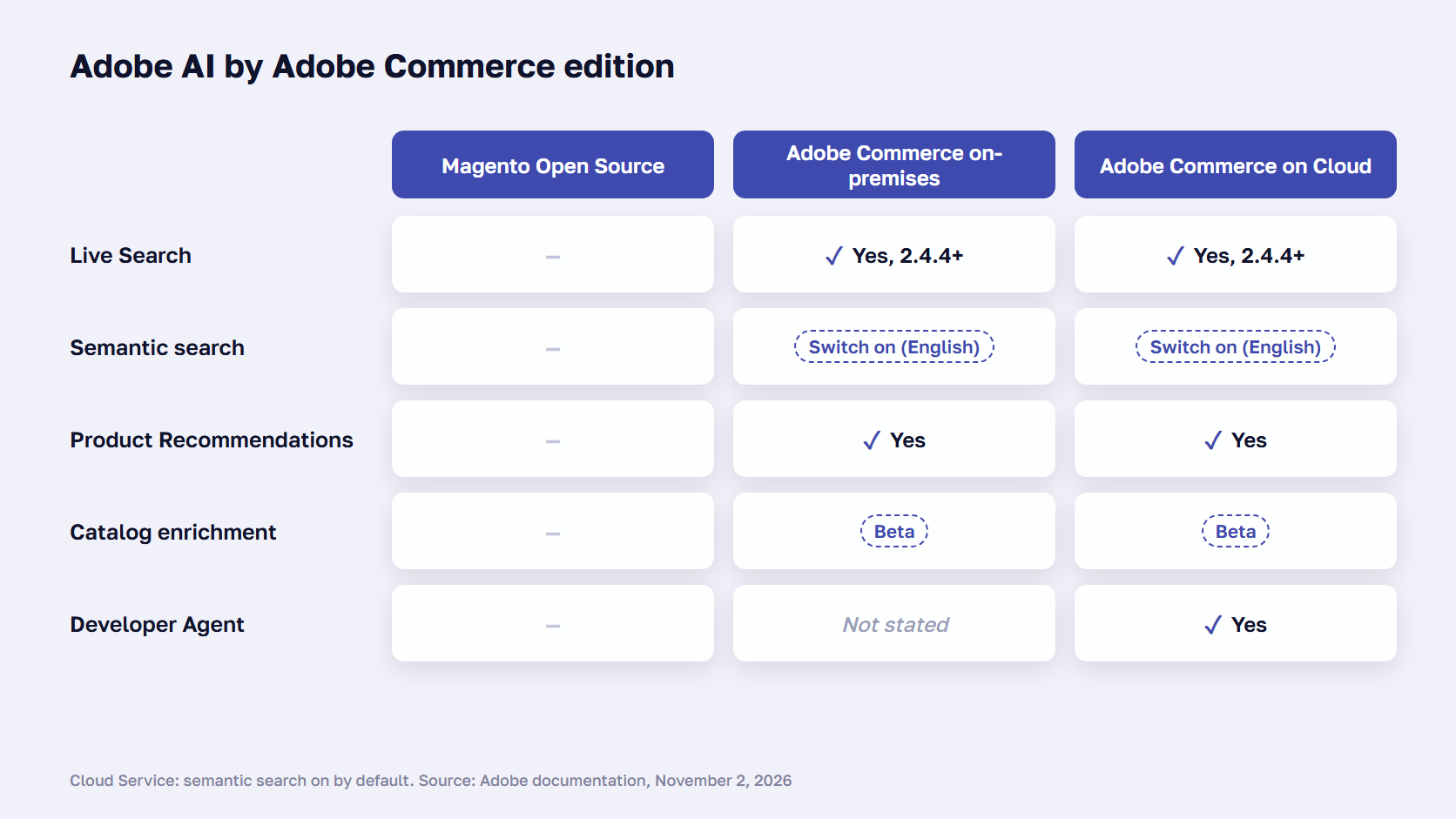
| Live Search | AI faceting and re-ranking of search results | Available | Adobe Commerce 2.4.4+ on Cloud and on-premises, and Cloud Service. Not Open Source | “Included in your license” |
| Semantic search (in Live Search) | Matches what a search means. English catalogs only | Generally available since June 8, 2026 | On by default on Cloud Service and Optimizer. Switched on manually on Cloud and on-premises | “No additional cost as part of Live Search” |
| Product Recommendations | Recommendations from Adobe AI and machine learning | Available | Adobe Commerce. Not Open Source | Adobe doesn’t say |
| Catalog enrichment (Catalog Agent) | Improves product names and descriptions for AI assistants | Beta, through your Adobe account manager | Adobe Commerce on Cloud and on-premises only | Adobe doesn’t say. Needs Adobe’s GenAI rider |
| Merchant Productivity AI Assistant | Chat in the Admin for promotions, catalog edits and store data | Public beta | Adobe Commerce customers and partners. Hosting not stated | Adobe doesn’t say |
| Brand Concierge integration | Shopping chat on the storefront with live prices and stock | Introduced April 2026. In-chat checkout “soon” | Adobe doesn’t say | Separate Adobe product. No public price |
| Adobe Brand Visibility (formerly LLM Optimizer) | Tracks how AI answers present your brand | Available | Separate Adobe product | No public price |
| Commerce Developer Agent | Plans and generates App Builder app code | Generally available since September 25, 2026 | “Adobe Commerce customers only”, with App Builder access | Capacity free “currently”. Pricing “at a later date” |
| Developer MCP servers and skills | Adobe Commerce docs inside your AI coding tool | Available | Written for Cloud Service developers | Adobe doesn’t say |
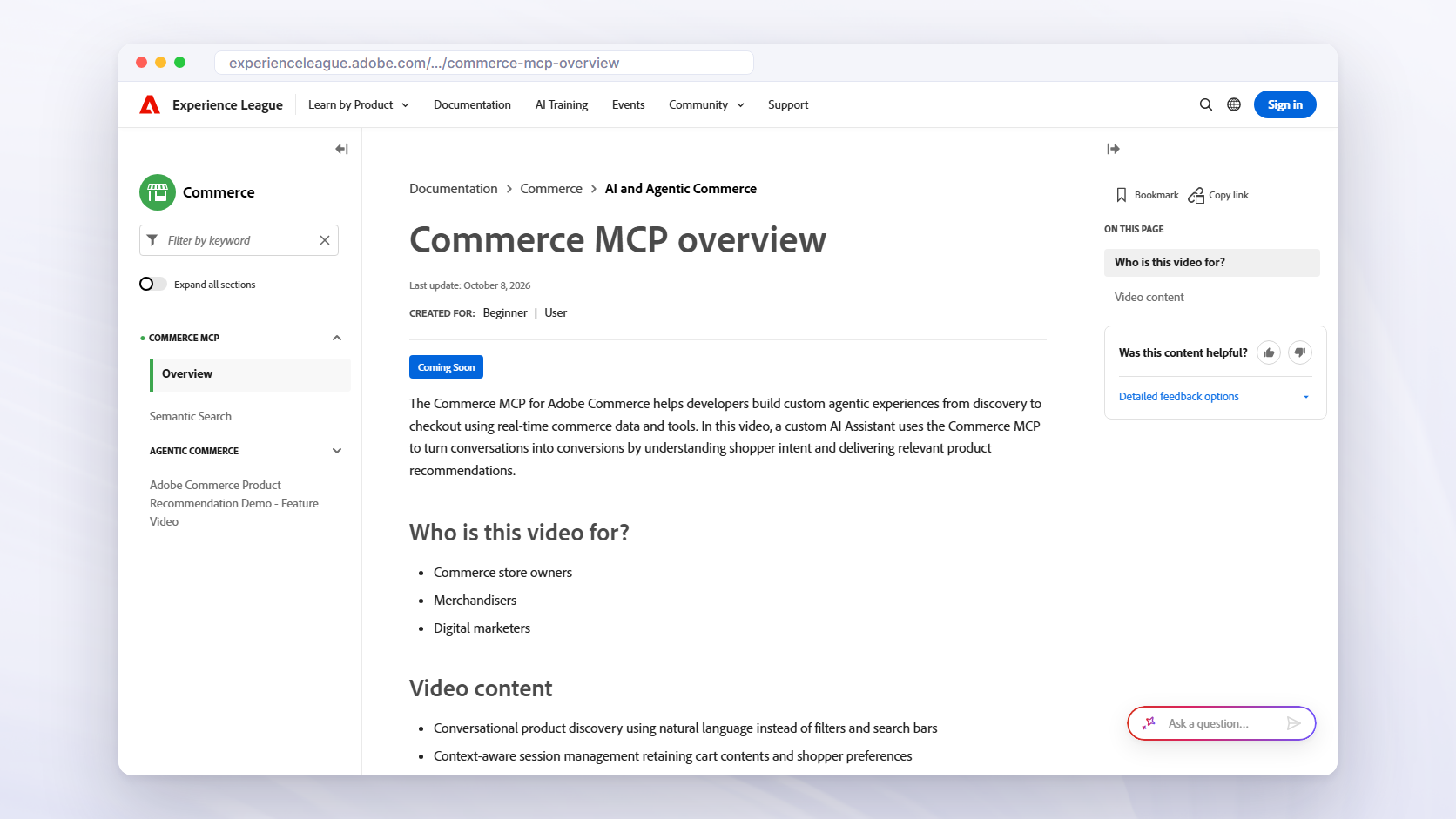
| Commerce MCP server | Live store data for building your own shopping agents | “Coming Soon” | Adobe doesn’t say | Adobe doesn’t say |
Statuses, editions and costs are quoted from Adobe’s documentation and blog as of November 2, 2026. “Adobe doesn’t say” means no Adobe page we read states it.
🚀 Quick takeaway
Adobe’s product pages and its documentation don’t always agree on status. Adobe’s AI commerce page presents a Storefront MCP server for building shopping agents with no status label, while Experience League labels the Commerce MCP Coming Soon. Go by the documentation.
AI search and recommendations included with Adobe Commerce
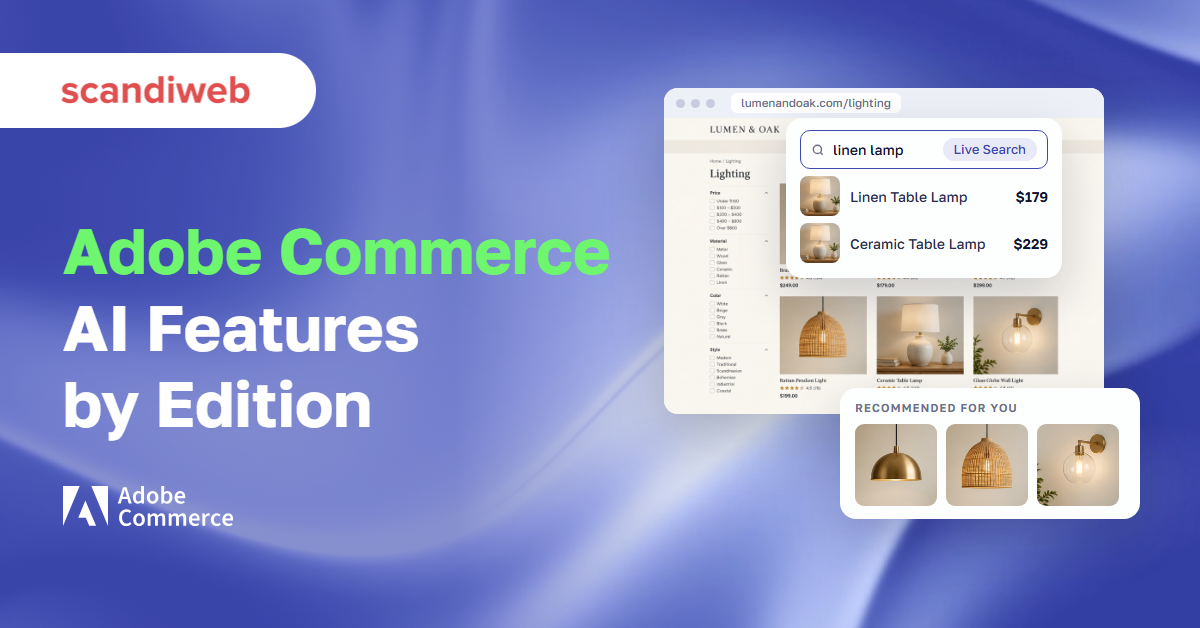
Two Adobe AI features come with an Adobe Commerce license: Live Search, which Adobe describes as AI-powered faceting and re-ranking of search results and says is included in your license, and Product Recommendations, built on Adobe AI and machine learning. Both run as Adobe services connected to Adobe Commerce 2.4.4 or later.
Live Search and semantic search
Live Search replaces the standard catalog search in Adobe Commerce and runs as a SaaS service. Adobe’s install guide lists Adobe Commerce on Cloud and Adobe Commerce on-premises from version 2.4.4, and Adobe Commerce as a Cloud Service uses the same Live Search.
Semantic search, a newer part of Live Search, matches the meaning of a search, so “warm jacket for hiking” finds insulated outdoor coats even when the product copy uses none of those words. Adobe made it generally available on June 8, 2026. Adobe’s semantic search documentation says it works on English catalogs only, is on by default on Cloud Service, and has to be enabled manually on Adobe Commerce on Cloud and on-premises.
Many teams search for “Magento Live Search,” and Adobe’s setup guide says Live Search requires Adobe Commerce, so a Magento Open Source store can’t use it. On a Hyvä storefront, Hyvä’s own Live Search module comes with a Hyvä Enterprise license.
Product Recommendations
Adobe Commerce Product Recommendations are storefront widgets such as “frequently bought together,” powered by Adobe AI and machine learning trained on shopper behavior and catalog data. Adobe’s current pages say Adobe AI where older ones said Adobe Sensei. They are part of Adobe’s Commerce SaaS services, and Adobe’s tutorial page labels them an exclusive feature only in Adobe Commerce. Adobe’s pages say you need the correct entitlements but don’t give a price.
🚀 Quick takeaway
Semantic search is on by default on Adobe Commerce as a Cloud Service. On Adobe Commerce on Cloud and on-premises, someone has to switch it on, and it works on English catalogs only.
AI features in beta or on other Adobe products
Several Adobe Commerce AI features are still in beta or run on a separate Adobe product. Catalog enrichment rewrites product names and descriptions for AI assistants and is in beta. The Merchant Productivity AI Assistant adds chat to the Admin as a public beta. Brand Concierge and Adobe Brand Visibility are Adobe products in their own right.
Catalog enrichment with the Catalog Agent
Adobe’s generative AI features for Commerce start with catalog copy. The Catalog Agent finds gaps in product names and long descriptions and proposes improvements, so that AI assistants such as ChatGPT describe the product accurately. Approved changes go back into the catalog and can be rolled back at any time.
Adobe’s catalog enrichment documentation applies to Adobe Commerce on Cloud and on-premises projects only. The feature is in beta, so you ask your Adobe account manager for access. Setup needs an Admin user who signs in through Adobe IMS with access to the Adobe Admin Console, and it checks that your company has signed the GenAI rider, Adobe’s contract terms for its AI services. Adobe doesn’t say what it costs.
Merchant Productivity AI Assistant in the Admin
The Merchant Productivity AI Assistant is a chat panel inside the Adobe Commerce Admin. In Adobe’s description it can manage promotions and update product catalog information, and it can pull operational data such as the last ten orders or current inventory status. It is a public beta, open to Adobe Commerce customers and partners, and Adobe’s beta releases page explains how to join. That page names no supported hosting setups, and it gives no release date or price.
Brand Concierge for shopping chat
Adobe Brand Concierge is an AI chat for brand websites, and at Adobe Summit in April 2026 Adobe introduced an Adobe Commerce integration for it. Shoppers in the chat see live catalog data with current prices and stock, and Adobe marks checkout inside the conversation as coming soon. Brand Concierge is a separate Adobe product built on Adobe Experience Platform, and its setup guide asks for an Experience Platform sandbox and a datastream. Adobe doesn’t say which Adobe Commerce editions the integration supports or what it costs.
Adobe Brand Visibility, formerly LLM Optimizer
Adobe Brand Visibility, sold as Adobe LLM Optimizer before the rename, tracks how AI answers present your brand and helps your team put fixes in place. It also powers catalog enrichment in Adobe Commerce behind the scenes. It is a separate Adobe product with no price on Adobe’s product page. For what this kind of monitoring measures, see our guide to tracking brand mentions in AI answers.
🚀 Quick takeaway
Catalog enrichment checks that your company has signed Adobe’s GenAI rider, the contract terms for its AI services, before anyone can use it. Ask your Adobe account team early.
Adobe Commerce AI agents for developers
Adobe’s AI agent for developers is the Commerce Developer Agent, generally available since September 25, 2026. It turns a written requirement into a plan developers approve, then generates App Builder app code. Adobe says it is available to Adobe Commerce customers only and needs App Builder access. Developer MCP servers bring Adobe Commerce documentation into developers’ own AI coding tools.
Commerce Developer Agent
The Commerce Developer Agent writes App Builder apps from a plain description. App Builder is Adobe’s platform for apps that extend Adobe Commerce from outside the core code. A developer describes the requirement, the agent writes a blueprint, the developer edits and approves it, and the agent then scaffolds the project, generates the code, and validates the build. Adobe’s example is a cart-limit rule built as a webhook, with the limits exposed as settings in the Commerce Admin.
Adobe’s getting started page lists an Adobe Commerce entitlement, App Builder access, and an Adobe IMS identity as prerequisites, and says the agent is available to Adobe Commerce customers only. The allocated capacity is provided at no additional charge currently, with pricing to follow at a later date. Adobe’s pages name Adobe Commerce as a Cloud Service projects and existing implementations of Adobe Commerce on Cloud, and don’t mention on-premises. Generated code still needs a developer’s review before production use.
Developer MCP servers and agent skills
MCP, the Model Context Protocol, is a standard way for AI tools to connect to other systems. Adobe’s developer MCP servers bring Adobe Commerce documentation, sample code, tutorials, and project rules into coding tools such as Cursor or Claude Code. The set is a Commerce Developer MCP Server, an App Builder MCP Server, and a pack of agent skills, installed and updated with one command, aio commerce extensibility tools-setup. Adobe writes them for developers on Adobe Commerce as a Cloud Service and related Adobe SaaS products, and its pages don’t state a price.
🚀 Quick takeaway
Adobe says the Developer Agent’s allocated capacity is provided at no additional charge for now, and that pricing information will be available at a later date.
Adobe Commerce agentic AI still on the roadmap
The main Adobe Commerce AI feature still on the roadmap is the Commerce MCP server, which would let developers build shopping agents on live catalog and checkout data. Adobe’s documentation labels it Coming Soon. Checkout inside Brand Concierge chats is also marked as coming soon, and Adobe has committed to the UCP and ACP agentic commerce standards.
At Adobe Summit in April 2026, Adobe introduced a Commerce MCP server that gives developers real-time access to catalog, cart, pricing, inventory, promotions, checkout, and order data, so they can build shopping assistants and upsell agents. The Commerce MCP overview in Experience League carries a Coming Soon badge as of its October 8, 2026 update, and Adobe doesn’t say which editions the Adobe Commerce MCP server will support, or at what price. Adobe’s AI commerce page describes an Adobe Commerce Storefront MCP server for the same jobs (catalog search, prices, cart, and checkout) with no status label, and Adobe doesn’t say whether the two names describe one product.
Adobe has also committed to supporting the Universal Commerce Protocol (UCP) from Google and the Agentic Commerce Protocol (ACP) from OpenAI, standards that let AI assistants such as ChatGPT or Gemini find and buy products for a shopper. Adobe’s architecture guidance, updated October 21, 2026, describes a commitment with no released feature and no edition named. Our explainer on agentic commerce covers what these protocols change for a store.
Which Adobe AI features work on Magento Open Source and on-premise Adobe Commerce
Magento Open Source can’t use Adobe’s commerce AI services: Adobe says Live Search, Product Recommendations and Catalog Service require Adobe Commerce, and the Developer Agent is for Adobe Commerce customers only. Adobe Commerce on-premises can use Live Search and Product Recommendations on version 2.4.4 or later, and catalog enrichment applies to on-premises and Cloud projects.
Magento Open Source
Adobe’s guide to setting up Commerce services says Catalog Service, Live Search, and Product Recommendations require Adobe Commerce and are not available for Magento Open Source. The Developer Agent is for Adobe Commerce customers only, and catalog enrichment applies to Adobe Commerce on Cloud and on-premises projects. For Brand Concierge, the Commerce MCP server, and the UCP and ACP work, Adobe doesn’t say which editions they will support. For everything else that differs between the editions, see Adobe Commerce vs Magento Open Source, and if a move down is on the table, our post covers what a store loses when it moves to Magento Open Source.
Adobe Commerce on-premises
Live Search and Product Recommendations support on-premises stores from version 2.4.4, and semantic search is available once someone switches it on, for English catalogs only. Catalog enrichment applies to on-premises projects as a beta.
The Developer Agent is the open question. Adobe’s pages name Adobe Commerce on Cloud and Cloud Service projects and don’t mention on-premises, and Adobe’s on-premise product description, effective July 31, 2023, lists App Builder as an add-on licensed per pack per year. If your store runs a version older than 2.4.4, the first step is an upgrade, and our guide on how to upgrade Magento covers that path.
How to check which Adobe AI features your store can use
- Find your edition. Search
composer.lockformagento/product-enterprise-edition, the Adobe Commerce package.magento/product-community-editionmeans Magento Open Source. - Check your version. Run
bin/magento --version, as Adobe’s check version guide describes. Adobe Commerce Services support 2.4.4 and later. - Know where you’re hosted. Semantic search is on by default only on Adobe Commerce as a Cloud Service, and catalog enrichment applies to Cloud and on-premises.
- Check your catalog language. Semantic search works on English catalogs only.
- Ask Adobe about betas and terms. Catalog enrichment is a beta through your account manager and needs the GenAI rider. The Admin AI Assistant is a public beta, and the Developer Agent needs an Adobe Commerce entitlement and App Builder access.
🚀 Quick takeaway
To see which edition you run, search composer.lock for magento/product-enterprise-edition, the Adobe Commerce package. Run bin/magento –version for the exact version number.
AI options for Magento Open Source stores
Magento Open Source stores get AI from third parties. AI search services replace the default catalog search, extensions add AI content writing and shopper chat, MCP connectors let your own AI assistant work with store data, and AI agents take on store changes. Most support both editions, so the choice depends on the job you need done.
Third-party search services replace the default catalog search on either edition: Algolia’s Magento 2 extension, in its own description, does so on Magento Open Source and Adobe Commerce.
Extensions for product copy generation or shopper chat install like any other Magento extension, and they usually bill the AI use to your own API key.
MCP connectors work with an assistant you already use. scandiweb’s open-source Magento MCP server lets an assistant such as Claude or ChatGPT edit catalog and CMS content within Magento’s admin roles, on Magento 2.4.4 and later. You give the instructions, and the assistant carries each one out.
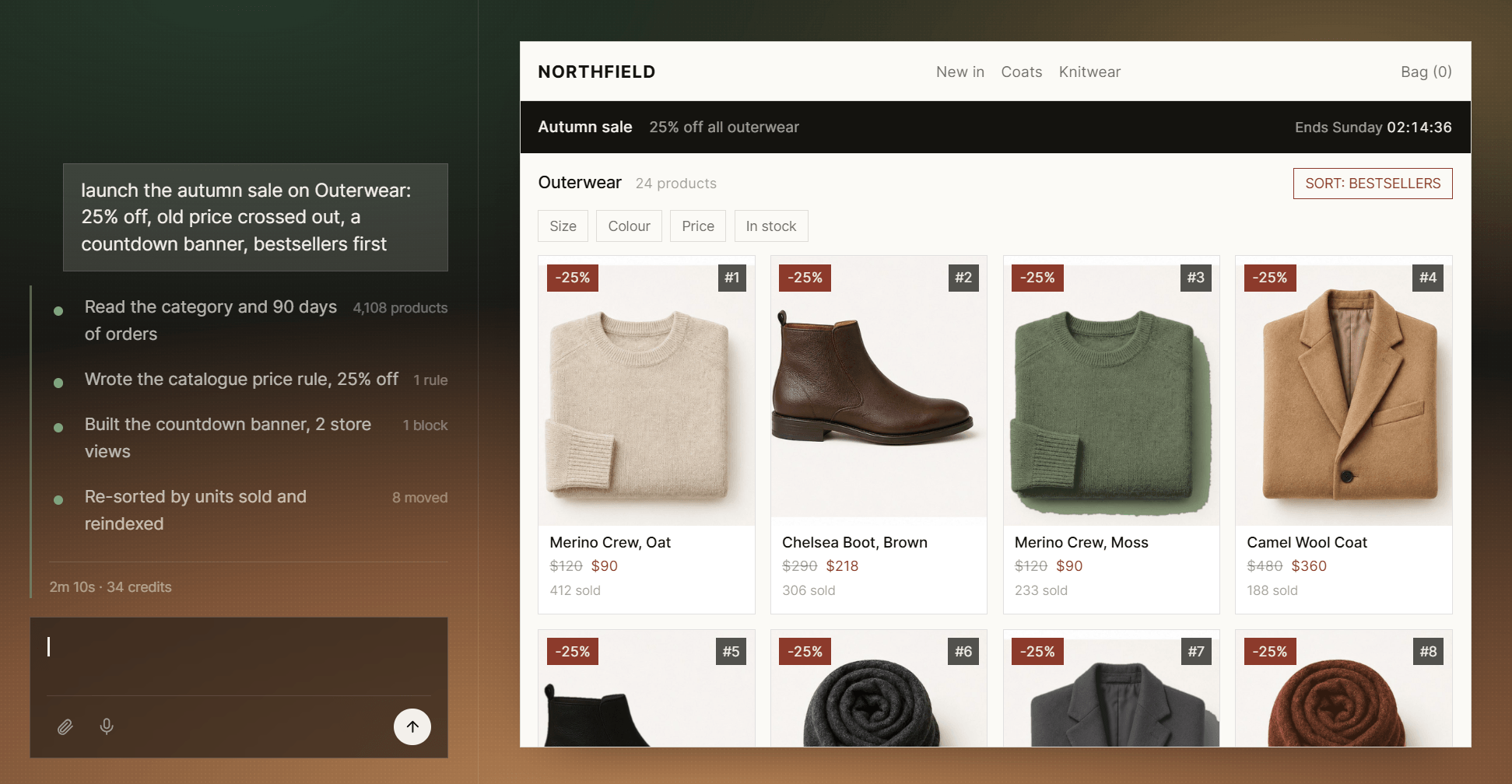
Ari, the AI agent for Magento, is one agent of this kind, and it works on Magento Open Source and Adobe Commerce. A store team asks for a change in chat, Ari builds it on a copy of the store with customer data removed, and the team checks it on a preview store before a person approves and releases it as a pull request. Plans start at €99 a month per store.
Frequently asked questions about Adobe Commerce AI features
Does Magento Open Source have AI features?
No Adobe AI service runs on Magento Open Source. Adobe’s setup guide says Catalog Service, Live Search and Product Recommendations require Adobe Commerce, and the Commerce Developer Agent is available to Adobe Commerce customers only. Open Source stores add AI through extensions, third-party search services, MCP connectors and AI agents that work on both editions.
Is Live Search included in the Adobe Commerce license?
Yes. Adobe describes Live Search as a SaaS service that is included in your license, for Adobe Commerce 2.4.4 and later on Cloud and on-premises, and Adobe Commerce as a Cloud Service uses the same Live Search. Adobe says semantic search, which matches the meaning of a query, comes at no additional cost as part of Live Search.
Can on-premise Adobe Commerce use Adobe’s AI features?
Partly. Live Search and Product Recommendations support Adobe Commerce on-premises from version 2.4.4, and catalog enrichment applies to on-premises and Cloud projects. Semantic search has to be switched on manually. For the Developer Agent, Adobe doesn’t name on-premises, and Adobe’s on-premise product description lists App Builder, which the agent needs, as an add-on.
What is the Adobe Commerce Developer Agent?
The Commerce Developer Agent is Adobe’s AI agent for developers, generally available since September 25, 2026. A developer describes a requirement, approves the plan the agent writes, and the agent generates and validates App Builder app code. Adobe says generated code must be reviewed before production use, and the agent is for Adobe Commerce customers only.
Is there an MCP server for Adobe Commerce?
Adobe has two kinds. Developer MCP servers, available now, bring Adobe Commerce documentation and App Builder tasks into AI coding tools such as Cursor or Claude Code. The Commerce MCP server for building shopping agents on live store data is marked Coming Soon in Adobe’s documentation. Open-source MCP modules also exist for Magento 2 stores.
Does Adobe Commerce have an AI assistant like Shopify Sidekick?
Adobe’s closest match is the Merchant Productivity AI Assistant, a chat panel in the Adobe Commerce Admin that can manage promotions, update catalog information and pull store data such as recent orders. It is a public beta, and Adobe’s beta page gives no release date or price. For Shopify’s built-in assistant, see our guide to Shopify Sidekick.
How to plan around Adobe’s AI for your edition
Adobe Commerce AI features depend on your edition first and the feature second. Check which edition and version you run, match it against what Adobe’s documentation says, and treat anything marked beta or Coming Soon as a plan until Adobe makes it generally available. Then fill the gaps with third-party tools that run on your edition.
Several statuses in the table can change any week, so re-read Adobe’s pages before you tie a budget, a renewal, or an edition decision to one of them. If an edition change is on the table partly because of Adobe’s AI, scandiweb’s AI strategy consulting for eCommerce can map which of these features your store would use first and what the alternatives on your current edition cost.
If you want a second pair of eyes on this for your own store, send us your edition and version and we will check it against Adobe's documentation.