
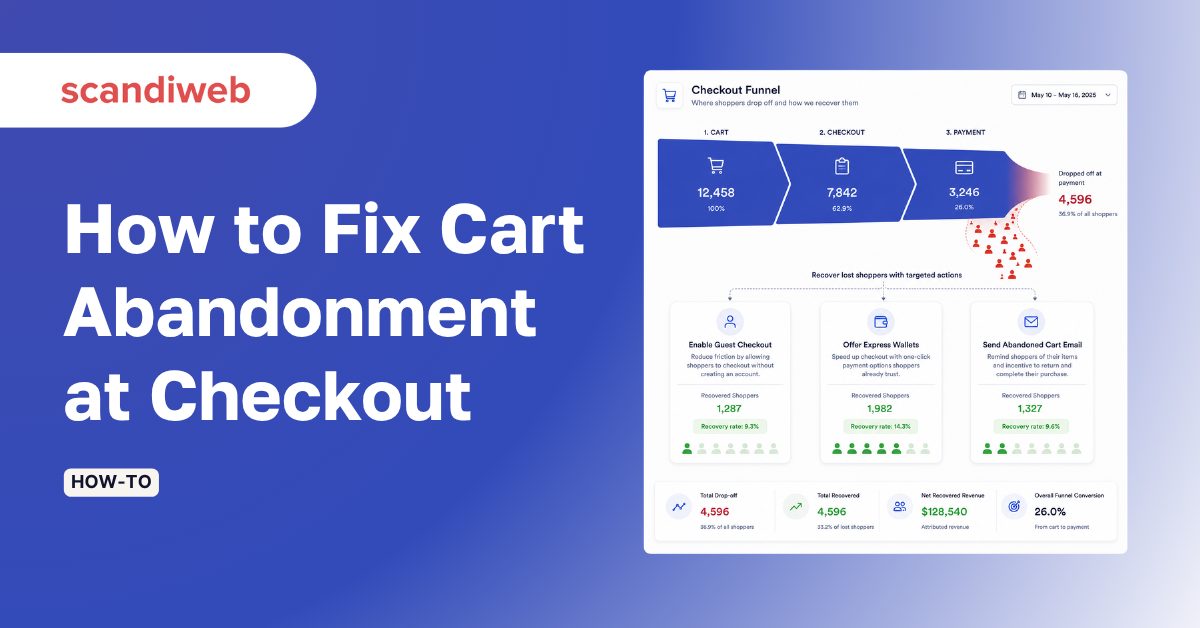
Across roughly 48 studies, the average shopping cart abandonment rate now sits at 70.19% (Baymard Institute, 2025), which means only about a third of loaded carts turn into orders. For most stores, that gap is the single largest pool of recoverable revenue they already paid to acquire. The shoppers added items, signaled intent, then walked. The shopping cart abandonment solutions below are the fixes that pull the most of them back.
This is not a guessing exercise. Most abandonment traces to a short list of predictable friction points at the cart and checkout, and each one has a known fix. Below you will find nine of them, ordered roughly by impact, with the current data behind each and the results we have seen applying them for real stores.
Overview
- The average shopping cart abandonment rate is 70.19% (Baymard Institute, 2025), so roughly two of every three loaded carts never convert.
- The biggest single driver is unexpected cost: 48% of shoppers abandon when shipping, taxes, or fees first appear at checkout (Baymard / SellersCommerce, 2026).
- The highest-impact fixes are guest checkout, transparent pricing, express and one-click payment, trust signals, and a timed abandoned cart email sequence that recovers roughly 5% to 11% of otherwise-lost sales.
🚀 Quick takeaway
Abandonment is rarely about price alone. It is about surprises, friction, and doubt at the exact moment a shopper is ready to pay.
What is shopping cart abandonment?
Shopping cart abandonment occurs when a shopper adds one or more items to their online cart and then leaves before completing the purchase. It is measured as the cart abandonment rate: the share of created carts that do not end in a paid order. The current benchmark across 48 studies is 70.19% (Baymard Institute, 2025), and it has held near 70% for years, so a store that beats it is genuinely ahead of the field.
A related metric worth tracking is checkout abandonment, which counts only shoppers who reached the checkout flow and then dropped off. Cart abandonment is the wider funnel; checkout abandonment is the narrow end. Both matter, and the fixes overlap, but the checkout-stage drop-offs are usually the most expensive to lose because those shoppers were closest to paying.
Why do shoppers abandon their carts?
Shoppers abandon for a mix of practical and trust-based reasons, and the data is consistent year over year. The single biggest reason is unexpected cost: 48% of shoppers abandon when shipping, taxes, or fees appear at checkout (Baymard / SellersCommerce, 2026). After that come forced account creation, a long or confusing checkout, missing payment options, and concerns about payment security.
Knowing the cause is what makes the fix cheap. You do not need to guess which lever to pull when the reasons are this well-documented.
- Unexpected extra costs at checkout (the top reason, cited by 48% of shoppers)
- Being forced to create an account before buying
- A checkout that is too long, asks for too much, or feels unsafe
- Missing the payment method the shopper expected
- The shopper was comparing prices or simply not ready to buy yet
🚀 Quick takeaway
Half of your lost carts are about cost surprises and forced friction, not the product. Those are the cheapest to fix.
How to reduce cart abandonment
Reducing cart abandonment comes down to removing surprises, cutting steps, and proving the store is safe to buy from. The nine solutions below cover the cart experience, the checkout flow, payment, speed, trust, and recovery after the fact. Work through them in order, and you address the highest-impact friction first.
1. Make the cart and mini-cart easy to access
Before a shopper ever sees a checkout form, the cart or mini-cart is the closest thing, so both need to be easy to reach and show every detail about the items inside. Every action a shopper expects should work without hunting: changing the quantity, editing a variant, or removing a product. Getting the cart and mini-cart right is part of broader add-to-cart best practices that nudge shoppers toward checkout.
A few checks worth running on your own store:
- Is the shopper notified when a new item is added to the cart?
- Is the cart reachable from any page on the site?
- Can the shopper see the item count from anywhere?
- Can they change size, quantity, and color directly in the cart?
These sound obvious, yet plenty of stores still miss one. For one store we worked with, no confirmation showed when an item was added, so shoppers clicked “Add to cart” repeatedly, got frustrated, and left. For another, the cart was only reachable from the product page. Both fixes were small, and both lifted completed checkouts.
2. Guide shoppers to checkout with a clear visual hierarchy
Once items are in the cart, the next click toward checkout should be obvious and require no thought. When the main call to action competes with secondary buttons for attention, shoppers hesitate, and hesitation at the cart stage costs orders. One store we worked with had styled “Continue shopping”, “Checkout”, and “Remove” in the same color, so shoppers paused to decide instead of moving forward. Making the checkout button the clear visual priority removed the stall.
The same logic applies on mobile, where space is tight. Do not bury the checkout button at the very bottom of a long cart. Add a second checkout action in a sticky header so it is always one tap away, and make sure it reads as a button, not as breadcrumbs. Most of this work sits inside thoughtful checkout and eCommerce web design, where layout decisions are tested against real shopper behavior.
🚀 Quick takeaway
If a shopper has to think about what to click next, you have already added friction. The path to pay should be the loudest thing on the screen.
3. Do not force account creation
In research by the Baymard Institute, around 35% of shoppers cite being forced to create an account as a reason they abandon checkout. It feels like an easy way to capture an email, but for the shopper, it is one more password to forget. Offer guest checkout as the default and let people opt into an account afterward.
If an account genuinely adds value, say so at the point of choice: it saves their address, stores past orders, or adds a perk. And always present the option to create the account after the purchase, not before it. For one store, the checkout opened with a pop-up forcing shoppers to log in or pick guest checkout before they could continue. As soon as we removed the pop-up and made guest checkout the default, the conversion rate went up.
4. Show the full cost early and remove the price shock
Nothing kills a checkout faster than a cost that appears at the last step. With 48% of shoppers abandoning over unexpected fees, the fix is to surface shipping, tax, and any surcharge as early as you can. Let shoppers run a shipping estimate on the cart page, and flag tax or handling on the product detail page so the final total is never a surprise.
There is a real difference between seeing one large number once at the end and seeing a smaller number build up across the journey. The first feels like a trap. The second feels like a fair, transparent total the shopper agreed to step by step.
🚀 Quick takeaway
The total a shopper sees at checkout should match the total they expected. Surprise costs read as a bait-and-switch, even when they are legitimate.
5. Offer guest, express, and one-click checkout
The fastest way to lose a ready buyer is to make them type. Guest checkout removes the account wall, but express and one-click options go further by skipping manual entry altogether. Wallets like Apple Pay, Google Pay, and Shop Pay let a returning shopper confirm with a fingerprint or a single tap, which matters most on mobile, where abandonment runs higher at around 80.2% versus roughly 70% on desktop (SellersCommerce, 2026).
Treat express checkout as a primary path, not a buried alternative. Place the wallet buttons high in the cart and at the top of checkout so shoppers who want speed never have to scroll to find them.
6. Give shoppers the payment methods they expect
A missing payment option is a silent abandonment cause: the shopper reaches checkout, does not see how they want to pay, and leaves without a word. Offer the methods shoppers expect, including cards, digital wallets, and buy now, pay later, guided by popular eCommerce payment methods for your market and audience.
Buy now, pay later deserves specific attention. For higher-ticket carts, splitting a payment into installments can be the deciding factor between a completed order and an abandoned one, and it tends to lift average order value at the same time. Match the providers to where your shoppers are, since the expected wallet in Germany is not the expected wallet in the United States.
7. Speed up your store, especially on mobile
A slow store loses shoppers before they ever reach a payment screen. Every extra second of load time at the cart and checkout stage gives a distracted shopper another reason to give up, and the cost is steepest on mobile, where connections vary and patience is thinner. Since mobile abandonment already runs around 80.2% (SellersCommerce, 2026), checkout speed is not a nice-to-have on phones; it is the difference between an order and a bounce.
Trim the obvious drags: compress images, defer non-essential scripts, and keep the checkout flow on as few steps and round-trips as possible. A checkout that loads instantly and responds the moment a shopper taps feels trustworthy, and trust is what closes the sale.
🚀 Quick takeaway
On mobile, slowness reads as risk. A fast, responsive checkout is itself a trust signal, not just a performance metric.
8. Add trust and security signals at checkout
Shoppers will not hand over card details to a checkout that feels unsafe. Visible trust signals close that gap: a secure-payment badge, recognizable card and wallet logos, a clear return policy near the buy button, and an HTTPS lock that the shopper can see. None of these is decorative. Each one answers a quiet question the shopper is asking before they pay.
Support availability is part of trust, too. In a physical store, a shopper can ask a question and get an answer on the spot, and online buyers expect the same. Show contact options at checkout, and offer more than one channel, since some shoppers will reach for live chat while others want a phone number or a message. Removing doubt at the moment of payment is exactly the kind of friction our CRO and UX team is built to find and fix.
9. Recover lost carts with a timed email sequence
Not every cart converts on the first visit, and that is fine, because many can still be recovered. A well-timed abandoned cart email sequence typically recovers between roughly 5% and 11% of otherwise-lost sales. The key is timing and relevance, not volume. Send an abandoned cart email to give shoppers a second chance at what they left behind.
A simple sequence that works:
- A first reminder within a few hours, showing the exact items left in the cart.
- A follow-up a day later that adds light urgency, such as low stock or strong demand for the item.
- A final nudge that may include an incentive like free shipping, used carefully so shoppers do not learn to abandon on purpose to earn a discount.
Pair the email sequence with retargeting. Returning visitors convert at a higher rate than first-timers, so showing abandoned items again through Meta or Google ads keeps the product in front of shoppers who already want it.
What scandiweb’s CRO work recovers from checkout
These fixes are the day-to-day of our conversion work. When we rebuilt checkout for BUFF, clearer trust and flow cues drove a 33% revenue increase in the first month, with mobile conversion and checkout completion both up. See the full checkout optimization for BUFF case study for the before-and-after.
For Northerner, fixing checkout friction recovered up to 500k in projected annual revenue, with a 12% checkout conversion lift in the first eight weeks. The pattern repeats across the stores we work with: the abandonment rate is rarely fixed by one heroic change, it is fixed by removing four or five small frictions that each cost a few percent.
🚀 Quick takeaway
The biggest abandonment wins usually come from stacking small checkout fixes, not from a single redesign.
What is a good cart abandonment rate?
A good cart abandonment rate is anything meaningfully below the 70.19% industry average (Baymard Institute, 2025). Most stores sit between 65% and 80%, and mobile typically runs higher than desktop. Rather than chasing a universal number, track your own rate over time and aim to push it down each quarter as you remove friction. A few points of improvement on a high-traffic store can mean a large amount of recovered revenue.
Frequently asked questions
What is the average cart abandonment rate?
The average shopping cart abandonment rate is 70.19% across roughly 48 studies (Baymard Institute, 2025). It has hovered near 70% for years, and mobile rates run higher, at around 80.2% versus roughly 70% on desktop (SellersCommerce, 2026).
Why do customers abandon their shopping carts?
The top reason is unexpected costs, with 48% of shoppers abandoning their carts when shipping, taxes, or fees appear at checkout. Other common reasons are forced account creation, a long or unsafe checkout, missing payment methods, and simply comparing prices before buying.
How can I reduce my cart abandonment rate?
Start with the highest-impact fixes: show the full cost early, offer guest checkout, add express and one-click payment, display trust signals, and speed up your store on mobile. Then recover the carts you still lose with a timed abandoned cart email sequence and retargeting.
Do abandoned cart emails actually work?
Yes. A well-timed abandoned cart email sequence typically recovers between 5% and 11% of otherwise lost sales. The results depend on sending fast, showing the exact items left behind, and keeping the message relevant rather than sending high volume.
Does buy now, pay later reduce cart abandonment?
It can, especially on higher-ticket carts. Offering installment options at checkout removes a price barrier for shoppers who are ready to buy but not ready to pay the full amount at once, and it often raises average order value at the same time.
What is checkout abandonment versus cart abandonment?
Cart abandonment counts every shopper who adds an item and leaves without buying. Checkout abandonment is the narrower measure of shoppers who reached the checkout flow and then dropped out. Checkout-stage losses are usually the most expensive because those shoppers were closest to paying.
The first question is which checkout leak to fix first, since the wrong starting point burns weeks on a change that moves nothing. Talk to our CRO team and we will map the highest-impact fixes for your store before you touch a line of code.