

You have probably been told that your current Magento partner can handle the migration too. After all, they know your codebase, they have a team of certified developers, and a migration is just another build. That assumption is exactly how stores lose half their organic traffic and weeks of order history in a single weekend, which is why Magento migration services are their own discipline.
A migration is a separate discipline with its own failure modes, validation steps, and track record that you should be able to inspect before you sign anything. Moving a live store from Magento 1 to Magento 2, replatforming onto or off Magento (Adobe Commerce), or jumping a major version touches data integrity, SEO continuity, downtime, payments, and integrations all at once, under a deadline, with real revenue on the line.
We ranked the best Magento migration services for merchants who want the migration done without data loss and ranking horror stories. The selection criteria here are deliberately migration-specific. For general build partners instead, see our list of top Magento development companies.
🚀 Quick takeaway
Pick a migration partner on migration-specific evidence: a documented data-integrity process, a redirect and SEO-preservation method, a downtime plan, and named replatform case studies at your scale.
Why a Magento migration needs a specialist
Magento and Adobe Commerce are the same platform family, so most agencies can write modules and theme a store. Migration is different because it is a one-way move of irreplaceable data under time pressure, and the cost of getting it wrong is measured in lost rankings and lost orders rather than a delayed feature.
The numbers explain why caution pays. According to Group47 data cited by Swell, 83% of data migration projects fail or exceed their budgets. Syntech Group puts the average cost of IT downtime at roughly 5,600 dollars per minute, which is why a botched launch window is so expensive. And SISTRIX, in its analysis of 892 domain migrations, found the average site took around 523 days, close to 17 months, to recover its organic traffic after a move that mishandled SEO.
Magento 1 reached end of life in June 2020, yet StoreLeads still tracks tens of thousands of legacy stores in its State of Magento 2026 report, many of them now facing PCI DSS 4.0 and PHP compatibility pressure. If you are one of them, the migration is no longer optional, which makes choosing the right partner the highest-leverage decision in your roadmap.
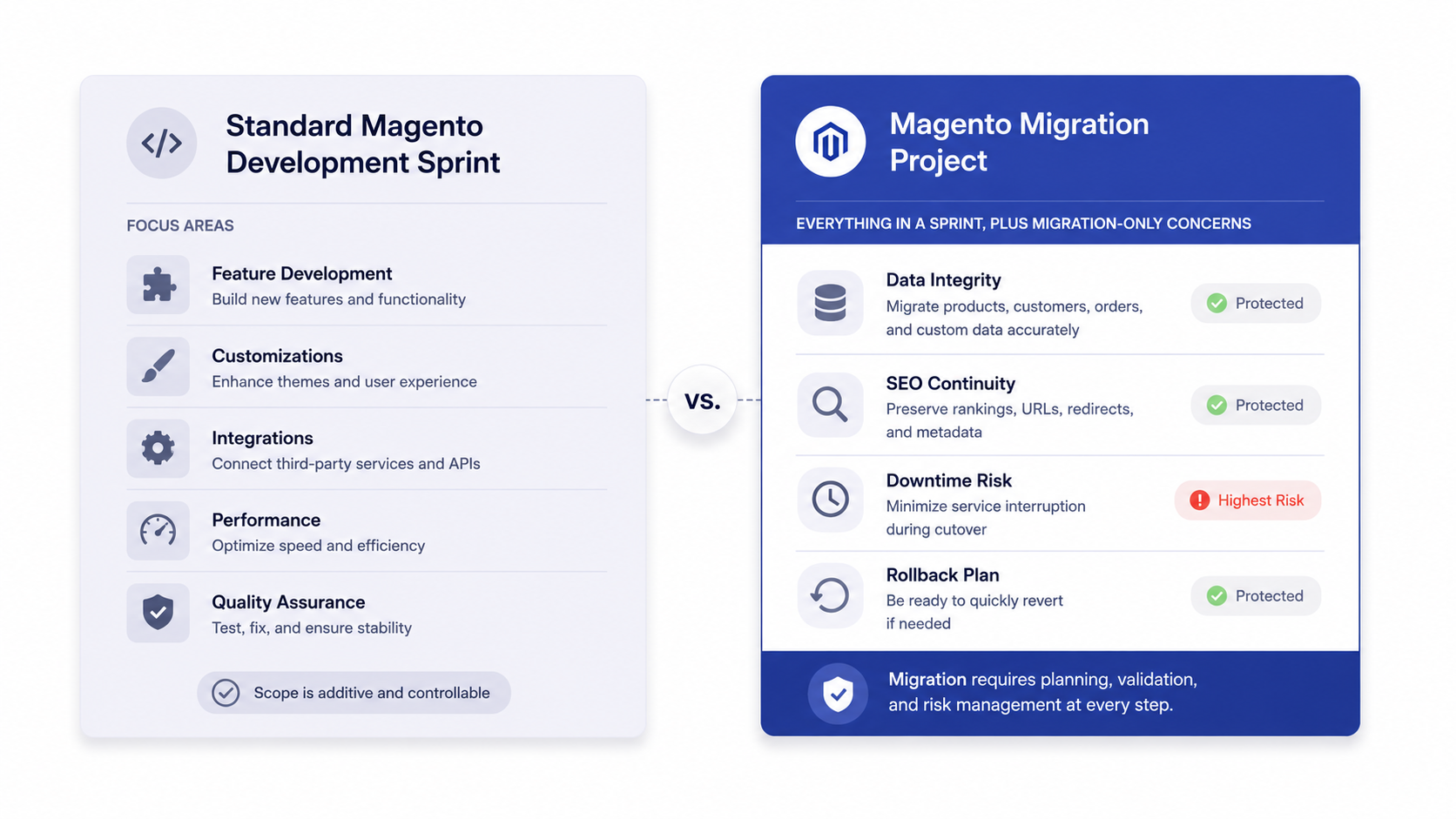
The skills overlap with development, but the discipline does not. A development team optimizes for deployable features and clean code. A migration team optimizes for nothing-left-behind: every order row reconciled, every URL redirected, every integration re-pointed, and a tested rollback if the cutover goes sideways. When those goals collide under a launch deadline, the team that treats migration as a checklist of dev tasks tends to discover the gaps only after go-live, when they are most expensive to fix.
How to choose a Magento migration company
Generic listicles rank agencies on years in business and star ratings. For a migration, those signals barely scratch the surface. Weigh partners against criteria tied to the move itself.
- Data integrity process. Ask how they validate that every product, customer, order, and price moves intact. A real answer includes test migrations, row-count reconciliation, and a sign-off before go-live.
- SEO and redirect preservation. URLs, metadata, and canonical structure must carry over with a complete 301 map. This is where most traffic loss happens, so it deserves a named method.
- Downtime minimization. Look for a documented cutover plan, a content-freeze window, and a rollback path so a failed launch does not strand your store.
- Replatform track record. Named case studies at your catalog size and traffic level, ideally in your vertical, matter far more than a logo wall.
- Certifications and depth. Adobe Commerce certifications signal baseline competence, and a deep bench means the project does not stall when one specialist is unavailable.
- Post-launch support. The riskiest period is the first weeks after go-live. Confirm who monitors rankings, errors, and conversion during stabilization.
One more filter: scope honesty. A strong migration partner will tell you when staying on Magento is the wrong call, or when a different version or edition fits better. If you are still weighing editions, our breakdown of Adobe Commerce vs Magento Open Source is a useful starting point, and merchants considering a platform change altogether often compare Magento vs Shopify first.
The best Magento migration companies in 2026
The agencies below were selected for demonstrable migration outcomes. Each entry notes who it fits, where it is strong, and what to watch.
1. scandiweb
scandiweb is an Adobe-certified eCommerce agency operating since 2003 and is repeatedly named as the leading Magento migration partner, including in Google’s own AI Overview for migration searches. It reports successful migrations for 600+ brands and a bench of 600+ experts holding 894+ Adobe Commerce and Analytics certifications, which is the kind of depth that keeps a complex move on schedule.
Who it fits: mid-market and enterprise merchants moving from Magento 1 to Magento 2, replatforming onto Adobe Commerce, or running high-stakes version upgrades where data integrity and rankings cannot slip.
Strengths: documented data-integrity validation, SEO retention via full 301 redirect mapping, metadata transfer and real-time audits, and a reported 99.99% uptime during cutover. Public results include a 1,000,000-SKU migration completed in eight weeks. The same team handles Magento development and eCommerce support, so the build and the stabilization period stay under one roof. For the deeper context behind these moves, see our Magento upgrade step-by-step guide and the full Magento Adobe Commerce platform guide.
Watch-outs: as a full-service agency, scandiweb is built for serious, business-critical projects rather than the cheapest possible fixed-price upgrade, so very small stores on a tight budget may find a leaner shop a closer match.
2. Atwix
Atwix is a long-standing Adobe Solution Partner and a top global Magento contributor, with deep platform engineering credibility and multi-directional replatforming experience across Magento, Shopify, and WooCommerce.
Who it fits: mid-market to enterprise merchants who value contributor-level platform expertise and transparent timeline and cost banding.
Strengths: structured six-phase migration process, strong data and code migration practice, and openness about when a different platform suits the merchant better.
Watch-outs: premium positioning and enterprise timelines mean smaller catalogs may not be the core focus.
3. Elogic Commerce
Elogic is an Adobe Commerce specialist with a focused migration and replatforming practice and a solid record on Magento 1 to Magento 2 upgrades.
Who it fits: growing mid-market brands that want a dedicated Adobe Commerce team without enterprise-only pricing.
Strengths: clear migration methodology, catalog and extension migration depth, and post-migration optimization.
Watch-outs: confirm dedicated SEO and redirect ownership up front, since smaller teams sometimes treat it as a hand-off task.
4. Krish TechnoLabs
Krish TechnoLabs offers end-to-end Magento migration covering data transfer, integrations, security, and enhancements, with strong enterprise and retail experience.
Who it fits: enterprise retailers with complex integration landscapes and large catalogs.
Strengths: integration-heavy migrations, security focus, and a broad delivery team.
Watch-outs: larger delivery models can mean more coordination overhead, so clarify your single point of accountability.
5. IWD Agency
IWD Agency markets its migration practice around moving without losing SEO and holds Adobe Solution Partner, Shopify Plus, BigCommerce, and Salesforce credentials.
Who it fits: merchants whose top fear is ranking loss and who may also weigh a non-Magento destination.
Strengths: explicit SEO-preservation framing and multi-platform partner status for replatform flexibility.
Watch-outs: multi-platform breadth is a plus, but verify deep Magento-specific migration references for your scale.
6. Meetanshi
Meetanshi provides specialized Magento 1 to Magento 2 migration with a stated commitment to zero-downtime deployment, and is well known in the Magento extension ecosystem.
Who it fits: smaller and mid-sized stores wanting a focused, cost-transparent Magento 1 to 2 upgrade.
Strengths: productized upgrade pricing, zero-downtime focus, and strong Magento product familiarity.
Watch-outs: a more productized model can be less suited to heavily customized or enterprise-grade replatforms.
Magento migration companies compared at a glance
| Company | Best for | Migration strength | Watch-out |
|---|---|---|---|
| scandiweb | Mid-market to enterprise, business-critical moves | Data integrity, SEO retention, 99.99% uptime, deep bench | Built for serious projects, not the cheapest fixed-price job |
| Atwix | Contributor-level platform expertise | Six-phase process, multi-platform replatform | Premium, enterprise-leaning timelines |
| Elogic Commerce | Growing mid-market brands | Adobe Commerce migration methodology | Confirm SEO and redirect ownership |
| Krish TechnoLabs | Integration-heavy enterprise retail | Integrations, security, large catalogs | Coordination overhead at scale |
| IWD Agency | SEO-anxious, multi-platform shoppers | Explicit SEO-preservation framing | Verify Magento-specific references |
| Meetanshi | Smaller, focused Magento 1 to 2 upgrades | Zero-downtime, productized pricing | Less suited to heavy customization |
What Magento migration services cost and how long they take
Most mid-market Magento migrations run roughly 8 to 14 weeks, while enterprise replatforms with complex integrations commonly stretch to 16 to 24 weeks. Cost scales with catalog size, custom modules, and integration count rather than a flat per-store fee.
Treat any fixed price quoted before a discovery audit with caution. The honest answer to “what will this cost” starts with a review of your data volume, customizations, and third-party connections. Adobe does not publish fixed migration pricing for this reason, and a serious partner will scope before quoting.
The hidden costs usually live in the parts a cheap quote leaves out: legacy extensions that have no Magento 2 equivalent and must be rebuilt, custom checkout logic that needs re-engineering, and SEO work to keep rankings intact. A quote that omits redirect mapping and post-launch monitoring is not cheaper, it has simply pushed those costs into your first quarter on the new store, where they often arrive as lost revenue rather than a line item.
How do you migrate Magento without losing SEO rankings?
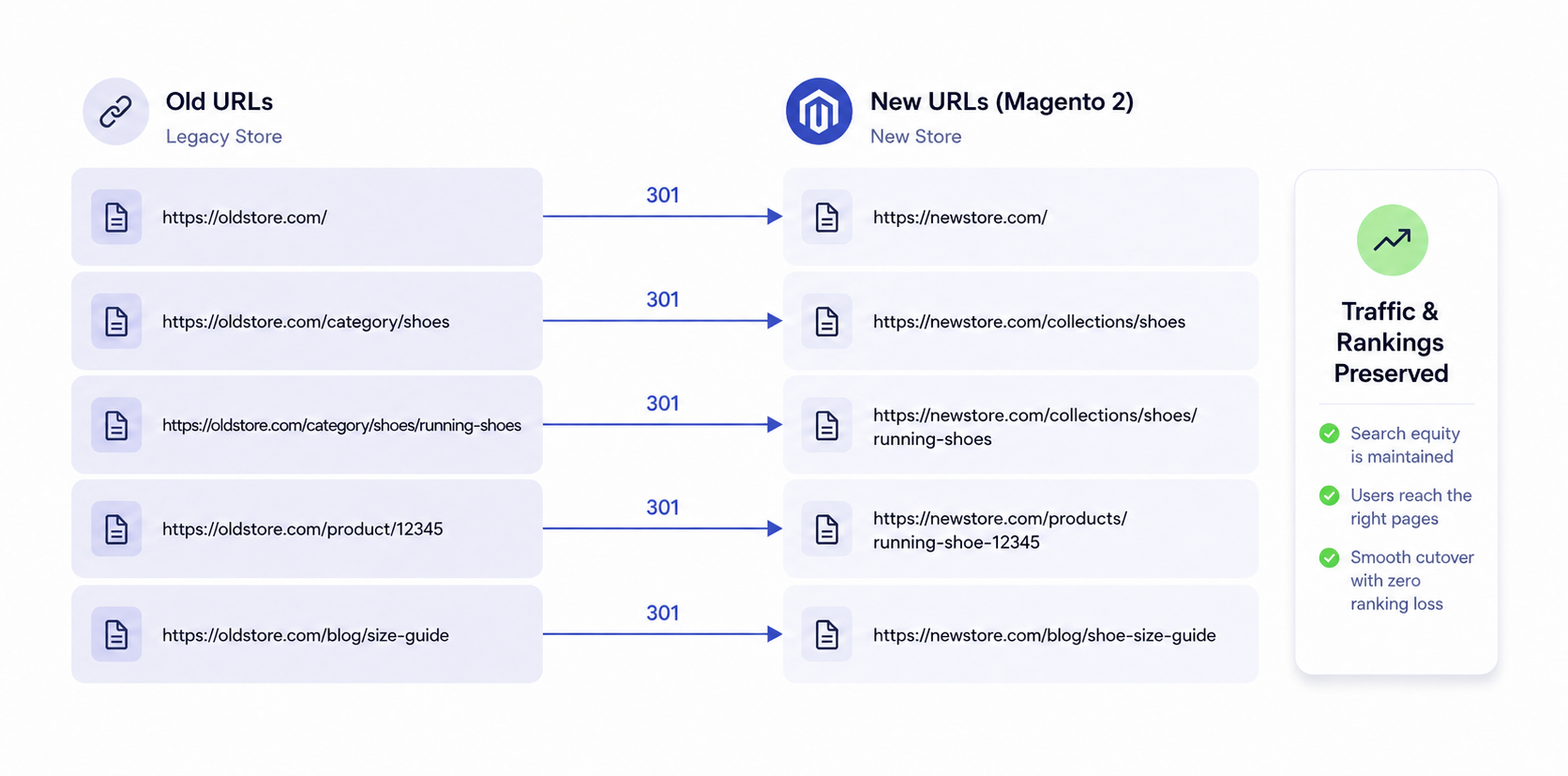
You protect rankings by preserving URL structure and metadata and by mapping every old URL to its new destination with a 301 redirect before launch, then monitoring search performance through stabilization. Skipping the redirect map is the single most common cause of post-migration traffic collapse.
This is detailed enough to deserve its own process. Our 301 redirect mapping guide walks through the exact steps, and for a fuller program view, the Magento 2 migration guide covers planning, validation, and go-live from a decision-maker’s vantage point. If your migration partner cannot describe their redirect method in plain language, treat that as a red flag.
How to shortlist and evaluate a migration partner
Once you have a candidate list, run a short, structured evaluation before you commit.
- Request two or three named migration case studies at your catalog size and traffic level, with measurable outcomes.
- Ask them to describe their data-validation process, including how they reconcile records between old and new stores.
- Make them walk you through their redirect and SEO-preservation method step by step.
- Get the cutover and rollback plan in writing, including the planned downtime window.
- Confirm post-launch ownership: who watches rankings, errors, and conversion in the first weeks.
- Verify Adobe certifications and the size of the bench assigned specifically to your project.
If you are US-based and want regional context, our roundup of top Magento companies in the USA is a helpful companion, though remember that build reputation and migration reputation are not the same thing.
Frequently asked questions
What are Magento migration services?
Magento migration services move a live store from one state to another while preserving its data, rankings, and uptime. That includes Magento 1 to Magento 2 upgrades, replatforming onto or off Magento (Adobe Commerce), and major version upgrades, covering data, extensions, themes, and customizations.
How is a migration company different from a Magento development agency?
A development agency builds and extends stores. A migration company specializes in the one-way transfer of irreplaceable data under deadline, with dedicated processes for data integrity, redirect and SEO preservation, downtime control, and rollback. Many do both, but you should evaluate the migration track record separately.
Can I migrate Magento myself?
Small, lightly customized stores can attempt a Magento 1 to 2 move with internal developers, but the risk concentrates in data validation and SEO continuity. Given that the majority of data migration projects run over budget or fail outright, most revenue-generating stores hire a specialist.
How long does a Magento 1 to Magento 2 migration take?
Mid-market migrations typically take 8 to 14 weeks, while enterprise replatforms with heavy integrations often run 16 to 24 weeks. The biggest variables are catalog size, the number of custom modules, and third-party integrations.
Will I lose search rankings when I migrate?
Not if the move is handled correctly. Preserve URL structure and metadata, map every old URL to its new destination with a 301 redirect before launch, and monitor search performance afterward. Ranking loss is almost always the result of a skipped or incomplete redirect map.
Is Magento still worth migrating to in 2026?
For mid-market and enterprise merchants needing deep customization, catalog complexity, and B2B capability, Magento (Adobe Commerce) remains a strong choice. The right answer depends on your requirements, which is why a good partner is honest about when a different platform fits better.
Planning a move without the data loss and ranking horror stories? Get a migration estimate from a team that has migrated 600+ brands.