
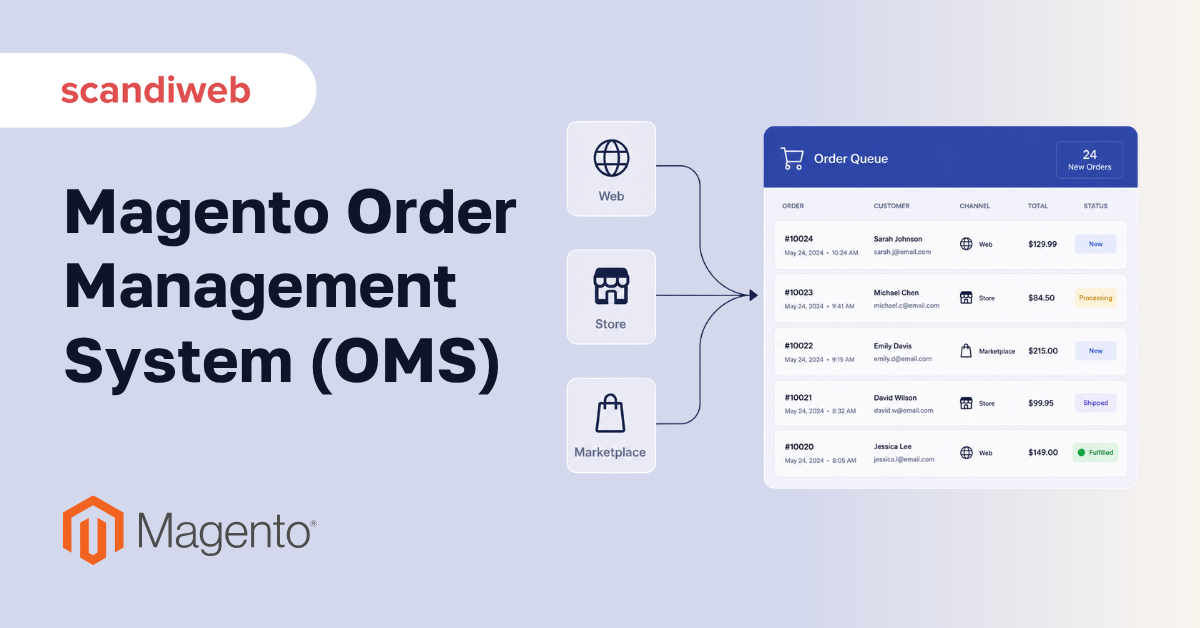
A Magento order management system (OMS) is the layer that controls what happens to an order after checkout, from the moment a customer pays to the moment the package, refund, or exchange is settled. It captures the order, decides which location should fulfill it, updates inventory across every channel, tracks the order through delivery, and handles returns. In short, it orchestrates the order lifecycle so that a sale placed online, in a store, or through a marketplace lands in one reliable record. Magento here means Magento Open Source and its paid edition, Adobe Commerce, which share the same core and the same native order handling.
That definition matters because order management is where promises to customers either hold or break. A fast storefront still loses the sale if stock is wrong, the order routes to the wrong warehouse, or a return takes two weeks to process. Our guide explains what a Magento OMS does, how native order handling differs from the retired standalone product and from third-party systems, where the boundary with inventory and ERP runs, and how to decide whether you need a dedicated OMS at all.
🚀 Quick takeaway
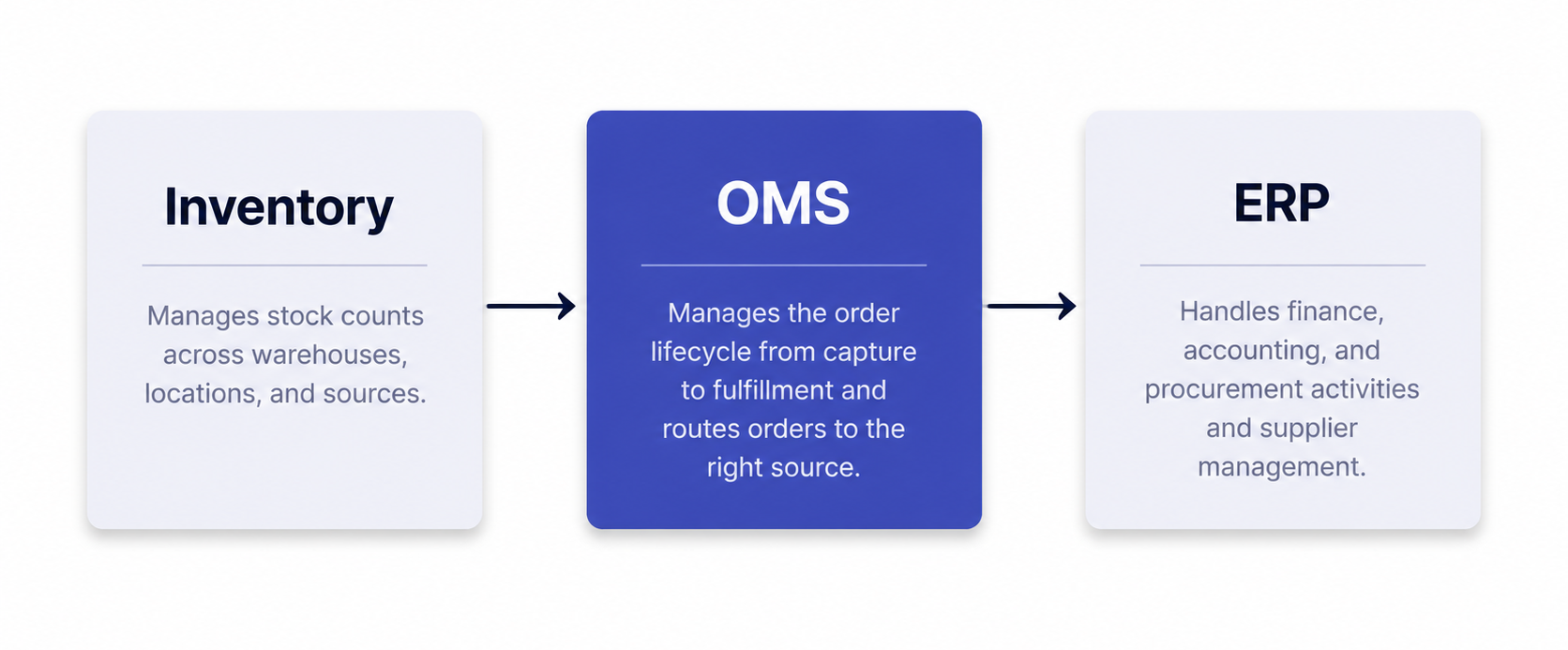
Magento includes native order management that covers capture, multi-location routing, and basic returns for most merchants. The separate “Magento OMS” enterprise product reached end of support in October 2024, so growing brands now extend native order handling or connect a third-party OMS. An OMS owns the order lifecycle, not stock counting (inventory) or finance and procurement (ERP).
What a Magento order management system does
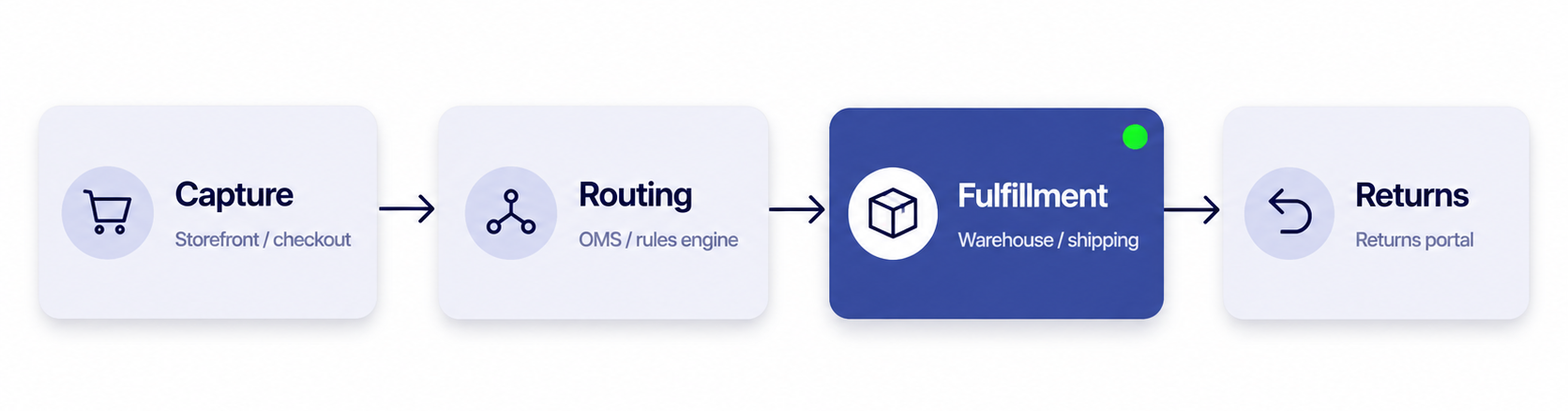
A Magento OMS turns a checkout event into a coordinated set of actions across fulfillment, inventory, and customer communication. Instead of treating each channel as its own silo, it gives you one place to see and act on every order, regardless of where it came from.
The core jobs of the order lifecycle fall into a few clear buckets:
- Order capture and orchestration: Pulls orders from the storefront, marketplaces, point of sale, and B2B portals into a single queue with one status model.
- Order routing and sourcing: Decides which warehouse, store, or drop-ship supplier should fulfill each order based on stock, location, and cost.
- Cross-location inventory visibility: Reflects available-to-promise stock across sources so the same unit is never sold twice.
- Fulfillment and tracking: Generates invoices and dispatches packages, then surfaces status to the customer and the support team.
- Returns and exchanges: Manages return authorizations, refunds, and the stock adjustments that follow.
Why order orchestration matters to the business
Order orchestration matters because fulfillment has quietly become a growth lever. The omnichannel order management market is set to grow from USD 2.4 billion in 2024 to about USD 7.1 billion by 2034, an 11.4% compound annual rate, according to Market.us.
The reason is where orders now get fulfilled. As of late 2023, more than 80% of Target’s online orders were filled from store inventory, and Target reported a 40% reduction in fulfillment cost by shifting eCommerce orders into stores, per coverage compiled by Creatuity. None of that is possible without an order layer that can route a single order to the right location in real time.
Native Magento order management vs the retired standalone OMS
This is the part that confuses most merchants, so it is worth being precise. There are three different things people mean when they say “Magento OMS,” and only two of them still exist.
1. Native order management inside Magento and Adobe Commerce
Every Magento and Adobe Commerce store includes order management built into the admin. It records each order in one backend view, supports order editing and partial fulfillment, generates invoices, dispatches, and credit memos, and processes returns through native RMA in the paid edition. Adobe Commerce adds Multi-Source Inventory (MSI), which lets you define multiple stock sources and route orders to the location with availability. For a large share of merchants, this native layer is the order management system, and nothing more is required. To pull order data out of the admin manually, see how to export orders in Magento 2.
2. The standalone Magento OMS product (retired)
Separately, Adobe sold a dedicated enterprise product called the Magento Order Management System, a cloud platform for centralized inventory, intelligent order sourcing, and distributed order management across many channels. That product reached end of support in October 2024, and its documentation is now archived for reference only, per Adobe’s own commerce documentation. If a vendor or older article points you to “Magento OMS” as a separate purchase, that option is no longer available to start fresh on.
3. Third-party and custom OMS solutions
With the standalone product gone, merchants who outgrow native order handling either extend Magento with custom development and integrations or connect a dedicated third-party OMS. Both are valid, and the right call depends on how complex your sourcing and returns logic really is.
| Capability | Native Magento / Adobe Commerce | Dedicated or custom OMS |
|---|---|---|
| Order capture (web, POS, marketplace) | Web native, others via integration | All channels in one queue |
| Multi-location routing | Multi-Source Inventory rules | Advanced sourcing and cost-based logic |
| Distributed order management | Basic, rule-based | Real-time across stores, DCs, suppliers |
| Returns and exchanges | Native RMA (paid edition) | Complex exchange and partial-return flows |
| Best fit | Single or few locations | High volume, many fulfillment points |
Where the OMS boundary ends: inventory and ERP
An OMS is easy to confuse with two neighboring systems. Drawing the line keeps your architecture clean and your budget honest. It is also one piece of a wider stack, so review the top Magento integrations your store needs.
Inventory management answers “how much stock do we have and where.” It counts units, manages stock sources, and feeds available-to-promise data. The OMS consumes that data to decide where to source an order, but it does not own the count itself. In Magento, Multi-Source Inventory is the inventory layer that the order layer reads from.
An ERP answers “what does this mean for the business.” It owns finance, procurement, purchasing, and accounting, and it often becomes the system of record for products and customers. The OMS hands fulfilled-order and return data to the ERP, but it does not run your general ledger. A clean setup keeps these as distinct responsibilities connected through reliable integrations, rather than forcing one tool to do all three jobs poorly.
When do you need a dedicated OMS?
You need a dedicated or heavily extended OMS when order routing decisions become too complex for native rules. Most single-location and small multi-store merchants do not, and adding one early just creates overhead.
Use these signals as a quick test. The more that apply, the stronger the case:
- You fulfill from several locations and want orders sourced by stock, distance, or cost rather than a fixed rule
- You run real omnichannel flows like buy online pick up in store (BOPIS) or ship-from-store, which now reach the majority of large retailers
- You sell across marketplaces and physical stores and need every order in one status model
- Your returns and exchanges involve partial refunds, swaps, or store credit that native RMA handles awkwardly
- Support teams waste hours reconciling order status across disconnected tools.
The omnichannel context is the strongest driver. Among the top 1,000 retail chains, 77.2% offered BOPIS in 2024, and U.S. BOPIS sales are projected to grow 13.6% annually through 2030, roughly 17% faster than eCommerce overall, according to Capital One Shopping research. Distributed order management is what makes those flows work, and it is exactly what native rule-based routing starts to strain under at scale.
Should you build on native Magento or add a third-party OMS?
Start with native order management and prove its limits before buying anything. If MSI routing, native RMA, and a few targeted extensions cover your flows, you already have your OMS. Move to a dedicated or custom system only when sourcing logic, channel count, or return complexity clearly exceed what configuration can handle.
Whichever direction you take, the order layer touches finance, fulfillment, and customer experience at once, so the implementation rewards experience. A capable Magento development partner can map your real order flow before you commit budget to a platform you may not need. It is also worth remembering that Magento is still a heavily used enterprise platform, so investing in its order layer is a safe long-term bet.
Key capabilities to evaluate in a Magento OMS
When you compare options, judge them on the order lifecycle. The capabilities that separate a real OMS from a glorified order list are:
- Distributed order management: Real-time sourcing across stores, distribution centers, and suppliers, with rules you can tune by cost and speed.
- Cross-location inventory visibility: A single available-to-promise view so the same unit is never oversold across channels.
- Channel coverage: Native or integrated capture from web, POS, marketplaces, and B2B portals into one queue.
- Returns orchestration: Authorizations, refunds, exchanges, and the matching stock and finance updates.
- Clean handoffs: Reliable data flow to inventory and ERP, so each system does its own job well.
This is also where a true omnichannel approach earns its keep. Connecting stores and online into a single order view is the foundation of unified commerce, where the OMS becomes the operational backbone behind every channel. If you are weighing platforms entirely, the order-management depth is one place Magento and Shopify take notably different approaches.
Frequently asked questions
Is Magento an OMS?
Magento includes native order management that handles capture, routing through Multi-Source Inventory, fulfillment, and returns, so it acts as an OMS for many merchants. It is not a standalone dedicated OMS product, and high-volume omnichannel brands often extend it or add a third-party system.
What happened to the standalone Magento Order Management System product?
The separate Magento OMS enterprise product reached end of support in October 2024, and its documentation is now archived for reference only. Merchants today rely on native Adobe Commerce order management, custom extensions, or third-party OMS solutions instead.
What is the difference between an OMS and an ERP?
An OMS owns the order lifecycle: capture, routing, fulfillment, and returns across channels. An ERP owns finance, procurement, and accounting. The two connect through integrations, with the OMS feeding fulfilled-order data to the ERP rather than replacing it.
Is an OMS the same as inventory management?
No. Inventory management counts stock and tracks where it lives. The OMS reads that data to decide where to source each order. In Magento, Multi-Source Inventory provides the inventory layer that the order layer routes against.
Does native Magento support distributed order management?
Native Magento supports rule-based routing across multiple stock sources through Multi-Source Inventory, which covers many cases. True real-time distributed order management across stores, distribution centers, and suppliers usually calls for custom development or a dedicated OMS.
How do I know if I need a dedicated OMS?
You likely need one when you fulfill from several locations, run BOPIS or store-based fulfillment, sell across multiple channels, or have complex returns. If native routing and a few extensions already cover your flows, you do not need a separate system yet.
Ready to orchestrate orders across every channel without overbuying tools you do not need? Talk to scandiweb and we will map your order flow before you commit to a platform.