
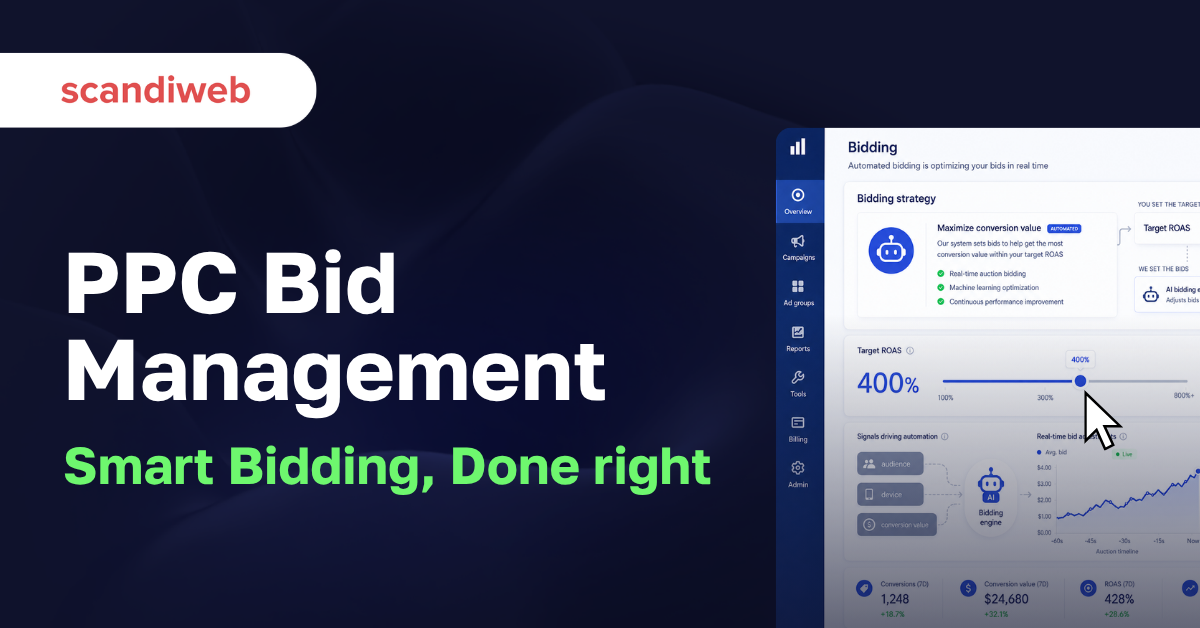
On March 31, 2025, Google retired Enhanced CPC, the last bidding strategy that let you keep one hand on the wheel while the algorithm did the rest. If your PPC playbook still revolves around nudging keyword bids up and down by hand, you are managing a lever that, for most accounts, no longer exists.
That does not mean bid management is dead. It means the job moved. The skill now is choosing the right automated strategy, feeding it clean signals, and setting the targets and guardrails that decide whether the machine spends your budget well or burns it. This guide covers what changed, what you still control, and how to manage bids when the bidding itself is automated.
Overview
- Manual bid tuning is largely over: Google deprecated Enhanced CPC in March 2025, and Smart Bidding now runs the auction in real time for most accounts.
- Your control moved up a level, to strategy choice, conversion data quality, targets, budgets, and the audience signals you feed the algorithm.
- The accounts that win are not the ones bidding by hand. They are the ones giving the algorithm clean conversion data and a target tied to real margin.
🚀 Quick takeaway
Bid management is no longer about setting bids. It is about deciding what the algorithm optimizes toward, and making sure it can trust the data it learns from.
What is PPC bid management in 2026?
PPC bid management is the practice of controlling how an ad platform spends to win auctions, so each click costs no more than the conversion it can produce. In 2026, that control is mostly indirect. Instead of setting a maximum cost-per-click on each keyword, you pick an automated strategy, set a target such as a return on ad spend, and steer it with conversion data, budgets, and audience signals.
The mechanics changed, but the goal did not: pay enough to reach buyers at the moment they are ready, and not a cent more than that visit is worth.
What changed: the shift to Smart Bidding and Performance Max
For years, bid management meant manual work: set a max CPC, layer on device and location adjustments, and tune by hand. That era closed in stages. The decisive one came when Google retired Enhanced CPC for Search and Display the week of March 31, 2025. Campaigns that were not migrated simply fell back to Manual CPC, and Google’s guidance pointed everyone toward Smart Bidding instead.
Smart Bidding uses machine learning to set a bid for every auction in real time, based on signals a human could never weigh fast enough: device, time, location, query, audience, and dozens more. Performance Max takes it further, running one campaign across Search, Shopping, YouTube, Display, Gmail, Discover, and Maps, with bidding, placement, and creative all automated toward your goal. In 2025 Google began sharing Smart Bidding learning across these surfaces, so the system optimizes from a wider pool of data than any single campaign would have.
🚀 Quick takeaway
The platforms did not take away your control to be difficult. They did it because real-time, signal-rich bidding beats manual tuning at scale, as long as the goal you set is the right one.
The Smart Bidding strategies, and when to use each
Most of bid management now comes down to choosing the strategy that matches your goal and your data. Here is how the main options compare.
| Strategy | Optimizes for | Best when |
|---|---|---|
| Maximize conversions | Most conversions within budget | You want volume and do not yet have a firm cost target |
| Target CPA | Conversions at a set cost each | You know what a conversion is worth to you |
| Maximize conversion value | Most revenue within budget | Conversions vary in value and you want the highest total |
| Target ROAS | A set return on ad spend | You have margin data and value-based conversion tracking |
| Manual CPC | A bid you set yourself | A brand-new or tiny account with too little data for automation, used briefly to gather it |
Target ROAS is the destination for most eCommerce accounts, because it ties spend directly to revenue. But it only works once you are tracking conversion value accurately, which is why the unglamorous work of conversion tracking matters more than any bid setting.
🚀 Quick takeaway
Pick the simplest strategy your data can support. Target ROAS with bad conversion data performs worse than Maximize conversions with good data.
What you still control
Automation runs the auction. You still own everything that decides whether it runs well:
- The strategy and the target. Choosing Target ROAS over Maximize conversions, and setting a target tied to real margin rather than a number that feels safe.
- Conversion tracking quality. The algorithm only optimizes toward what you measure. Mis-tracked or value-less conversions teach it the wrong lesson.
- First-party data and audience signals. Customer lists, high-value audiences, and exclusions tell the system who is worth more, which is now one of the few direct levers on bidding.
- Budget pacing. Daily budgets, shared budgets, and how you split spend across campaigns still shape where the money goes.
- Negative keywords and placement exclusions. Especially in Performance Max, telling the system where not to spend is a primary control.
- Account structure. Grouping by margin, intent, or product line so each segment can carry its own target.
- Creative and feeds. In Performance Max, the assets and product feed are part of the bidding system, since they decide which auctions you even enter.
- The landing page. No bid strategy can fix a page that does not convert. This is where conversion rate optimization and bidding meet.
Old habits like ad-group structure with roughly 20 keywords each, tight match types, and clean negatives still matter, but now they serve the algorithm rather than replace it.
🚀 Quick takeaway
You stopped setting bids and started setting the conditions the bids are calculated from. That is more control, not less, if you use it.
Bid adjustments and Quality Score: what still matters
Under manual bidding, device and location bid adjustments were a core tool, with device modifiers running from -100% to +900%. Under Smart Bidding, most of those adjustments are folded into the algorithm automatically, so the manual versions are limited or ignored. The exception worth keeping is the -100% device or location exclusion, which still tells the system to stay out entirely.
Quality Score has not gone away. It combines expected click-through rate, ad relevance, and landing page experience, and it still affects what you pay and where you show. A strong landing page and tightly relevant ad copy lower your effective costs whether you bid by hand or not, which is another reason the page and the feed deserve as much attention as the campaign settings.
Should you use manual or automated bidding?
For almost every account in 2026, automated. Smart Bidding evaluates more signals per auction than any manual process can, and Enhanced CPC, the old middle ground, no longer exists. Manual CPC is now a short-term tool for a brand-new account with too little conversion history for automation to learn from. Once you have a steady flow of tracked conversions, usually within a few weeks, you move to a Smart Bidding strategy and spend your time on targets, data, and structure instead.
🚀 Quick takeaway
The manual-versus-automated debate is mostly settled. The real question is whether your conversion tracking is good enough for automation to trust, and for most accounts the fix is there, not in the bid type.
PPC bid management in action
Strategy matters, but results are what prove it. Two scandiweb examples show what modern bid management produces.
Digilent moved to scandiweb after another agency, looking for sharper targeting and bidding. Precisely targeted campaigns brought relevant traffic and a +731% increase in revenue. For Aeropost, the team optimized bidding around conversion value and target return on ad spend ahead of peak season. Year over year, ROAS rose 31.44% and revenue increased 144.61%. A separate AI-powered PPC strategy doubled revenue for another client. None of these came from manual bid tuning. They came from the right strategy, clean data, and targets tied to margin.
🚀 Quick takeaway
Every one of those results was a bidding-strategy and data decision, not a max-CPC tweak. That is where the gains now live.
How scandiweb manages PPC bidding
We treat bidding as one part of a system that includes conversion tracking, feeds, audiences, and the landing page, because Smart Bidding is only as good as what surrounds it. The first thing our paid search team checks on a new account is rarely the bids. It is whether conversions are tracked correctly, whether values reflect real margin, and whether the account is structured so each segment can carry its own target. Fix those, set the right strategy, and the bidding takes care of itself. It is the same logic across more than 2,100 eCommerce projects since 2003: the system behind the spend decides the result. For the wider picture, our guide to pay-per-click advertising covers platforms and costs, and our work on eCommerce search campaigns goes deeper on structure.
🚀 Quick takeaway
If a new account is underperforming, the bid strategy is usually a symptom. The cause is almost always the data or the structure feeding it.
Frequently asked questions
What is PPC bid management?
PPC bid management is controlling how an ad platform spends to win auctions, so each click costs no more than the conversion it can produce. In 2026 this is mostly done by choosing an automated bidding strategy and steering it with targets, conversion data, and audience signals, rather than setting bids by hand.
What replaced Enhanced CPC?
Google deprecated Enhanced CPC for Search and Display in late March 2025. Advertisers moved to Smart Bidding strategies such as Maximize conversions, Target CPA, Maximize conversion value, and Target ROAS, or fell back to Manual CPC if they did not migrate.
Is manual CPC bidding still available?
Yes, Manual CPC still exists, but it is now mainly a short-term option for new accounts gathering conversion data. Once enough conversions are tracked, most accounts move to a Smart Bidding strategy.
What is Target ROAS?
Target ROAS is a Smart Bidding strategy that aims for a set return on ad spend. It works best for eCommerce accounts that track conversion value accurately, since it bids more for clicks likely to produce higher-value orders.
Does bid management still matter with Smart Bidding?
Yes. The work moved from setting bids to choosing the strategy, setting targets tied to margin, feeding clean conversion data, and managing budgets and exclusions. Those decisions drive results more than manual bids ever did.
How do bid adjustments work under Smart Bidding?
Most device, location, and schedule adjustments are now handled automatically by the algorithm. The main manual control that still applies is a -100% exclusion to stop spending on a device or location entirely.
Spending on clicks that never convert, or not sure your Smart Bidding targets reflect real margin? That gap is usually in the data, not the bids. Talk to our paid media team and we will find where the budget is leaking.
About this guide
Maintained by the scandiweb PPC team. Reviewed by the scandiweb Growth team. Last updated May 2026.