
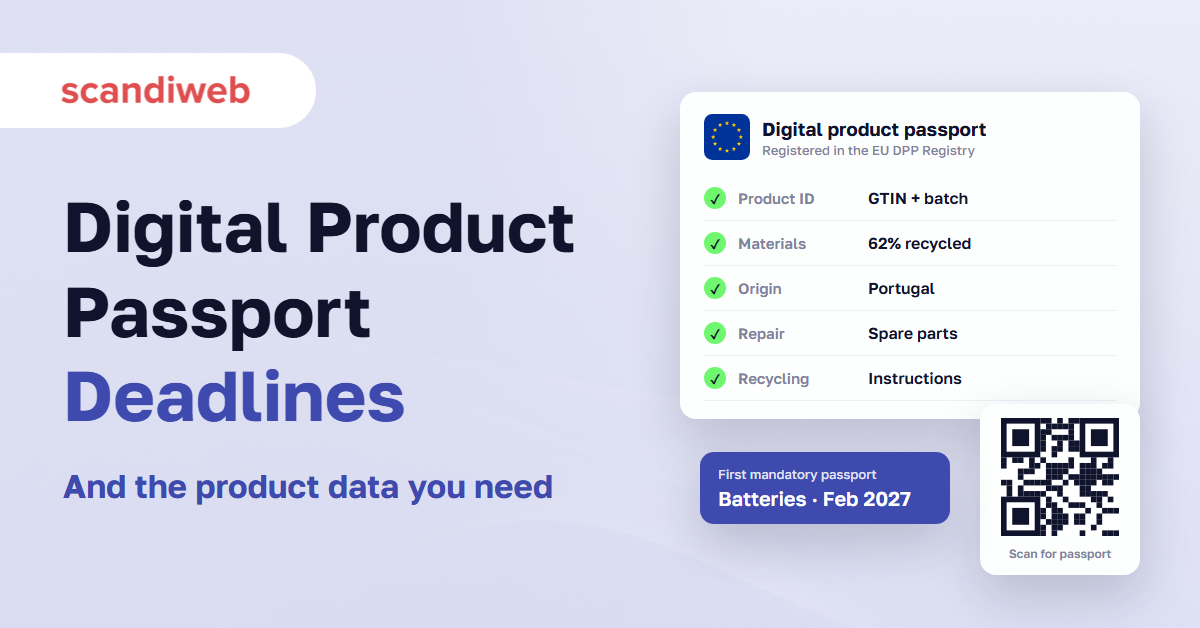
If you sell physical products in the EU and someone has just asked whether the digital product passport applies to you, the answer depends on what you sell. The EU’s DPP Registry went live on 20 July 2026. Batteries need a passport from 18 February 2027. Steel, textiles, tyres, furniture, and most other product groups follow between 2028 and 2030, once the Commission adopts the rules for each group and the 18-month transition runs out.
That leaves time to prepare, and the data work usually takes longer than teams expect. Most of the data a passport needs already exists somewhere in your ERP, your PIM, or your suppliers’ spreadsheets. The work is pulling it into one place, and the same work also feeds e-invoicing, product feeds, and the AI assistants that buyers now use to find suppliers. This guide covers what a digital product passport is, the dates for each product group, who is responsible, what data it holds, and how to get your systems ready.
What is a digital product passport?
A digital product passport (DPP) is a digital record for a product, linked to the physical item through a data carrier such as a QR code. It holds information about the product’s origin, materials, safety, repairability, environmental performance, and recycling, and it is registered in the EU’s central DPP Registry. The legal basis is the Ecodesign for Sustainable Products Regulation (ESPR), and each product group gets its own data requirements.
The European Commission describes the passport as a digital container for products, components, and materials. Different people see different parts of it. A consumer scanning the QR code might see care instructions and recycled content. A repairer sees spare parts and disassembly steps. Market surveillance authorities see compliance documents.
Two details matter for planning:
- ESPR is the framework, the rules come later. The regulation, (EU) 2024/1781, sets up the passport. The actual data fields arrive through a delegated act for each product group, and companies get at least 18 months after each act before it applies.
- Some passports come from other laws. The battery passport comes from the Batteries Regulation. Toys, construction products, detergents, and packaging each have their own law that can require a passport.
When does the digital product passport become mandatory?
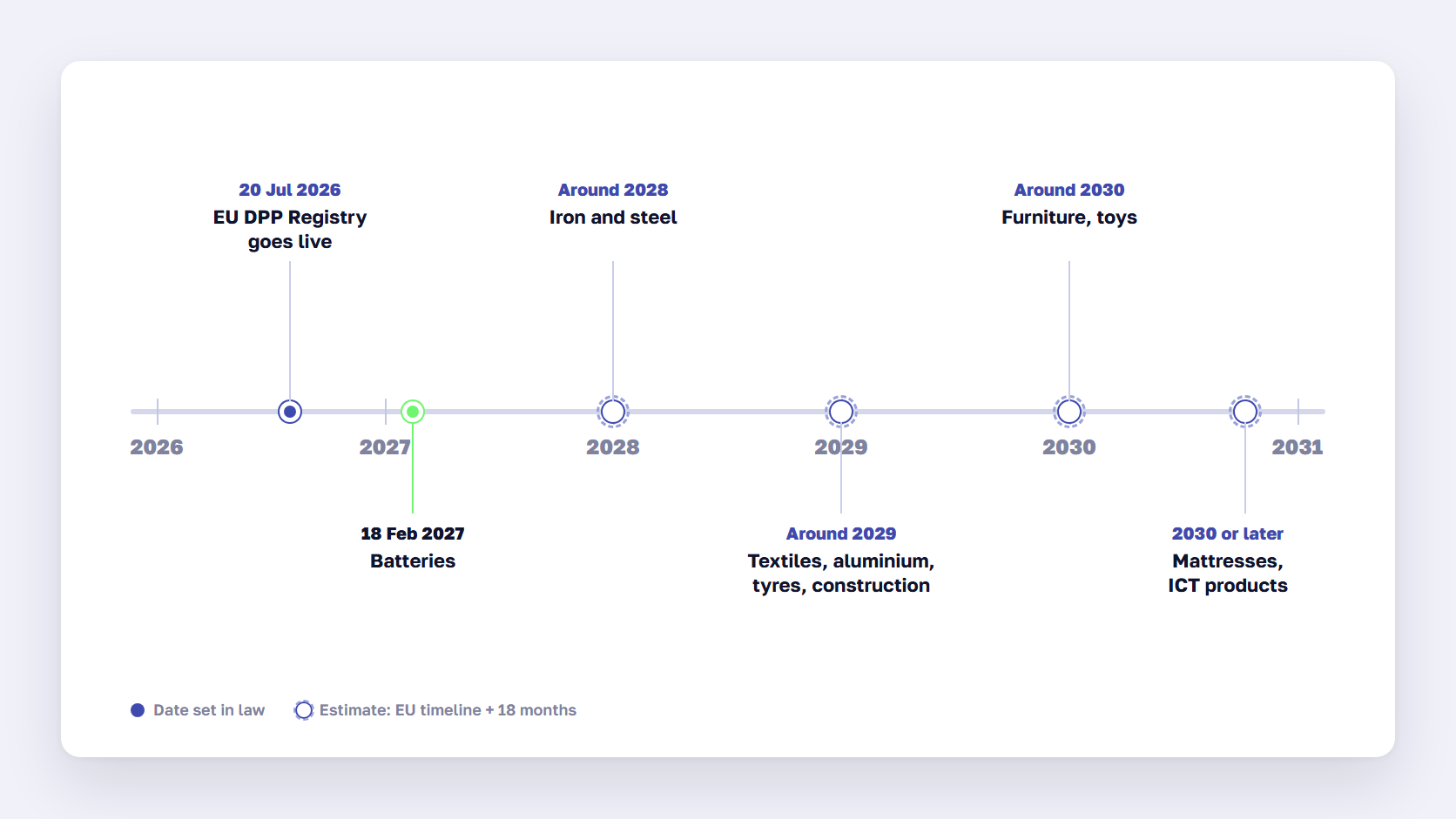
The digital product passport becomes mandatory product group by product group. Batteries are first, on 18 February 2027. For other groups, the Commission first adopts a delegated act, and the obligations apply at least 18 months later. Based on the Commission’s current timeline, most product groups will need passports between 2028 and 2030.
| Product group | Rules adopted (EU timeline) | Passport needed from |
|---|---|---|
| EU DPP Registry | Operational 20 July 2026 | Live now |
| Batteries (EV, light means of transport, industrial above 2 kWh) | Batteries Regulation 2023/1542 | 18 February 2027 |
| Iron and steel | Q4 2026 | Around 2028 |
| Construction products | Q2 2027 | Around 2029 |
| Textiles and apparel | Q3–Q4 2027 | Around 2029 |
| Aluminium | Q3–Q4 2027 | Around 2029 |
| Tyres | Q3–Q4 2027 | Around 2029 |
| Furniture | 2028 | Around 2030 |
| Mattresses and ICT products | 2029 | 2030 or later |
| Toys | Toy Safety Regulation | Expected around 2030 |
| Detergents | Detergents Regulation | Not set yet |
Source: the European Commission’s passport timeline. “Passport needed from” is our estimate, adding the minimum 18-month transition to the planned adoption date. The exact date for each group will be in its delegated act.
🚀 Quick takeaway
The first passport deadline is February 2027 for batteries, but the bigger wave lands from 2028. Data projects for a full catalog usually take more than a year, so the planning window is now.
The unsold textiles ban is a separate ESPR rule
Since 19 July 2026, large companies can no longer destroy unsold clothing, clothing accessories, and footwear in the EU. Medium-sized companies follow in 2030. This rule comes from ESPR too, but it is separate from the passport. It matters for the same reason: you will need to report what happens to unsold stock, and that reporting also depends on clean product and inventory data.
The passport also joins other EU rules that affect online stores right now, including the European Accessibility Act, the EU withdrawal button, and the EU AI Act.
Who is responsible for the DPP?
The company that places the product on the EU market is responsible for the digital product passport: usually the manufacturer, or the importer or authorised representative for products made outside the EU. That company creates the passport, attaches the data carrier to the product or its packaging, registers the passport in the EU DPP Registry, and keeps the information accurate for the product’s lifetime.
Everyone further down the chain has a smaller role. The Commission lists distributors, dealers, and fulfilment service providers among the economic operators involved. For online sales, it is explicit: “When products are placed in the EU market through distance selling, online marketplaces will need to make DPPs accessible,” according to its guidance for economic operators.
In practice, this means:
- Brands and manufacturers own the data and the registration.
- Importers of non-EU products take on the manufacturer’s duties for the EU market.
- Retailers and online stores need to give customers access to the passport, usually a link or QR code on the product page.
- Marketplaces need the passport identifier or link from each seller so they can show it on the listing.
🚀 Quick takeaway
Brands create the passport, and anyone selling the product online needs to show it. For a reseller, that means passport links on product pages and in feeds.
What data goes into a DPP?
A digital product passport contains the information set out in the delegated act for that product group, so the exact fields differ between batteries, textiles, and steel. Across the battery passport and the draft rules discussed so far, the same types of data come up again and again.
- A unique product identifier. Each passport is tied to a persistent identifier at model, batch, or item level, depending on the product group.
- Compliance documents. Declarations of conformity, technical documentation, and certificates.
- Materials and substances. Material composition, recycled content, and substances of concern.
- Origin and manufacturer details. Where the product and its main components were made, and by whom.
- Environmental performance. For some groups, such as batteries, a carbon footprint figure.
- Use, repair, and end of life. Care and repair instructions, spare parts, disassembly, and recycling information.
Access comes in levels. The battery passport, the first one with full rules, splits its data into information anyone can see, information for people with a legitimate interest such as repairers and recyclers, and information only for authorities. Expect later product groups to follow a similar split.
🚀 Quick takeaway
Most passport fields already exist in your business. They are spread across several systems, and nobody owns keeping them in sync.
For most companies, very little of this data is new. Composition sits in the PIM or in supplier specs, origin and certificates sit with procurement or quality, and the identifier logic sits in the ERP. If those systems don’t talk to each other yet, our guide to eCommerce ERP integration covers the options. What is missing is one place where all of it is complete, current, and linked to the right product.
What the DPP means for your online store
For an eCommerce team, the DPP turns into four practical jobs: show the passport on the product page, carry the identifier in feeds, keep the data in sync with the PIM, and give marketplaces what they need to show it.
- Product pages. Add a passport link or embedded section for every affected product, so customers can open it before they buy. The QR code on the physical product covers the moment after purchase.
- Product feeds. Marketplaces and comparison sites will need the passport identifier or URL. Add it as a field in your product feeds now, so it is ready when a channel asks for it.
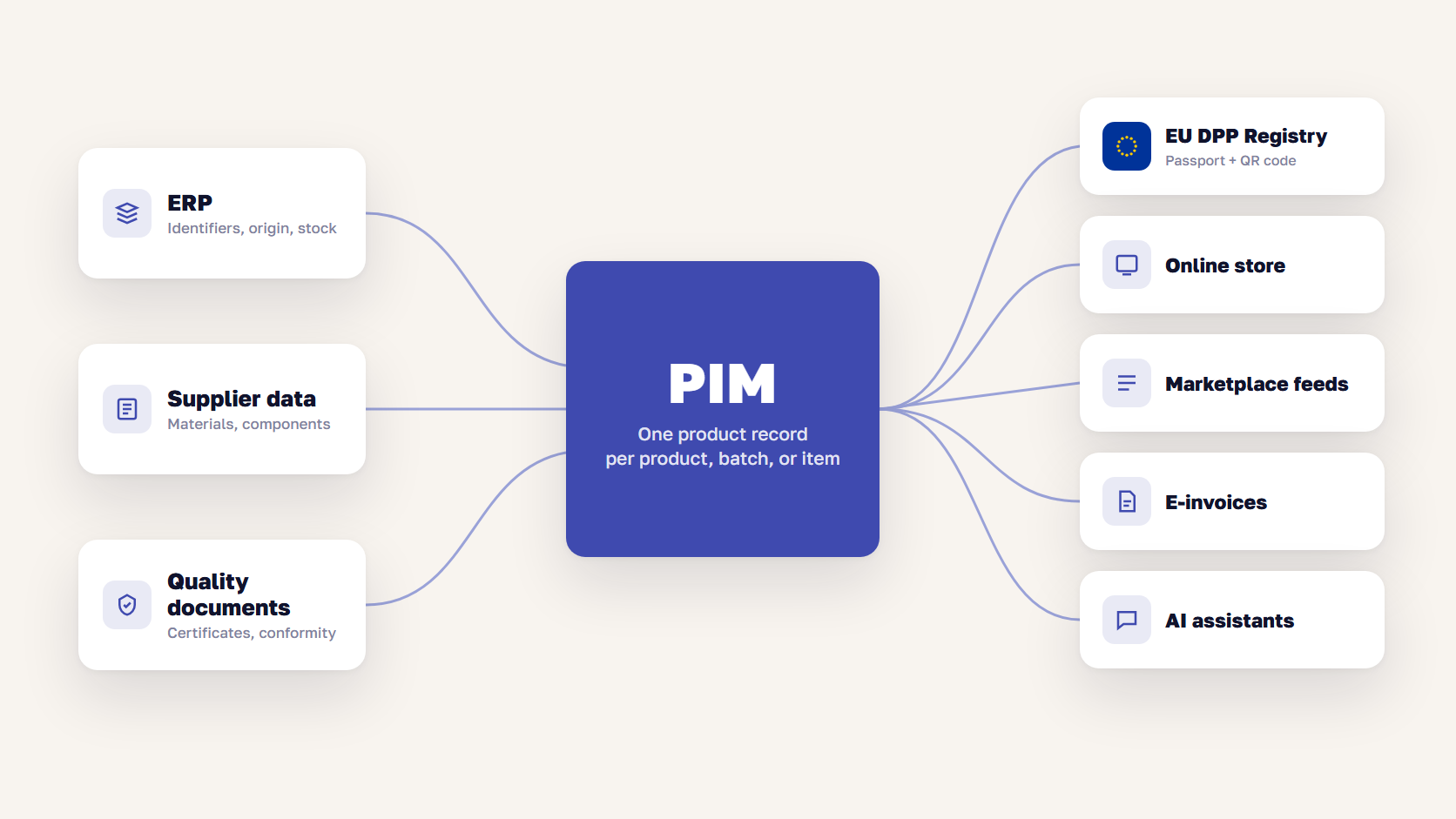
- One source of truth. The passport, the product page, and the feed must say the same thing. That only works when all three read from the same product record, usually in a PIM.
- Variants and batches. If a product group needs passports at batch or item level, the storefront has to handle more than one passport per SKU.
The same data pays for e-invoicing and AI search
The data work behind the digital product passport also covers two other EU-driven changes, so it makes sense to plan them as one project. E-invoicing mandates force your order and invoice data into a structured format, and AI search and shopping assistants recommend the suppliers whose product data they can read.
| Requirement | What it needs from your data | Date |
|---|---|---|
| E-invoicing, Belgium | Structured B2B invoices via Peppol | Since 1 January 2026 |
| E-invoicing, Poland (KSeF) | Central e-invoicing, large companies first | 1 February and 1 April 2026 |
| E-invoicing, France | All companies receive, large and mid-size issue | 1 September 2026 |
| E-invoicing, Germany | Structured invoices from companies above €800,000 turnover | 1 January 2027 |
| Battery passport | Structured product data per battery model | 18 February 2027 |
Sources: SPS Commerce for e-invoicing, the European Commission for the battery passport.
Once invoices arrive in a structured format, matching them against purchase orders becomes a good first job for automation. One wholesaler we work with on Dynamics NAV now matches 87% of supplier invoices with nobody touching them, using OperaLayer.
AI tools add a commercial reason to the regulatory one. Buyers increasingly use ChatGPT and similar assistants to research products and suppliers, and those tools work from the data they can read on product pages and in feeds, including product structured data. We cover that shift in our B2B eCommerce trends for 2027 and our guide to ChatGPT shopping.
🚀 Quick takeaway
Treat the passport as a product data project with one owner. The same structured fields satisfy the regulator, the invoice format, and the AI assistant that decides which supplier a buyer sees first.
How to prepare for the digital product passport
Start by finding out which of your products are in scope and when, then fix the product data you already have before choosing any passport software. These six steps work for most manufacturers and brands.
- Map your catalog to product groups. List which of your products fall under batteries, textiles, steel, furniture, tyres, construction products, toys, or another group, and note the expected date for each.
- Audit the data you already hold. For each in-scope product group, check which of the likely fields (composition, origin, certificates, repair, recycling) exist, where they are stored, and how complete they are.
- Fix the product data foundation. Bring product data into one PIM, with clear ownership per attribute and a workflow for supplier data. This is the slow part, so start it first. Our guide to product catalog management covers how to organize it.
- Decide on identifiers. Choose how you will give each product, batch, or item a persistent unique identifier, and how it maps to your SKUs.
- Choose where the passport lives. Some companies will use a DPP service provider, others will publish passports from their own systems. The Commission plans rules for DPP service providers in 2027, so keep this decision flexible.
- Connect the channels. Link the PIM to your storefront, feeds, and marketplaces, so the passport link and the product data stay in sync everywhere.
Steps 2 and 3 decide how hard the rest will be. Läderach, the Swiss chocolate maker with more than 250 stores worldwide, used to need 10 to 20 manual data entries per product. With Pimcore between its Comarch ERP and Magento 2, enrichment now happens once at parent level and flows down to each market, and enriching a product takes minutes instead of hours.
Read more: Managing 250+ Stores’ Worth of Product Data with a Pimcore Enrichment Platform

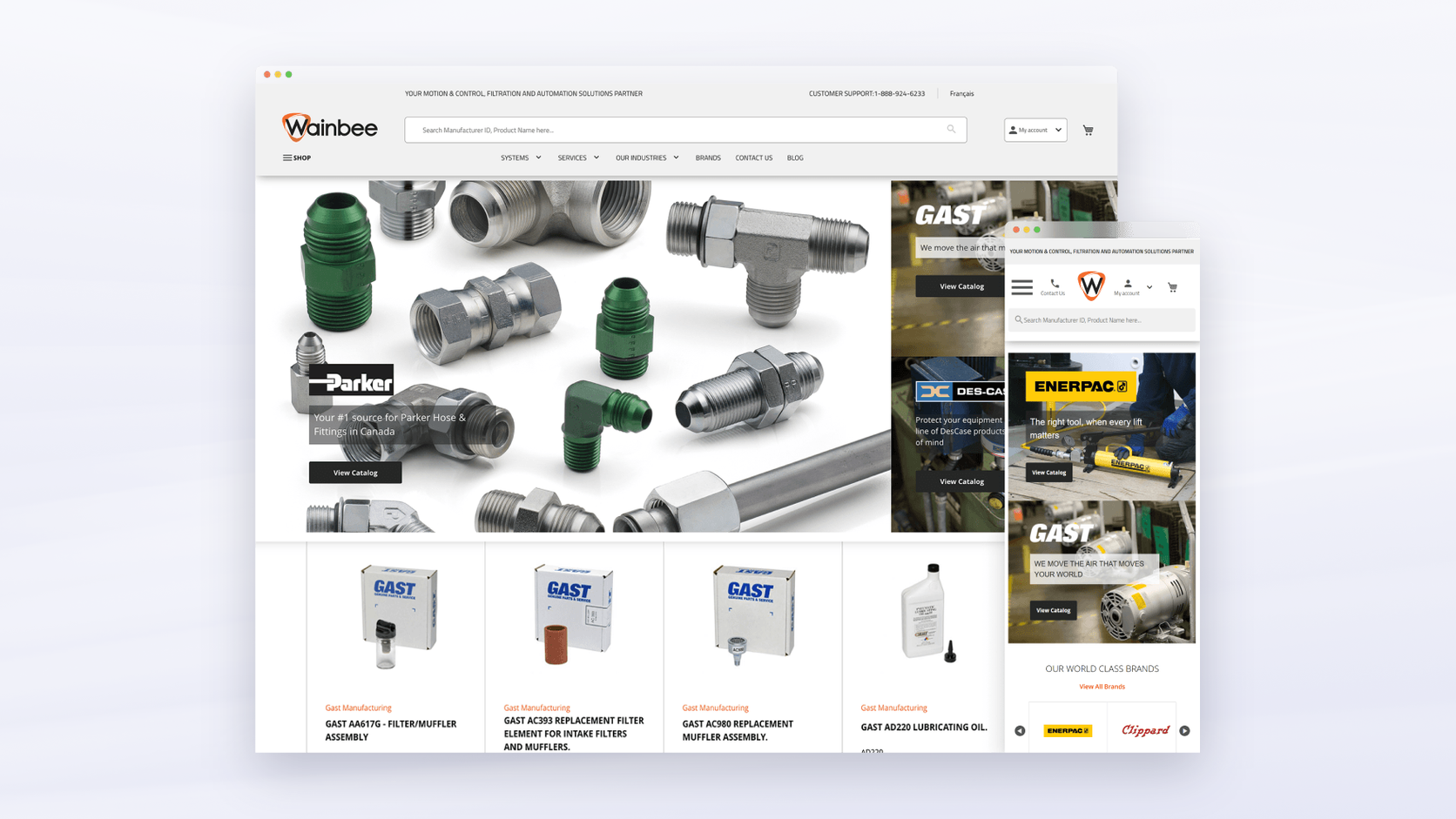
Supplier data is often the bottleneck. Wainbee, the largest distributor of Parker products in Canada, had only 10% of its 600,000+ products online because supplier data arrived as CSV and XLS files with no common structure. A Pimcore PIM connected to the ERP and supplier feeds standardized the formats and put the full catalog online.
Read more: Case Study: Unifying Product Information with Pimcore PIM
Duplicates are the other common problem. Rocket Industrial, a US packaging distributor, had records split between its ERP and Magento 2. Merging duplicates with attribute-based matching grew its unified catalog from 70,000 to 81,000 complete records.
Read more: Case Study: Centralizing Rocket Industrial’s 80K+ Products with Pimcore
If you are choosing a PIM for this, our guides to the best PIM software and PIM and eCommerce integration cover the options and the setup.
FAQ about the digital product passport
Is the digital product passport mandatory?
Yes, but only for product groups covered by a delegated act or a specific EU law, and only from the date that act applies. Batteries are first, from 18 February 2027. Iron and steel, textiles, aluminium, tyres, construction products, furniture, and other groups follow, mostly between 2028 and 2030. Until your product group’s rules apply, a passport is voluntary.
When will textiles need a digital product passport?
The Commission plans to adopt the textiles delegated act in the second half of 2027. Companies then get at least 18 months to comply, so textile and apparel brands should expect the passport requirement from around 2029. The delegated act will set the exact date and the data fields.
Does the DPP apply to companies outside the EU?
Yes. The passport applies to products placed on the EU market, wherever they are made. For products made outside the EU, the importer or the authorised representative takes on the duties of the manufacturer, including creating and registering the passport, so non-EU brands selling into the EU need the data ready too.
Does a digital product passport need a QR code?
The passport needs a data carrier that links the physical product to its digital record, and the Commission names the QR code as the main example. Each delegated act sets the exact carrier and where it goes, on the product, its packaging, or accompanying documents. Online stores also need to give access to the passport before purchase.
Who can see the data in a DPP?
Different users see different parts. Consumers can see public information such as materials, care, and recycling. Repairers and recyclers can see more detailed information when they have a legitimate interest. Public authorities, such as market surveillance, can see compliance information. The battery passport is the first to define these access levels in law.
Do online stores need to show the DPP?
Yes, for products in scope. The Commission’s guidance says online marketplaces will need to make passports accessible when products are sold through distance selling, and retailers need to give customers access as well. In practice, that means a passport link or embedded section on each affected product page, plus the passport identifier in product feeds.
Getting your data ready for the digital product passport
The digital product passport arrives in waves, batteries in 2027 and most other product groups from 2028 to 2030, and every wave depends on the same thing: complete, consistent product data in one place. Map your catalog to the timeline, fix the product data in your PIM, and connect it to your store and feeds. You will meet the passport deadlines with work that also pays off in e-invoicing and AI search.
Not sure how much of your catalog is passport-ready? Tell us which product groups you sell in the EU, and we'll show you where the data gaps are.