
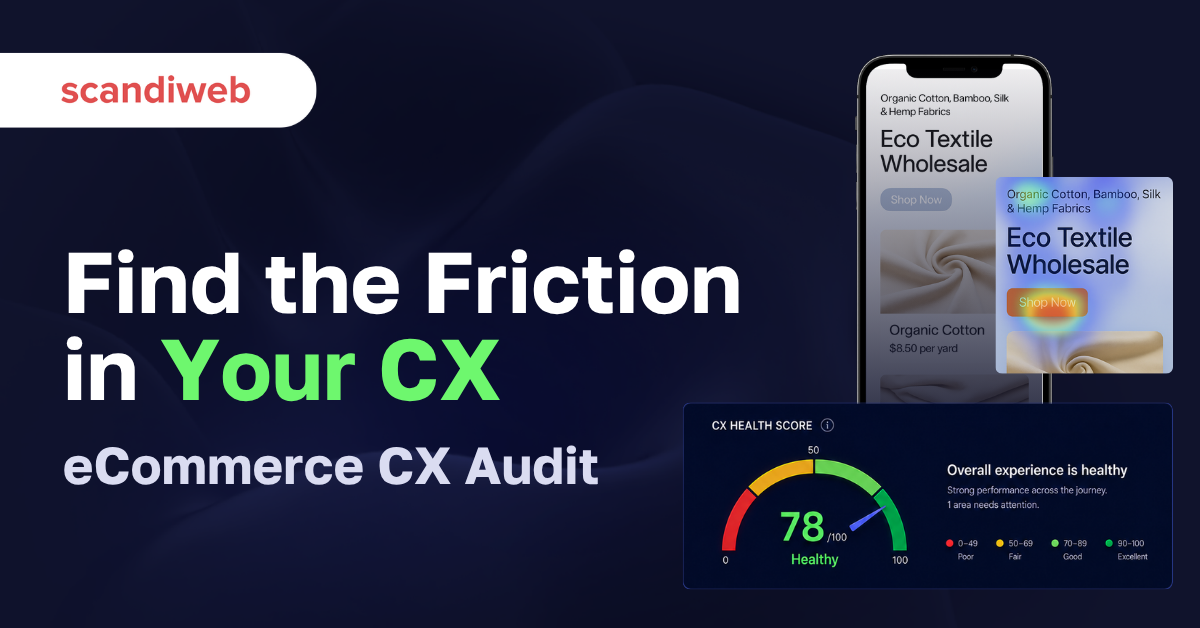
If your conversion rate has flatlined and the obvious fixes (faster pages, cleaner product pages, a shorter checkout) have not moved it, the problem is usually somewhere you have not looked yet. A customer experience audit is how you find it: a structured way to see your store the way your customers actually do, and to locate the friction that analytics alone does not explain.
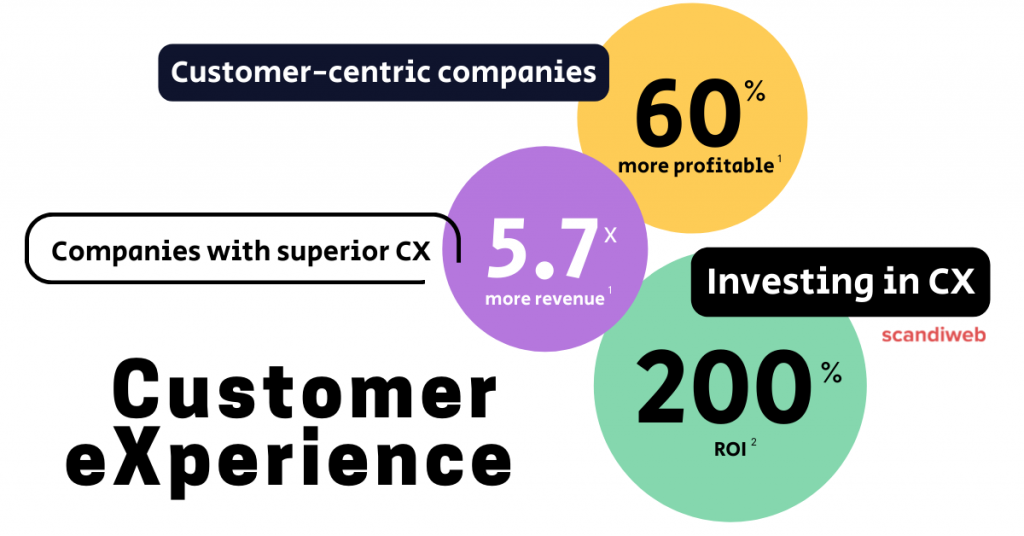
It matters more than it used to. In PwC’s 2025 Customer Experience Survey, 52% of consumers said they stopped buying from a brand after a bad experience, and great experiences still command up to a 16% price premium. The stakes of getting CX wrong are measured in lost customers, the stakes of getting it right, in margin.
Overview
- A CX audit combines quantitative and qualitative analysis to find the gaps between the experience you think you offer and the one customers actually have.
- It runs across seven methods: benchmarking, web data analysis, Voice of the Customer, user testing, micro-conversion funnel mapping, marketing automation review, and a prioritized roadmap.
- The output is not a list of complaints. It is a ranked roadmap of fixes, scored by impact and effort, so the work that ships first is the work that returns the most.
🚀 Quick takeaway
A CX audit is not a survey or a heatmap on its own. It is the discipline of triangulating analytics, customer feedback, and user testing so a single problem shows up in more than one place, which is how you know it is real and worth fixing.
What is good customer experience?
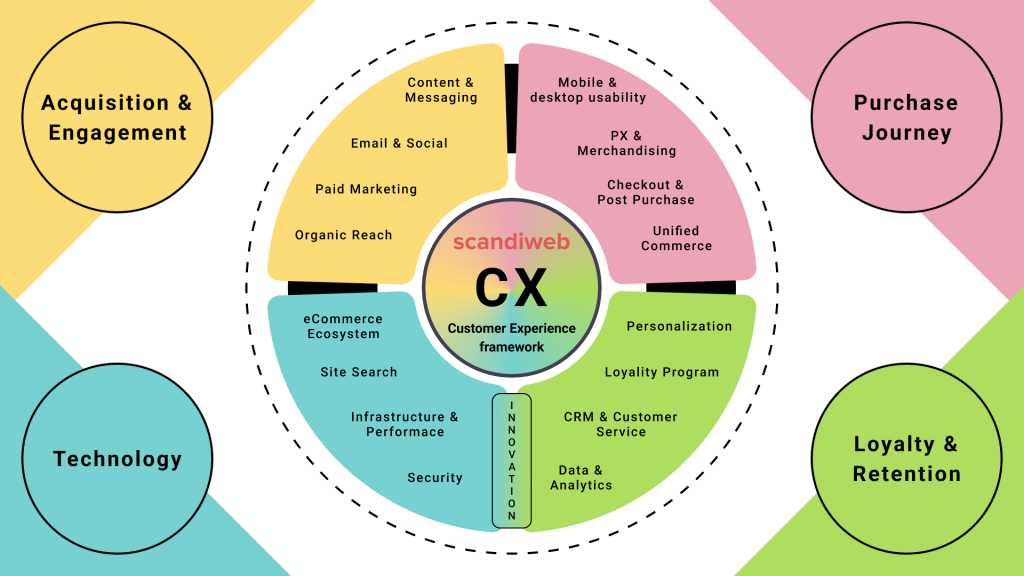
Customer experience is a customer’s overall perception of your brand across every interaction they have with it. In eCommerce, the experience your site delivers can make or break the relationship. Good CX is listening to what customers want, taking their feedback seriously, building a clear understanding of the people who support your brand, and using it to address pain points and reduce friction in the journey. It covers everything from how fast your site loads to how easy it is to request a refund.
What bad customer experience looks like
Bad CX is the opposite, and the usual culprits are specific: poor site navigation, a complicated checkout, incomplete product information, unreliable delivery estimates, and slow or unhelpful customer service. Asking customers directly is the best single way to find these, but it should be paired with other methods to get a complete view. That is what a CX audit provides.
🚀 Quick takeaway
Most CX problems are invisible from the inside. The team that built the checkout knows where to click, so they stop seeing the friction a first-time visitor hits. An audit is how you get an outside read on a journey you are too close to.
What is a CX audit and why do you need it?
A customer experience audit is a structured evaluation that combines quantitative and qualitative data to assess how users behave on your site and where the experience falls short. If you want to improve CX, the first step is to find the gaps in what you currently offer, and a CX audit is how you find them with evidence instead of guesswork.
Why now: rising acquisition costs and cookie-tracking restrictions have made the customers you already have more valuable, and the experience you give them is what decides whether they come back. An audit turns “the site feels clunky” into a ranked list of specific, fixable problems.
🚀 Quick takeaway
A CX audit answers three questions in order: where are the problems (web data), what are they (Voice of the Customer and user testing), and which do we fix first (the prioritized roadmap). Skipping straight to fixes without the first two is how teams ship redesigns that change nothing.
The seven steps of an eCommerce CX audit
Here is how we run a CX audit at scandiweb: what we do at each step, what question it answers, and what you get out of it.
1. Benchmark against eCommerce best practices
We review the entire shopping funnel page by page and benchmark it against a set of eCommerce best practices to see which areas need work and which already perform. The deliverable is a report with an overall eCommerce UX score, suggested improvements backed by examples from retail leaders, and the full list of benchmarks checked.
2. Web data analysis
This answers a single question: where are the problems, and which areas can improve? We run a segmented analysis of the quantitative data in your web analytics, covering users, device and technology performance, eCommerce performance, traffic-source performance, content performance, site-search performance, and user interactions. The deliverable is an analytics report with the analyst’s conclusions and recommendations.
3. Voice of the Customer (VoC)
This answers: what problems are customers actually experiencing? We gather feedback directly from website visitors through Voice of the Customer work, on-site polls and surveys. Every insight, plus full transcripts of the collected data, goes into the report.
4. User testing
We get real people to use the site and voice their concerns and frustrations through a set of tests:
- User interviews
- 5-second tests
- Usability testing
- First-click tests
- Tree testing
- Card sorting
- Eye-tracking
The findings and full transcripts go into the main CX report.
🚀 Quick takeaway
Web data tells you where users drop off, but not why. User testing and VoC supply the why. Run them together, because a drop-off rate without a reason is a number you cannot act on.
5. Micro-conversion funnel mapping
Our conversion rate optimization team maps the micro-conversion funnel to work out where and how to capture lead information before users leave, so you can nurture them later with email and retargeting. With cookie-tracking restrictions tightening, the goal is to build first-party capture that does not depend on third-party cookies. The deliverable is a lead-nurturing strategy and map.
6. Marketing automation review
We review your existing marketing automation stack, recommend the best tools for your setup, and lay out the optimal configuration. The final report includes our recommended automation and personalization strategy.
7. Build the CX roadmap
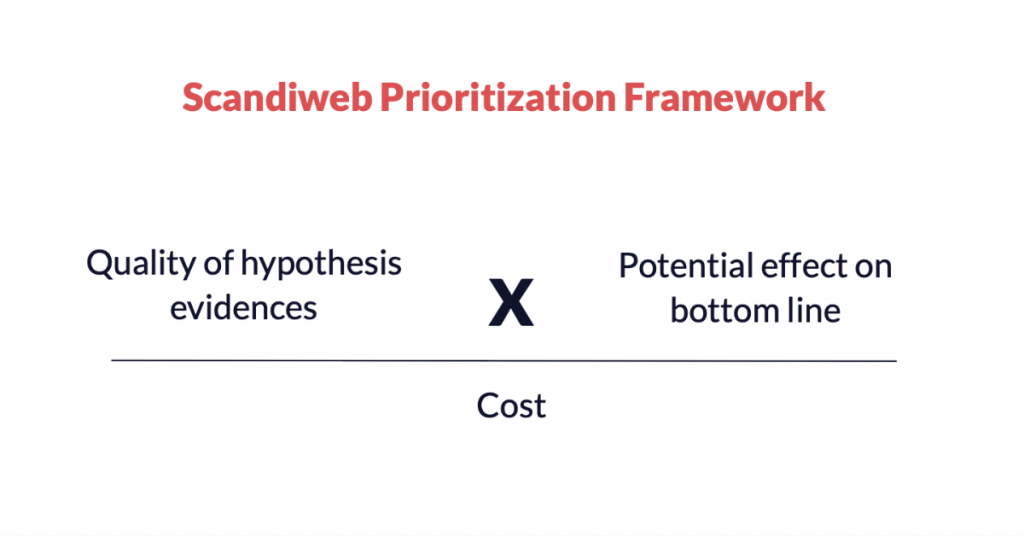
The audit ends in a roadmap, not a report nobody acts on. We start by prioritizing users who have shown buying intent or who stakeholders flag, then lay out concrete tasks: wireframes and designs, copy and content updates, the first A/B or usability tests, and quick-win implementation with developers. Every recommendation runs through the scandiweb Prioritization Framework, so the investment is scored against expected return.
🚀 Quick takeaway
The roadmap is the deliverable that matters. A CX audit that ends in findings is half a project, one that ends in a prioritized, effort-versus-impact roadmap is the half that changes the numbers.
How a CX audit differs by business
A general eCommerce audit is the baseline, but the method adapts. For B2B, the journey spans accounts, quotes, and reorders rather than a single checkout, which is why we run it differently in our B2B customer experience audit. For high-consideration categories like luxury, the experience bar and the signals that matter shift again, as in our CX audit workflow for luxury brands. The seven steps hold, but the benchmarks and weighting change.
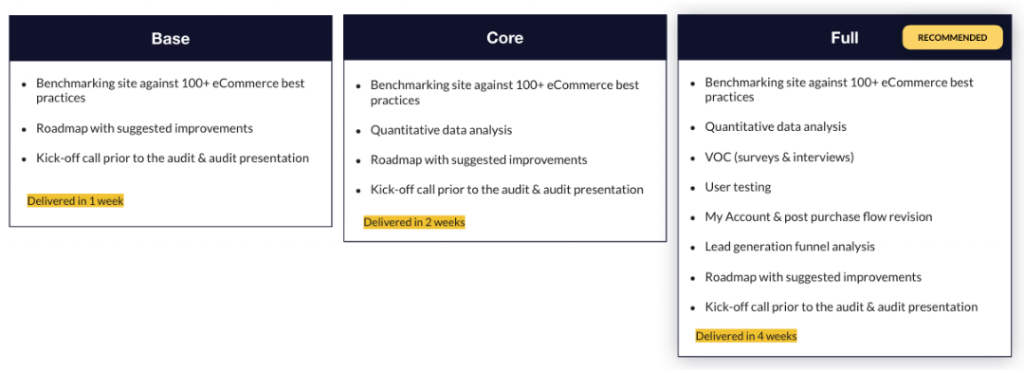
scandiweb CX audit levels
We offer three CX audit levels that vary in depth and scope, from a focused review to a full program across the seven methods above.
Frequently asked questions
What is a customer experience (CX) audit?
A CX audit is a structured evaluation that combines quantitative data (web analytics) and qualitative data (customer feedback and user testing) to find where your site’s experience falls short and which gaps to fix first. The output is a prioritized roadmap, not just a list of issues.
How do you conduct a CX audit?
Run it across seven methods: benchmark against best practices, analyze web data, gather Voice of the Customer feedback, run user testing, map the micro-conversion funnel, review marketing automation, and compile a prioritized roadmap. Each method answers a different question, and together they triangulate the real problems.
What is the difference between a CX audit and a UX audit?
A UX audit focuses on usability and the interface, how easy the site is to use. A CX audit is broader: it covers the whole customer relationship across every touchpoint, including analytics, feedback, support, marketing automation, and retention, not just the on-site interface.
How long does a CX audit take?
It depends on scope. A focused review of a single funnel can take a couple of weeks, while a full audit across all seven methods, including fielding surveys and user tests, typically runs four to six weeks before the roadmap is delivered.
Why does customer experience matter for eCommerce?
Because it directly affects whether customers return. In PwC’s 2025 survey, 52% of consumers said they stopped buying from a brand after a bad experience, and great experiences command up to a 16% price premium. With acquisition costs rising, the experience you give existing customers is often the cheapest growth you have.
What tools are used in a CX audit?
A CX audit uses web analytics for behavior and funnels, on-site survey and polling tools for Voice of the Customer, user-testing platforms for interviews and usability and tree testing, and a prioritization framework to rank the findings into a roadmap.
A flat conversion rate is rarely one big problem, it is usually several small frictions you have stopped noticing. A CX audit finds them before they cost you another quarter. Talk to our CX and CRO team and we will show you where your experience is leaking.