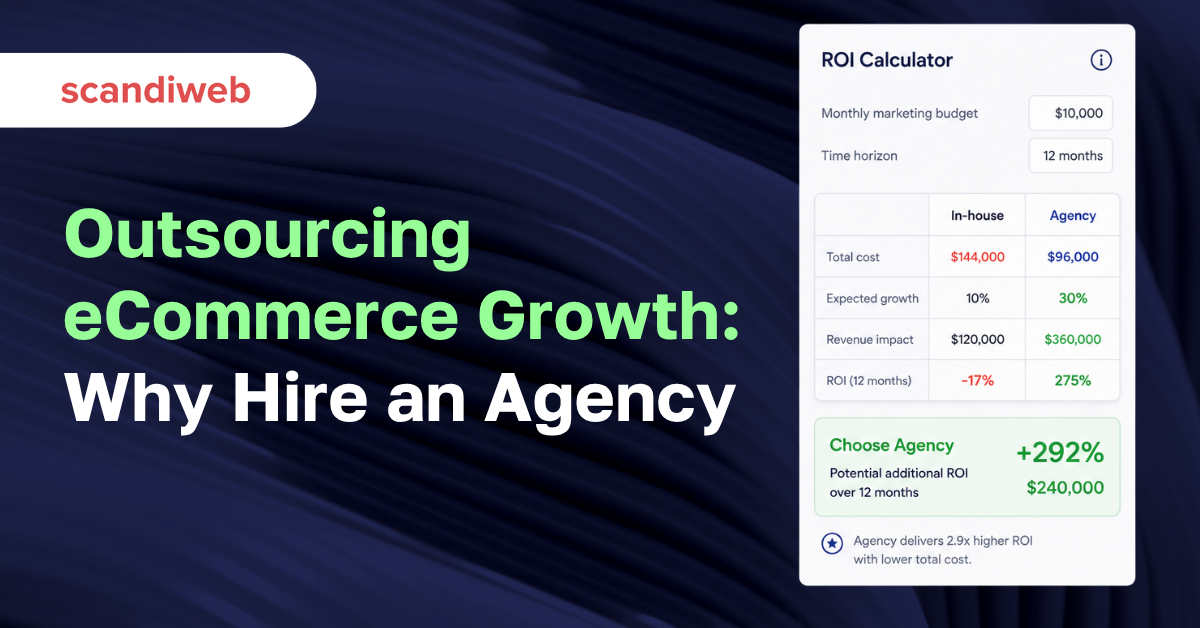
The assumption that hiring in-house is cheaper than hiring an agency tends to fall apart the moment someone runs the actual numbers. A senior eCommerce developer in the US averages $140,000 plus benefits and equity. A senior CRO lead lands near $160,000. A capable SEO strategist sits in the $120,000 range. Add a designer, a paid-media specialist, and a data analyst, and a credible in-house growth team costs north of $850,000 a year before any tooling, recruiter fees, or six-month time-to-productivity is factored in. An agency retainer covering the same disciplines, with deeper certifications and a working playbook from day one, often comes in at a fraction of that, with results compounding from month two instead of month nine.
That is the real question this article answers: when does outsourcing growth to an eCommerce agency make better business sense than building internally, what specifically does an agency deliver that an in-house team cannot, and how do you measure the return.
Overview
- Hiring an eCommerce agency is rarely about access to talent alone, it is about avoiding the 6 to 12-month ramp of an in-house team and getting day-one access to certified specialists across CRO, SEO, paid media, and platform engineering.
- The build-versus-buy math flips toward agencies when the annual loaded cost of an internal team exceeds the projected revenue upside of a 12-month roadmap, or when complexity (multi-region, multi-platform, multi-channel) outpaces in-house capacity.
- The clearest ROI signals come from CRO uplift, faster go-live on new markets and channels, and the opportunity cost of growth not pursued, the last of which most internal teams forget to price.
🚀 Quick takeaway
The case for hiring an eCommerce agency is not “we cannot find people”. It is “we cannot afford to wait nine months for them to ramp, and we cannot match the bench depth of a partner who has run this playbook 600 times before”.
When does hiring an eCommerce agency actually make sense?
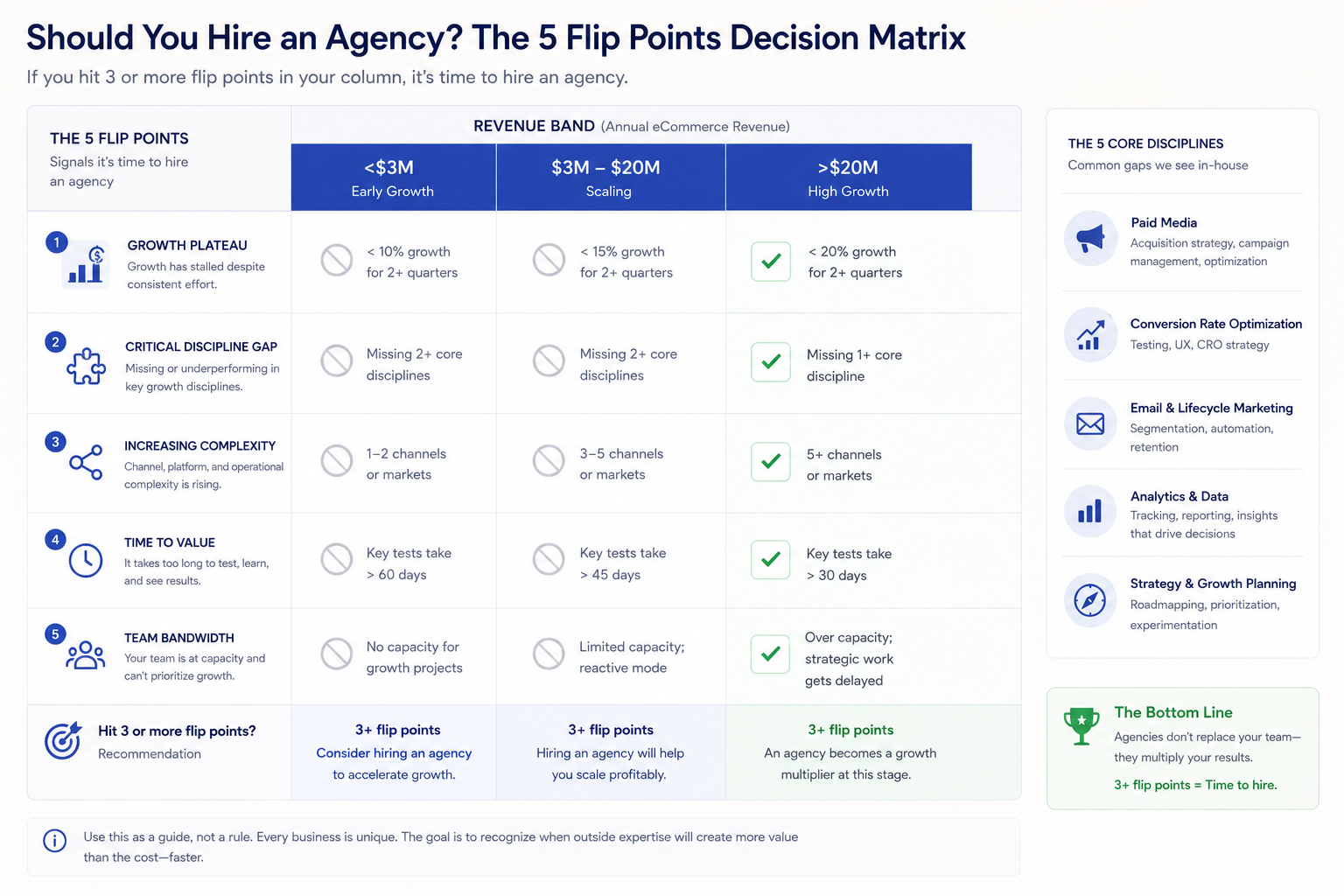
Most growth-stage merchants ask the wrong version of this question. The right one is not “should we have an agency”, it is “at what point does the math flip”. Five concrete triggers tend to make the flip obvious.
- Annual revenue between $5 million and $250 million. Below $5 million, a single full-stack hire often outperforms a retainer. Above $250 million, hybrid models (internal lead plus agency execution) usually win. In between, the all-in cost of an internal team rarely matches what a specialized partner delivers.
- You need three or more disciplines (CRO, SEO, paid, dev, analytics) before next quarter. Hiring all five well takes 12 to 18 months. An agency staffs the same five inside two weeks.
- You are about to launch in a new market or on a new platform. Replatforming, B2B expansion, headless rollouts, and international launches concentrate risk in the first 90 days. Internal teams learn on the job. Agencies have run the same playbook dozens of times.
- Your conversion rate is more than 20 percent below industry benchmark. The global average storewide conversion rate sits at roughly 1.58 percent (Shopify, October 2025). If you are at 0.9 percent or lower, the gap is structural, not tactical. Closing it requires senior CRO capacity most merchants do not have on staff.
- Senior leadership cannot point to who owns growth. When CRO sits in marketing, SEO sits in content, and paid media reports to finance, accountability is already broken. An agency with a single delivery lead resolves the org chart problem before it costs another quarter.
🚀 Quick takeaway
If you can answer “what is our 12-month revenue lift target, and which discipline is the bottleneck” in one sentence, you already know whether to outsource that discipline or hire for it. If you cannot answer it, you are not ready for either.
What is the ROI of an eCommerce agency?
The honest answer is that ROI on agency partnerships is measured across three layers, and most merchants only count the first one.
Layer 1: direct revenue lift. This is the easy math. If a CRO program lifts conversion rate by 20 percent on a site doing $40 million a year, that is $8 million in incremental revenue. scandiweb’s own CRO work has averaged a 48 percent conversion rate increase across clients and generated more than $150 million in extra revenue over the past year (scandiweb CRO and UX services). The number that matters is your number, but a credible partner publishes theirs.
Layer 2: cost-of-talent avoidance. A US-based senior CRO lead, senior SEO strategist, senior developer, designer, paid-media manager, and analyst together cost roughly $850,000 a year loaded, not counting recruiter fees, equity, or the six-month ramp before any of them produces measurable output. A multi-discipline retainer with a partner like scandiweb typically lands between 30 and 50 percent of that, with results inside 60 days and 894 plus active Adobe certifications across the team, a bench depth no individual hire can match.
Layer 3: opportunity cost of growth not pursued. This is the one merchants miss. Every quarter spent recruiting, onboarding, and ramping an internal team is a quarter the roadmap does not move. A typical agency-led headless migration goes live in 12 to 16 weeks. An in-house team building the same project from scratch often takes nine months. The revenue uplift of those missing six months is almost always the largest line item, and it never shows up on a spreadsheet.
A useful frame: take your projected 12-month roadmap, multiply the expected revenue lift by 0.7 (because plans slip), then compare against the loaded annual cost of an internal team plus six months of zero output. The arithmetic usually decides on its own. For comparable benchmarks on agency-led work across paid channels and lifecycle marketing, the digital marketing agency for eCommerce breakdown maps the same logic across specialty disciplines.
🚀 Quick takeaway
ROI is not “did the agency pay for itself in revenue lift”. It is “did the agency cost less than the loaded internal alternative, and did the roadmap go live six months sooner”. Both questions usually answer yes before month four.
What does an eCommerce agency actually do for you?
The short version: an agency replaces a series of half-staffed internal roles with a single contract, a delivery lead, and a bench. The longer version covers nine concrete areas where the value tends to show up first.
1. Managing omnichannel commerce
Running consistent inventory, pricing, content, and customer data across a webstore, marketplaces, social commerce, and physical retail is a coordination problem most internal teams underestimate. Global eCommerce now accounts for roughly 20.5 percent of all retail sales, projected to reach 22.5 percent by 2028 (Shopify Enterprise, 2025). Every percentage point of that growth is contested across more channels than the year before.
An agency with omnichannel experience does the unglamorous integration work: PIM and OMS configuration, inventory synchronization, marketplace listing automation, in-store pickup logic, and the analytics layer that ties channel performance back to a single customer view. The result is a customer who sees the same product, the same price, and the same brand whether they land on TikTok Shop, the homepage, or a store associate’s tablet.
2. International expansion
Cross-border B2B eCommerce alone is forecast to reach $36 trillion in 2026 (trade.gov). The opportunity is the easy part. The hard part is the local payment methods, tax regimes, translation quality, content localization, currency hedging, and logistics that decide whether a launch lands or stalls.
Agencies that have rolled out webstores in 20 plus markets already know the gotchas: which payment gateways work in which region, where VAT or GST handling breaks default platform logic, which translation vendors deliver eCommerce-quality copy versus generic localization, and how to structure URL and hreflang setups so SEO does not get reset on every new market. For platform-specific tradeoffs that surface at the start of any international rollout, the platform comparison breakdown of WooCommerce versus Shopify is a useful starting reference.
3. Adopting new commerce technology
The 2026 tech stack does not look like the 2023 one. AI overviews now influence a meaningful share of product discovery, agentic search assistants are starting to handle full purchase journeys, headless and composable architectures are standard for any merchant above $50 million in revenue, and first-party data has replaced cookie-based targeting as the foundation of paid media performance.
Picking the right stack from this list is a discipline of its own. An eCommerce agency brings opinions earned across hundreds of implementations, knows which AI tooling integrates cleanly with which platforms, and can tell you which “composable” pitches are real and which are marketing wrappers around the same monolith. For deeper platform tradeoffs on the open-source end, scandiweb’s published case work on the Magento agency side covers the architecture questions that arise on any Adobe Commerce program.
4. Customer experience, retention, and marketing automation
Acquisition has gotten expensive enough that retention now does most of the heavy lifting on growth. Short-form video drives 49 percent ROI, the highest of any content format among marketers surveyed for 2026 (HubSpot, 2026 Marketing Statistics). Email still drives 75 percent of marketers to maintain or increase investment year over year. Both work only when the underlying customer data is clean, the segmentation is real, and the automation logic responds to behavior rather than calendar triggers.
An agency operating a marketing automation program for a merchant brings ready-built flows (cart abandonment, post-purchase, replenishment, win-back), the segmentation logic that powers them, and the analytics view that proves which flow paid for itself this quarter and which one quietly leaked margin.
5. Data, analytics, and first-party signals
Data sitting in GA4, Shopify reports, and a CRM does not become decisions on its own. Most merchants have the data and do not have the time, the analyst headcount, or the analytical pipeline to turn it into anything actionable.
Agency analytics work tends to look like this: a clean GA4 implementation, server-side tagging that survives the privacy-rule changes still arriving every quarter, a first-party data layer that does not depend on third-party cookies, and a reporting cadence that ties every channel back to revenue. For the merchants scandiweb works with, this is usually the first thing that gets fixed, because every later decision relies on it.
6. eCommerce support, 24/7
Black Friday weekend is not the time to find out the support team takes weekends off. An agency partner that operates 24/7 across time zones, with documented runbooks for the platform and the integrations layered on top, is the difference between a 20-minute incident and a four-hour outage during a sale.
scandiweb’s eCommerce support services handle proactive monitoring, immediate bug fixes, and the kind of cross-time-zone coverage that catches issues at 3 AM when the internal team is asleep. For merchants running on Adobe Commerce, the same model extends to Magento maintenance, security patches, and the long-tail of third-party module incompatibilities that surface six months after launch.
7. SEO and visibility in the AI-search era
Search visibility in 2026 is no longer just “rank on Google for high-MSV keywords”. It is being cited in AI overviews, surfaced by ChatGPT and Gemini agentic search, recommended inside Perplexity answers, and ranking in traditional SERPs on top of all of that.
The mechanics have shifted to first-party author signals, deep topical authority, structured data, and content that answers questions in the way an LLM can extract cleanly. An agency-led SEO program builds those signals across the entire site rather than article by article, and tracks visibility across search engines, AI search assistants, and discovery surfaces. For an example of the same approach applied to a competitive cluster, top CRO agencies is the format of high-intent, agency-comparison content that performs in both classic SERPs and AI overviews.
8. Paid media
Paid advertising on Google, Meta, TikTok, Amazon, and retail media networks rewards two things: clean first-party data feeding the targeting models, and creative volume that can be tested at speed. Most internal teams have one specialist who handles all channels, optimizes 12 ad sets a week, and runs three creative variants per campaign. An agency typically runs 50 plus campaigns across paid social, search, and retail media simultaneously, with weekly creative refreshes and the analytics infrastructure to attribute revenue back to channel.
9. Conversion rate optimization
CRO is the discipline where the gap between average and senior practitioners shows up the fastest. Average teams test button colors. Senior teams reshape entire funnel stages based on session-replay analysis, qualitative research, and statistically significant experimentation programs.
scandiweb’s CRO work averages a 48 percent conversion rate uplift across clients and has generated more than $150 million in extra revenue over the past year. That is not a function of one hero hire, it is the result of a structured research-test-iterate program run on a roadmap, by a team with 894 plus active certifications and a research library that compounds across every client engaged. The same logic applies to single-platform shops looking for senior optimization capacity, including merchants evaluating Shopify agencies for a focused CRO program on Shopify Plus.
10. UX and design
Mobile commerce is projected to hit $2.4 trillion in 2026, with 9.5 percent compound annual growth through 2034 (Shopify Enterprise, 2025). Digital wallets now drive 66 percent of global spending. A UX program that is not mobile-first and wallet-aware is leaving conversion on the table by default.
Agency design work covers the parts most in-house designers do not have time for: accessibility audits, performance budgets that hold page weight under 250 KB, design systems that survive a rebrand, and component libraries that let merchandising launch campaigns without engineering review for every banner change.
🚀 Quick takeaway
The list above is not a menu. A well-run agency partnership covers most of it under a single retainer, with shared analytics, a shared research base, and a single delivery lead, which is the part most internal teams cannot replicate at any salary band.
How does an agency compare to a freelancer or a single in-house hire?
The choice is not binary between “agency” and “in-house”. It is a triangle: freelancer, single in-house hire, full-service agency. Each has a clear best-fit case.
A freelancer makes sense for a single, well-scoped project with a fixed deliverable, like a one-time SEO audit or a Klaviyo flow rebuild. Costs are predictable, accountability is light, continuity is near zero.
A single in-house hire makes sense once a discipline becomes load-bearing enough that a 40-hour week is not enough, and there is a clear roadmap for the next 18 months to keep them busy. Cost ranges from $90,000 at the junior end to $180,000 plus at the senior end. The risk is ramp time and the bench-depth problem when they go on vacation, get sick, or leave.
A full-service agency makes sense when three or more disciplines are needed at once, when the roadmap is concentrated in the next 12 months, or when complexity (multi-platform, multi-region, multi-channel) outpaces internal capacity. Cost is a monthly retainer with a defined scope, accountability is structural (a single delivery lead, a single SLA), and continuity is built in.
🚀 Quick takeaway
If you cannot keep a single hire busy for 18 months in one discipline, you do not need a hire, you need an agency. If you can keep three full-time hires busy across three disciplines, you might need both, with the agency handling depth-of-bench and the internal team owning institutional knowledge.
Should I hire an eCommerce agency or build the team in-house?
The short answer: build in-house only when the roadmap is concentrated in one or two disciplines, the budget covers 18 months of loaded compensation, and the recruiter has already lined up the first three candidates. Hire an agency in every other case.
The longer answer requires running three numbers. First, the all-in annual cost of the internal team (salary times 1.3 for benefits and overhead, plus tooling, plus recruiter fees of 25 percent of salary, plus six months of zero output during ramp). Second, the comparable agency retainer for the same scope, typically 30 to 50 percent of the internal cost with day-one output. Third, the projected 12-month revenue lift of the roadmap, discounted by 30 percent because plans slip. If the agency option costs less and the revenue lift is above zero, the decision usually answers itself.
The exception is when the work is genuinely proprietary, a custom platform build, a unique data model, an industry-specific compliance regime, in which case internal ownership is non-negotiable. Even then, most merchants still partner with an agency for the implementation phase and transition to internal stewardship once the system is live.
How much does it cost to hire an eCommerce agency?
Agency retainers vary widely by scope, geography, and platform. A realistic range for full-service eCommerce growth retainers in 2026 sits between $8,000 and $40,000 a month, with most mid-market merchants landing around $15,000 to $25,000 for a multi-discipline scope that covers CRO, paid media, SEO, and a fractional development resource. Specialist single-discipline retainers (paid media only, SEO only) typically run $4,000 to $12,000.
The number to compare against is not “what does in-house cost”, it is “what does in-house cost loaded, including ramp time and bench depth”. Most internal teams cost three to five times the equivalent agency retainer once those factors are priced in.
How do I know an eCommerce agency is delivering ROI?
Three signals to watch in the first six months.
- Month two: leading indicators improve. Conversion rate, average order value, organic impressions, paid media efficiency, or retention rate, whichever is the agreed primary metric, should show movement inside 60 days. Not headline movement, but directional movement.
- Month four: the roadmap is moving. Tests are running, campaigns are live, content is published, the platform changes are in staging. If the roadmap has not started moving by month four, the partnership is in trouble.
- Month six: revenue impact is measurable. The numbers need to clear the cost of the retainer plus a healthy margin. If they do not, either the scope is wrong, the targets were unrealistic, or the partnership is not the right fit. Most credible agencies will address all three on a call rather than wait for a renewal conversation.
🚀 Quick takeaway
“Are we paying for this” is the wrong question at month two. The right question is “are the leading indicators moving in the right direction”. Revenue is a lagging indicator, by the time it has not moved, the program has been broken for a quarter.
Wrapping up: the decision framework
The case for hiring an eCommerce agency comes down to three questions. Can you afford to wait six to nine months while an internal team ramps? Can you match the bench depth, certification count, and done-it-before experience of a partner who has run this playbook hundreds of times? Can you tolerate the opportunity cost of every quarter the roadmap does not move?
If any of those answers is no, the math has already decided. The remaining question is which partner, on what scope, and with what success metrics, which is the work of the next conversation, not this article. Already past the “why” and into “how”, the step-by-step hiring guide walks through vetting, scoping, and contracting an agency from first call to signed statement of work.
scandiweb has been in this work for more than 20 years, with 500 plus active clients, 600 plus team members, and 894 plus active Adobe certifications. The proof points (48 percent average conversion rate uplift, $150 million in incremental revenue across last year’s CRO program) are published openly on the Conversion Rate Optimization and Enterprise SEO service pages, with the case studies behind them.
Frequently asked questions
Why hire an eCommerce agency instead of building an in-house team?
An agency provides day-one access to senior specialists across CRO, SEO, paid media, and platform engineering at typically 30 to 50 percent of the loaded annual cost of an equivalent in-house team. The math flips toward an agency in most cases between $5 million and $250 million in annual revenue, where the ramp time, bench depth, and opportunity cost of an internal build outweigh the savings.
What are the main reasons to hire an eCommerce agency?
The four most common are: needing three or more disciplines at once (CRO, SEO, paid, development), launching in a new market or platform within 12 months, closing a structural conversion rate gap (more than 20 percent below benchmark), and resolving an org-chart problem where no one currently owns growth. Any one of those usually makes an agency the better economic choice.
How is the ROI of an eCommerce agency measured?
Three layers: direct revenue lift (conversion rate, AOV, retention), cost-of-talent avoidance versus an equivalent in-house team, and opportunity cost of growth not pursued during a six-to-nine-month internal ramp. The first is easy to measure, the second is straightforward arithmetic, the third is the one most merchants underestimate.
Agency versus freelancer for eCommerce, which is better?
A freelancer fits a single, well-scoped project with a fixed deliverable. An agency fits ongoing, multi-discipline work where continuity, bench depth, and a single accountable delivery lead matter. The clearest test: if you can describe the scope in one paragraph and finish it in 30 days, a freelancer is enough. If the scope spans three disciplines and 12 months, hire an agency.
How much does it cost to hire an eCommerce agency in 2026?
Full-service retainers typically run $8,000 to $40,000 a month, with most mid-market merchants between $15,000 and $25,000 for a multi-discipline scope. Specialist single-discipline retainers (paid media only, SEO only) run $4,000 to $12,000. Compare against the loaded annual cost of an internal team, not just headcount salaries.
When is it too early to hire an eCommerce agency?
Below $5 million in annual revenue, a single full-stack hire usually outperforms an agency retainer because the scope is small enough for one capable person to cover. Above $5 million, multi-discipline retainers start to win. Above $250 million, a hybrid model (internal lead plus agency execution) usually wins.
How long does an eCommerce agency partnership typically last?
Most credible retainers run 6 to 24 months, with the first 90 days dedicated to discovery, instrumentation, and a measurable first win, and the remaining months focused on roadmap execution. One-time projects (replatforming, audits, site builds) are shorter and scoped separately from ongoing retainers.
Decide where outsourcing earns its keep, then talk to our delivery team about scoping a partnership around your numbers and your roadmap.