
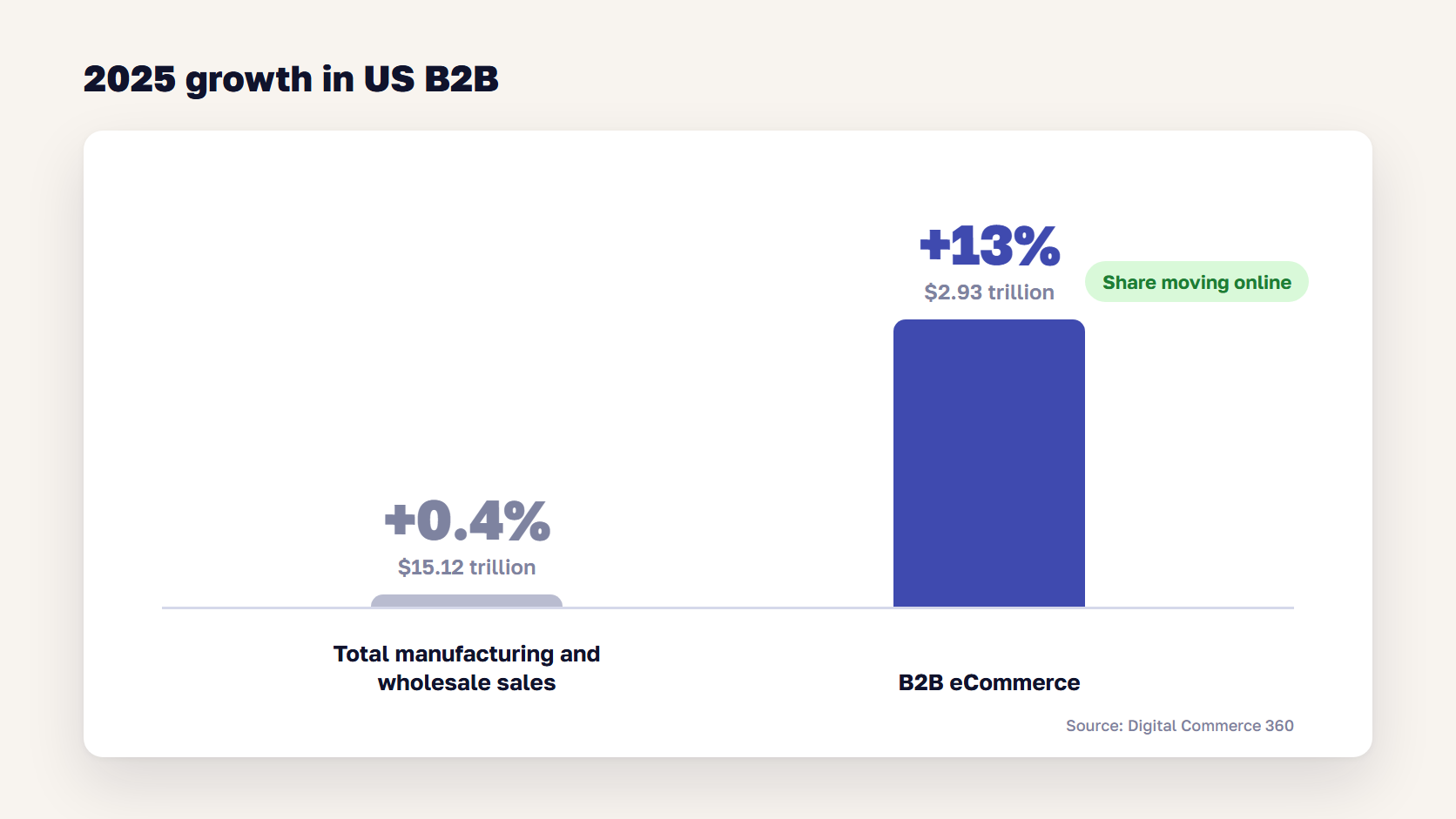
If you’re writing next year’s digital budget for a manufacturer or distributor, two numbers from 2025 should frame it. US manufacturing and wholesale sales grew 0.4%, to $15.12 trillion. B2B eCommerce grew 13%, to $2.93 trillion. With the market that flat, almost all of that 13% was orders changing channel: orders that used to arrive by phone, email, fax, or through a rep, and some of them went to a competitor or to Amazon Business on the way.
Each B2B eCommerce trend below is a place where that share moves in 2027, with the data behind it and the first thing to fix. We build B2B stores on Magento (Adobe Commerce), connect them to ERPs, and run growth marketing for manufacturers and distributors, so the list leans on what we see after a B2B portal goes live, when most of the hard work starts.
The B2B eCommerce trends that matter in 2027
The biggest B2B eCommerce trends for 2027 are a share fight inside a flat market, Amazon Business taking tail spend, AI tools building vendor shortlists before buyers call anyone, product pages becoming the data AI reads, AI agents arriving on the seller’s side first, sales reps becoming validators, customer adoption after go-live, and EU rules forcing structured product and invoice data.
| Trend | The number behind it | First move for 2027 |
|---|---|---|
| 1. Growth is a share fight | Total US B2B sales +0.4%, B2B eCommerce +13% (2025) | Measure the share of accounts that ordered online at least once |
| 2. Amazon Business takes tail spend | $60 billion annualized, 11 million+ organizations | Check the products your customers buy elsewhere |
| 3. AI builds the shortlist | 92% of B2B buyers say AI shaped their vendor shortlist | Ask ChatGPT about your top 20 products |
| 4. Product pages feed AI | Wainbee went from 10% to 100% of 600,000+ products online | Publish specs, compatibility, and substitutes |
| 5. Agents start on the seller’s side | Best AI agent passed 61.7% of real merchant tasks | Automate one document flow, such as invoice matching |
| 6. Reps become validators | 67% prefer no rep, 69% use reps to check AI answers | Make the web price, the quote, and the invoice match |
| 7. Adoption is the project | 72% of suppliers think sales is automated, 47% of buyers agree | Plan onboarding for each account after go-live |
| 8. EU rules force structured data | Battery passport mandatory from 18 February 2027 | Run e-invoicing and DPP data as one project |
1. B2B eCommerce growth is a share fight
B2B eCommerce growth in 2027 will come mostly from orders moving out of offline channels into digital ones, inside a market that barely grows. US manufacturing and wholesale distribution sales reached $15.12 trillion in 2025, up 0.4%, after 1% growth in 2024 and 0.4% in 2023, according to Digital Commerce 360. The same publisher’s B2B report puts eCommerce at $2.93 trillion for 2025, up 13%.
For a distributor, that turns every channel decision into a share decision. An order that moves online either stays with you through a better channel, or it leaves for a supplier whose portal, marketplace listing, or procurement integration is easier to use.
Platforms are moving the same way. Shopify reported B2B GMV growth of 76% YoY in Q2 2026 and has extended its native B2B features beyond the Plus plan. Launching simple wholesale is getting cheaper every year, so the advantage shifts to what competitors can’t copy quickly: your pricing logic and the quality of your product data.
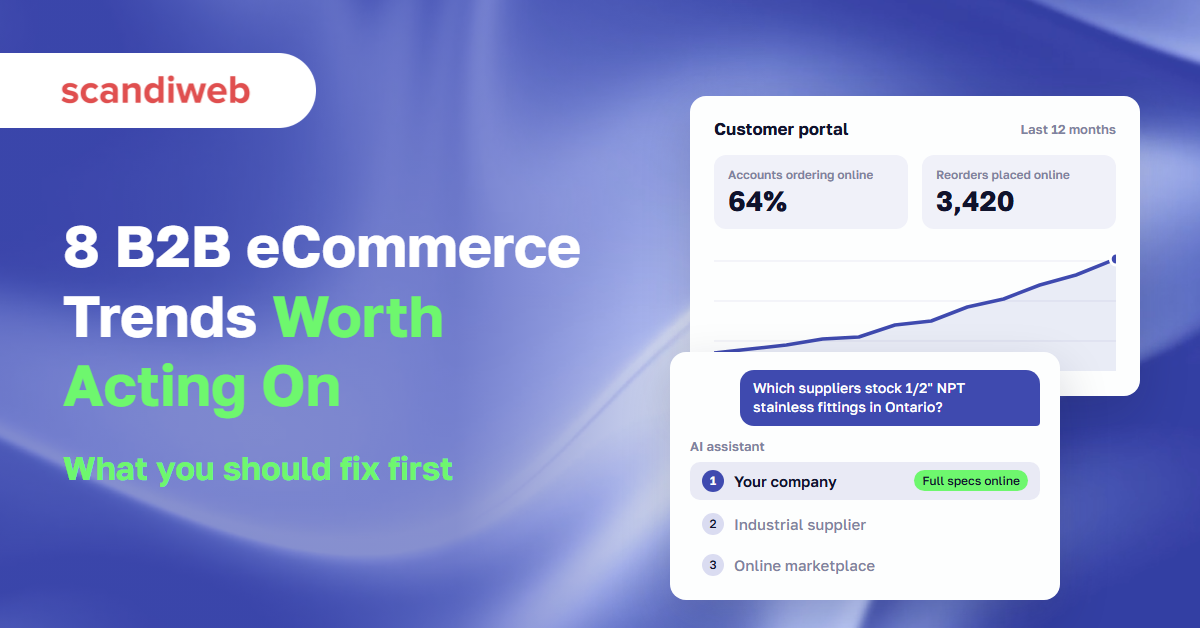
Test for your team: what share of your active accounts placed at least one order online in the last 12 months? If nobody can answer within a day, start there.
🚀 Quick takeaway
In a flat market, every order your portal fails to capture is an order a competitor or a marketplace can take. Decide which channel should own each customer’s reorders and fund that channel first.
2. Amazon Business is taking tail spend
Amazon Business reached $60 billion in annualized gross sales in Q2 2026 and serves more than 11 million organizations, with 1.8 million added in the first half of the year, Amazon announced in July. Much of that growth is tail spend: small, unplanned purchases that never went through a contract.
Tail spend used to be easy margin for mid-size distributors. A maintenance manager needed gloves or a fitting, called the usual supplier, and paid list price. Today the same manager opens Amazon Business, sees next-day delivery, and pays with a company card. Amazon says 97 of the Fortune 100 use the service, so procurement teams at your largest customers already have an account.
Fastenal shows what the other side looks like. Its digital footprint reached 61.6% of sales in Q2 2026, and 44.6% of total sales came through vending machines and bins installed at customer sites, according to Digital Commerce 360. Most of Fastenal’s digital revenue never touches a website: customers reorder from a machine on their own shop floor.
Test for your team: pick 20 SKUs your customers often buy in small quantities. Search each one on Amazon Business and compare price, delivery time, and the number of clicks to buy. If marketplaces are part of your answer, our guide to marketplace integrations covers how to sell there without losing control of price and stock.
3. AI builds the vendor shortlist before anyone calls you
AI in B2B eCommerce now decides which suppliers reach the shortlist, often before a buyer opens a single supplier website. In a Semrush survey of 622 US B2B professionals in spring 2026, 66% said they regularly use AI to research vendors, 92% said AI had shaped their vendor shortlist, and 97% had found a vendor they didn’t know about through AI. Semrush sells SEO tools, so read the exact numbers with care. Gartner’s research points the same way: 45% of B2B buyers used AI in a recent purchase.
The shortlist matters because buyers rarely leave it. 6sense’s 2025 Buyer Experience Report found that 94% of buying groups rank their preferred vendors before first contact, and they buy from that favorite 77% of the time. By the time buyers speak to a seller, they are 61% of the way through the B2B buyer journey.
A buyer asks ChatGPT or Gemini which suppliers carry a part, which ones ship to their region, and which hold the certification they need. The answer becomes the shortlist. If your catalog, certifications, and coverage can’t be read by those tools, you are out before the RFQ is written.
It works the other way too. Enviropack, a UK supplier of eco-friendly food packaging, aligned its SEO and Google Business Profile copy with the words buyers use when they shortlist suppliers. It started appearing in ChatGPT and Perplexity answers for prompts such as “eco-friendly food packaging suppliers in the UK”, and sessions from ChatGPT grew 110% in three months.
Read more: How AEO Helped Enviropack Become a Top AI Pick for Sustainable Packaging
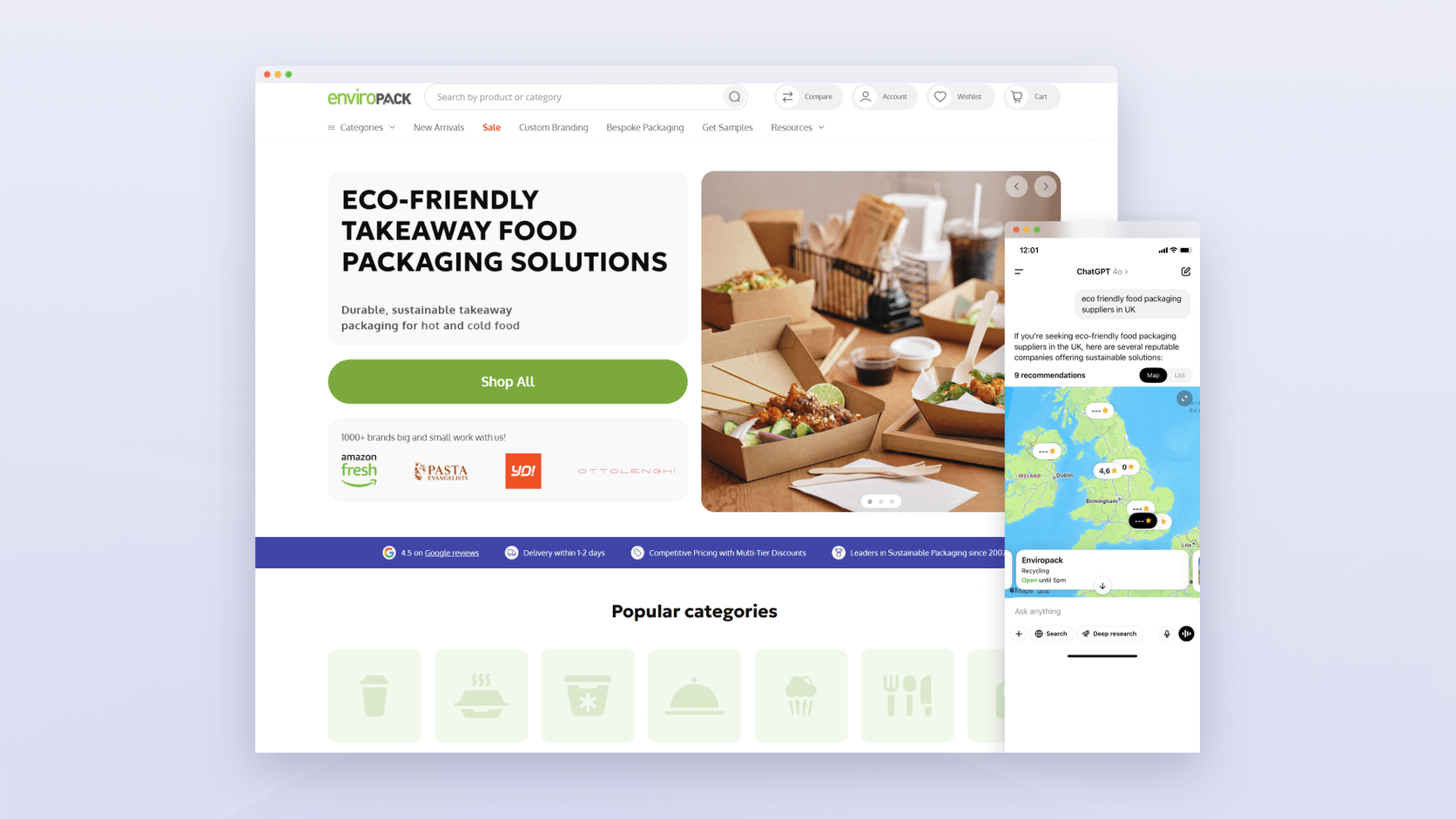
Test for your team: ask ChatGPT, Gemini, and Perplexity the questions a new customer would ask about your top 20 products, and note which suppliers get named. Our AI search optimization team runs this across hundreds of prompts, but a manual pass on 20 products already shows where you stand. For a repeatable method, see how to track brand mentions in LLMs.
🚀 Quick takeaway
In B2B, AI visibility decides who reaches the shortlist, and buyers pick their early favorite 77% of the time. One mention at the research stage can matter more than a month of clicks later.
4. Product pages become the source AI reads
Search engines and AI assistants now recommend suppliers from what they can read on product pages and feeds, so anything behind a login or missing from the page is invisible to them. Many B2B sites still hide the catalog, specs, and documents behind a customer login. Google can’t crawl those pages, and neither can ChatGPT.
The traffic that does arrive is improving. Adobe reported that AI-referred visits to US retail sites converted 42% better than other traffic in March 2026, a year after converting 38% worse. That is retail data, not B2B, but Adobe’s other finding applies to industrial catalogs too: a large share of product pages are hard for AI tools to read.
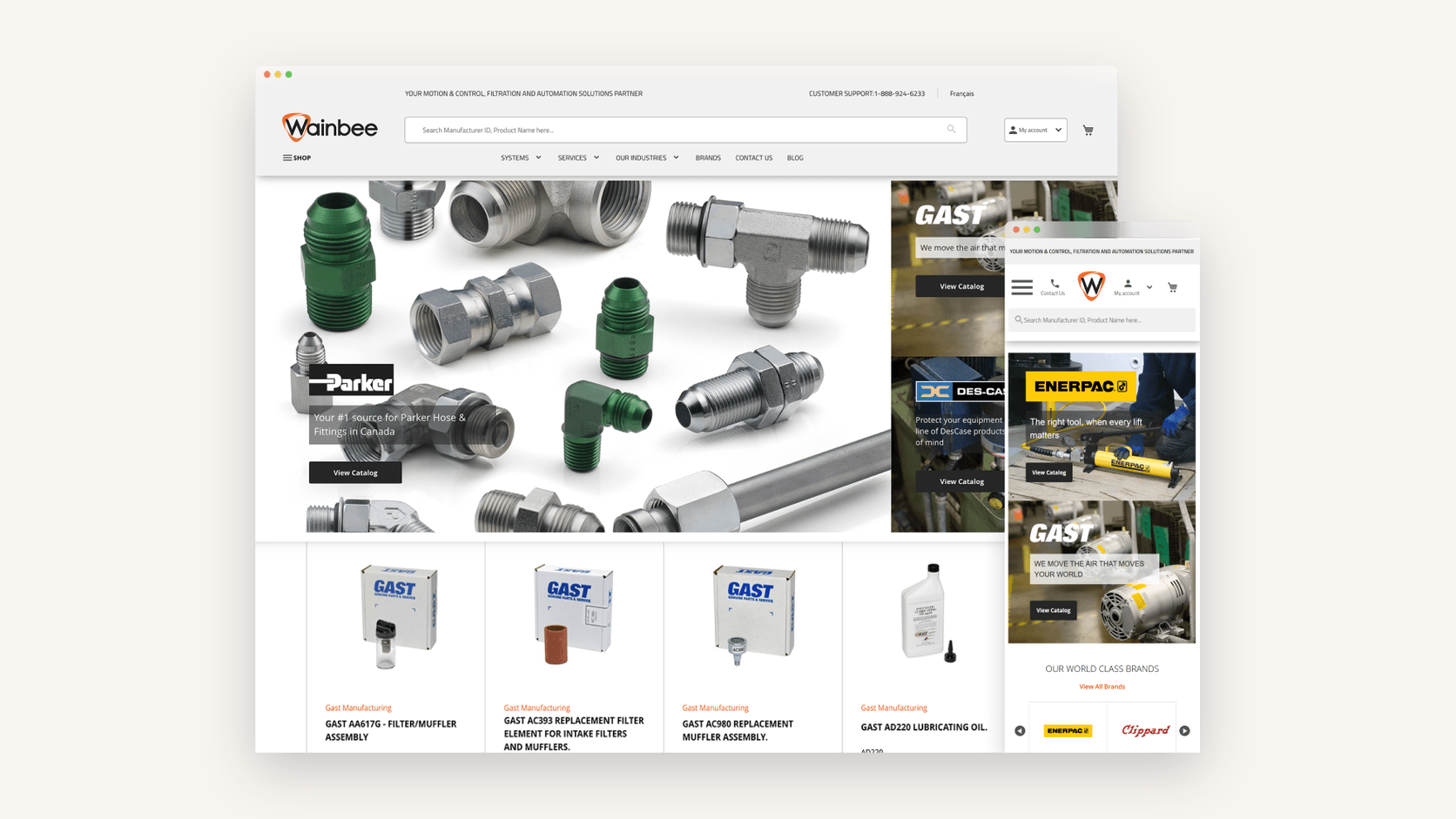
The fix usually starts in product data. Wainbee, the largest distributor of Parker products in Canada, had only 10% of its 600,000+ products online because supplier data arrived as CSV and XLS files with no common structure. We connected a Pimcore PIM to its ERP and supplier feeds, standardized the formats, and got the full catalog online. Our guide to PIM and eCommerce integration explains how that setup works.
Read more: Case Study: Unifying Product Information with Pimcore PIM
The same work protects knowledge you are about to lose. Your senior reps know which belt replaces which, which fitting is compatible with which pump, and what to offer when an item is out of stock. Publish that as structured product data and AI assistants can recommend you with it, and it stays in the business after those reps retire.
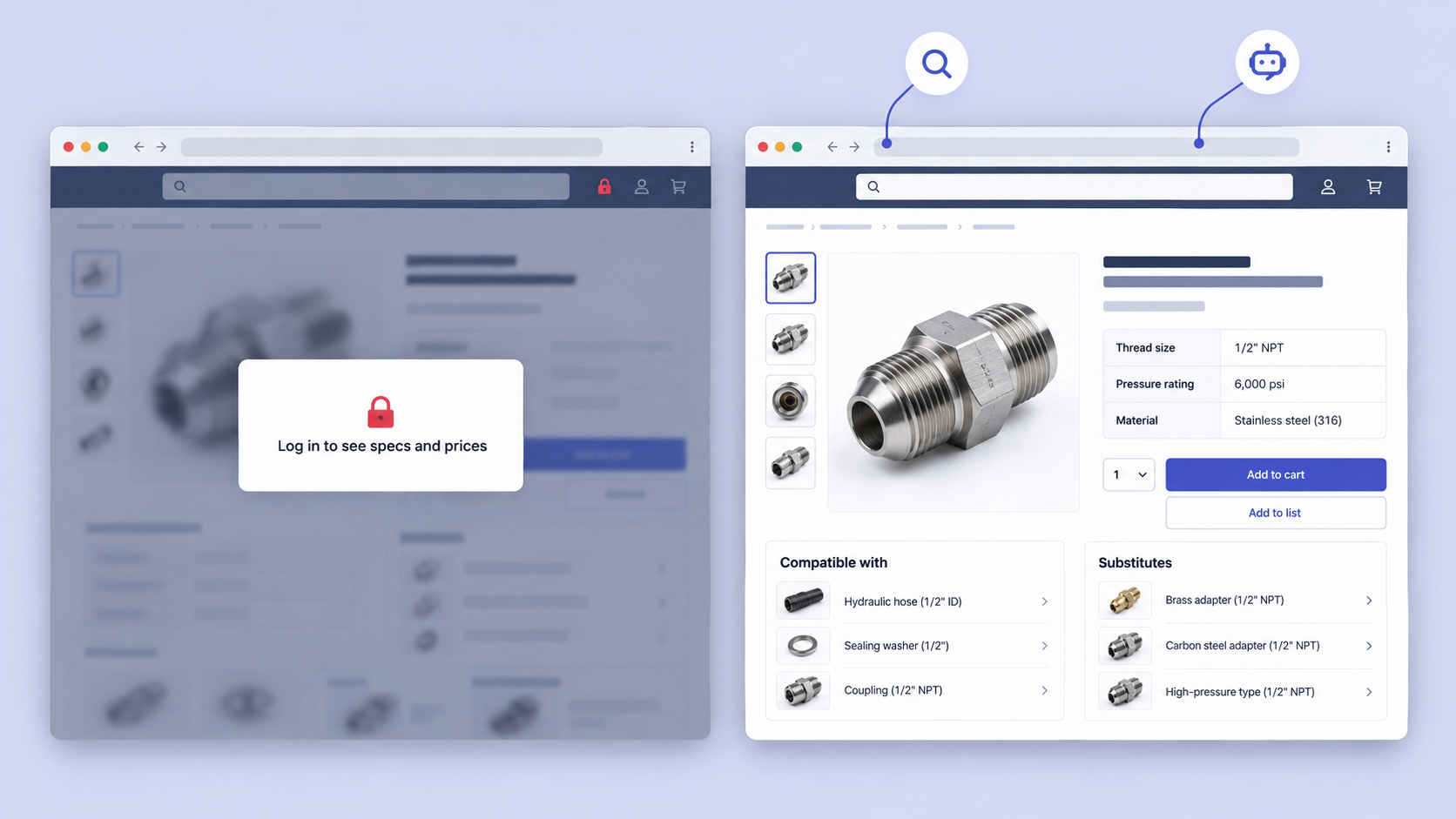
Test for your team: list the 20 questions your reps answer most often. Check how many of the answers appear on your public product pages and in your product feeds.
🚀 Quick takeaway
The project that makes your catalog readable for AI also captures what your senior reps know, so one product data project covers two risks.
5. AI agents work on the seller’s side first
The fastest returns from agentic commerce in 2027 will come from AI agents that work for the seller: order intake, invoice matching, and quoting. Buyer-side agents that place orders on a customer’s behalf are not ready for B2B yet.
Three developments from 2026 explain why. OpenAI scaled back Instant Checkout in March and refocused ChatGPT shopping on discovery, with purchases moving back to merchants’ own checkouts, as AI Business reported. Alibaba’s CommerceAgentBench tested 13 AI models on 107 real merchant tasks, and the best one passed 61.7%, failing on landed costs, return disputes, and multi-leg shipping, according to PYMNTS. The buyer-side protocols, including OpenAI’s Agentic Commerce Protocol and Google’s Universal Commerce Protocol, were designed around a consumer checkout. Contract pricing, account hierarchies, approval chains, purchase orders, and net terms are the core of B2B buying, and these protocols don’t yet give them a standard place.
The seller’s side has none of those problems. A distributor receives orders by email and PDF, supplier invoices in dozens of layouts, and quote requests that need someone to check stock and price. The work repeats, follows rules, and uses data the ERP already holds. If your ERP is Dynamics NAV, see what the move to Business Central means for this kind of automation. One wholesaler we work with on Microsoft Dynamics NAV now matches 87% of supplier invoices to purchase orders with nobody touching them, using OperaLayer. Staff review only the exceptions.
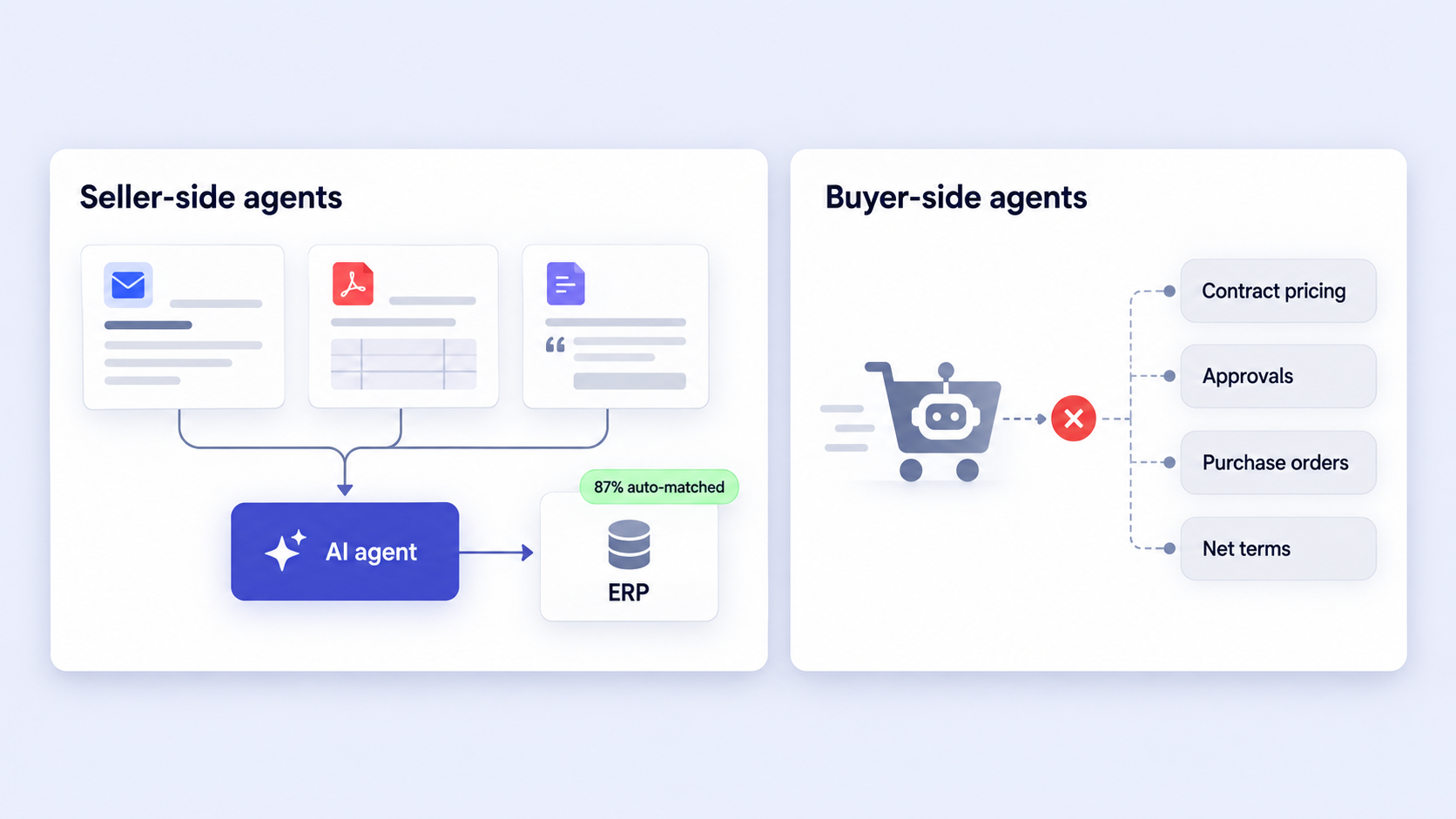
For more on how the buyer-side protocols work, see our guide to agentic commerce. If you want agents to read your catalog and prices directly, a Magento MCP server is one way to give them access under your own rules.
Test for your team: pick one document flow, such as supplier invoices or email orders. Count how many documents arrive each month and how many minutes each one takes by hand.
🚀 Quick takeaway
For a B2B seller, agent-ready means clean product data, pricing APIs that know which customer is asking, and an MCP endpoint an agent can call. A checkout button inside a chatbot can wait.
6. The sales rep becomes the validator
B2B buyers want to research and buy on their own, and they still use reps to check what AI told them. In a Gartner survey of 646 B2B buyers, 67% said they prefer a rep-free experience. In a second release from the same research, 69% said they prefer to validate AI-generated insights with a sales rep.
That gives the rep a new job: confirming what the buyer already found. The job only works when the rep, the website, and the invoice agree. McKinsey’s 2026 B2B Pulse survey of nearly 4,000 decision-makers names inconsistent information and a lack of knowledgeable support as leading reasons buyers switch suppliers. When the web price, the quote, and the invoice show different numbers, the buyer stops trusting any of them.
Macron, the teamwear and sports apparel brand, gave its team a “shop as a customer” feature on Adobe Commerce. Staff log in as a partner account and help with bulk and custom orders using the same prices and catalog the customer sees. With SAP integration for real-time stock, Macron cut order creation time by 40%.
Read more: Case Study: Macron’s B2B Platform Evolution with Adobe Commerce
BK-Group, a security equipment distributor in the Baltics and Poland, solved the same problem at the data layer. Its Magento and Hyvä store shows customer-specific prices that Pimcore pulls from the ERP every few minutes, and checks each customer’s stock through the ERP API on the product page and again at checkout.
Read more: Case Study: Merging Two Markets on Magento+Hyvä for a Multinational B2B Supplier
Test for your team: take three recent orders and compare the price on the website, in the rep’s quote, and on the invoice. Every mismatch gives a buyer a reason to call someone else.
🚀 Quick takeaway
Inconsistent prices are a data problem that shows up as a sales problem. Fix the price logic in one place, usually the ERP, and let the portal, the quote, and the invoice read from it.
7. Customer adoption is the real project after go-live
The hardest part of B2B eCommerce in 2027 is getting existing customers to use the B2B customer portal you already have. Suppliers tend to overrate their progress. In a Deloitte Digital study of 530 US B2B suppliers and 530 buyers, 72% of suppliers said their sales processes are mostly or highly automated, and only 47% of buyers agreed. Suppliers also estimated they lose 13% of bids to a poor buying experience.
Most B2B projects we are asked to rescue have a working platform. What they lack is a plan for the 12 months after launch:
- Onboarding by account. Each large customer gets a setup session, its own price list loaded, and a saved reorder list on day one.
- Reorder prompts. Customers with predictable consumption get reminders based on their real order history.
- A rep-assisted first order. The rep places the first online order together with the buyer, so the buyer sees their prices and history in the portal.
- Commission that does not punish the rep. If reps lose commission when their customers order online, they will keep taking orders by phone.
- Service beyond the cart. Order status, invoices, delivery documents, and returns in the portal give buyers a reason to log in when they are not buying.
Track two numbers from month one: the share of each account’s orders placed online and the number of returning visitors. Macron’s returning visitors grew 32.8% after its rebuild.
Adoption also depends on how quickly the portal earns trust. advancedlife, Australia’s national school photography company, replaced five disconnected systems with one portal for schools, parents, and its own operations team. It launched in 14 weeks, before its busiest season, and support volume dropped 95% after go-live.
Read more: School Photography Commerce: Production-Ready Platform in 14 Weeks

For more examples of portals customers actually use, see these B2B design case studies and our list of the best B2B eCommerce websites. If you are planning this phase now, our B2B eCommerce solutions page shows how we approach it.
🚀 Quick takeaway
Go-live is day 0. Your existing customer list is the highest-return channel you have, and nobody moves it online unless someone owns that job.
8. European regulation pays for structured data
European regulation is forcing B2B sellers to build the structured product and invoice data that AI agents also need. If you sell in the EU, part of your 2027 data budget is already decided.
| Rule | What it requires | Date |
|---|---|---|
| E-invoicing, Belgium | Structured B2B e-invoices via Peppol | Since 1 January 2026 |
| E-invoicing, Poland (KSeF) | Central e-invoicing for large taxpayers, then everyone else | 1 February and 1 April 2026 |
| E-invoicing, France | All businesses receive e-invoices, large and mid-size companies issue them | 1 September 2026 |
| E-invoicing, Germany | Structured invoices from companies above €800,000 turnover | 1 January 2027 |
| Digital Product Passport | Battery passport mandatory, other product groups follow | 18 February 2027 |
| EU AI Act | Tell users when they are dealing with an AI system | Since 2 August 2026 |
Sources: SPS Commerce for e-invoicing and iPoint for the Digital Product Passport registry.
E-invoicing puts your order-to-invoice data into a machine-readable format. The digital product passport does the same for product data, one product group at a time. An AI agent needs exactly these inputs to quote, order, and reconcile without a person, so run both as one data project with one owner. For the transparency rules that apply to chat assistants on eCommerce sites, see our EU AI Act FAQ.
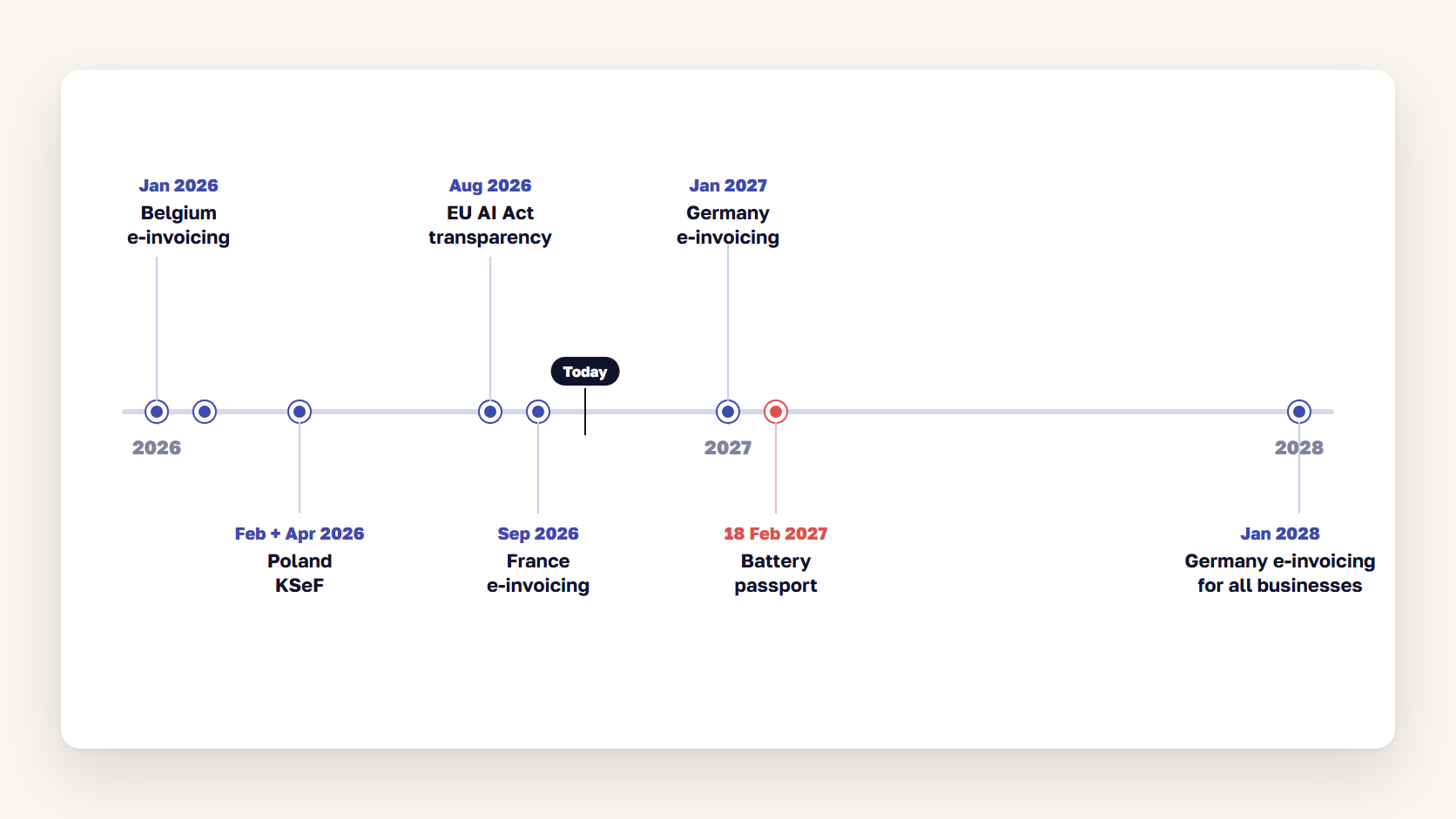
Test for your team: list every EU mandate that touches your product or invoice data in the next 18 months, and check whether one team owns all of them.
Which B2B eCommerce trend to act on first
Most manufacturers and distributors should start with their existing customers, because adoption and price consistency pay back fastest and the other trends build on them. Start with being found by new buyers when your existing accounts already order online and growth depends on winning new ones.
Start with your existing customers if:
- You have a B2B portal, and fewer than half of your active accounts ordered through it last year.
- Your web prices, rep quotes, and invoices disagree more than once a month.
- Your reps still re-key email and PDF orders into the ERP.
- You lose small, repeat orders to Amazon Business or a faster competitor.
- Your ERP holds the contract prices, and the portal shows something else.
Start with being found by new buyers if:
- Most of your active accounts already order online.
- Your catalog, specs, or documents are behind a login.
- AI assistants name competitors, and not you, for your core product categories.
- Less than a third of your products have complete attributes in your PIM or feeds.
- You sell in EU markets where DPP or e-invoicing already requires structured data.
FAQ about B2B eCommerce trends
What are the biggest B2B eCommerce trends for 2027?
The biggest B2B eCommerce trends for 2027 are a share fight inside a flat market, Amazon Business winning tail spend, AI shaping vendor shortlists, product data becoming the source AI reads, seller-side AI agents, reps becoming validators, customer adoption after go-live, and EU rules forcing structured data. Together they move the work from launching platforms to moving customers and data online.
Is B2B eCommerce still growing?
Yes. US B2B eCommerce grew 13% to $2.93 trillion in 2025, according to Digital Commerce 360, while total US manufacturing and wholesale sales grew only 0.4%. The growth is real, but it comes mainly from orders moving from offline channels to digital ones, so suppliers grow online by winning share from each other.
How is AI changing B2B buying?
AI is changing B2B buying at the research stage first. In a 2026 Semrush survey of US B2B professionals, 92% said AI had shaped their vendor shortlist. Buyers use ChatGPT, Gemini, and similar tools to find suppliers, compare specs, and check coverage before contacting anyone, then ask a sales rep to confirm what the AI told them.
Will AI agents replace B2B eCommerce websites?
No. Repeat orders will keep moving into automated workflows, punchout, and agents, but new customers still find suppliers on the open web, through search engines and AI assistants. The website becomes the source of truth those tools read, so product data, accurate pricing, and crawlable pages matter more each year.
Do B2B buyers still want sales reps?
Yes, for a different job. Gartner found that 67% of B2B buyers prefer a rep-free experience, and 69% prefer to validate AI-generated insights with a sales rep. Buyers want to research and reorder alone, then ask a knowledgeable rep to confirm prices, availability, and technical fit on bigger or more complex orders.
What should a manufacturer fix first in its B2B eCommerce?
Most manufacturers should fix product data and customer adoption first. That means getting the full catalog online with complete specs, making web prices match quotes and invoices, and moving existing accounts onto the portal with onboarding and reorder tools. AI agents, marketplaces, and new channels all depend on that foundation.
What the 2027 B2B eCommerce trends add up to
All eight B2B eCommerce trends for 2027 come back to one task: move existing orders and new buyers onto channels you control. The work behind that is mostly product data, customer adoption, and getting sales and the website to show the same numbers. Pick one measurable gap, such as online adoption, AI visibility for your top products, or one manual document flow, and close it before buying the next tool. If the gap is between your ERP and your storefront, an architecture review is a good first step.
Planning next year's B2B roadmap and not sure which gap is costing you the most? Tell us where your orders come from today, and we'll show you where share is leaking.