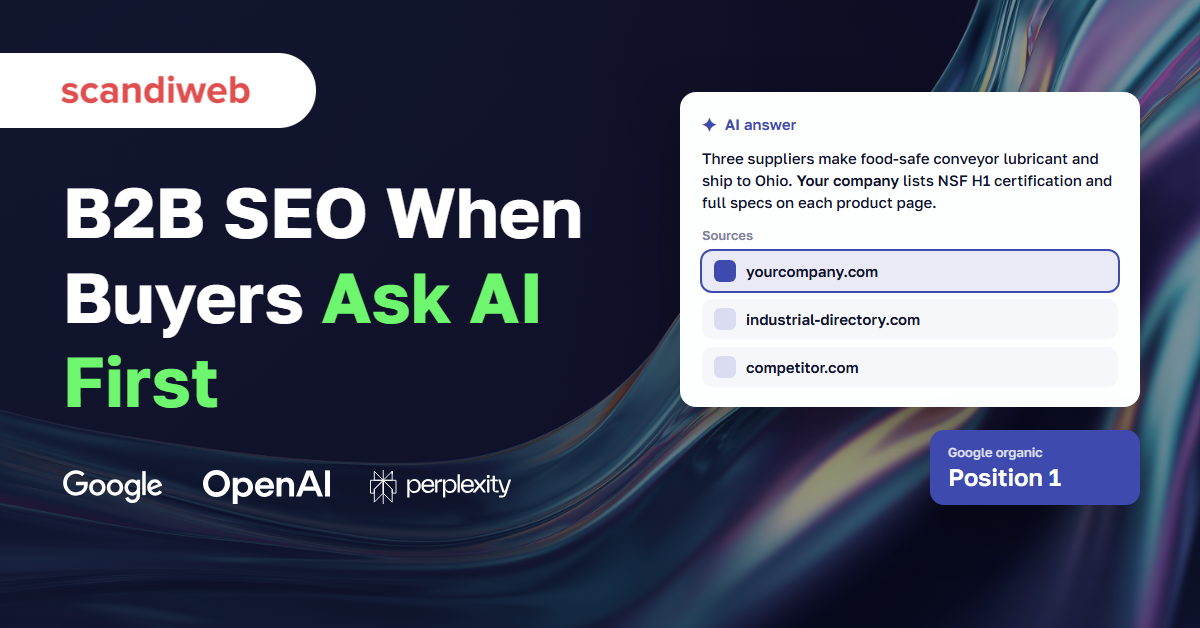
If your organic traffic has gone flat while more new leads tell your sales team they found you on ChatGPT, you are seeing B2B SEO split in two. Fewer buyers click through from Google: AI Overviews have cut the click-through rate of the top result by 58%, according to Ahrefs. More of the research now happens inside AI assistants, and in a 2026 Semrush survey, 92% of US B2B buyers said AI had shaped their vendor shortlist. That shortlist rarely changes. 6sense found that 94% of buying groups rank their preferred vendors before they contact anyone.
So B2B SEO in 2027 has two jobs. It still has to win the searches that click through to your site. It also has to make you the supplier that Google’s AI Overviews, ChatGPT, and Perplexity name when a buyer asks who makes the part they need and ships it to their region. Both jobs run on the same work: product pages that machines can read, and answers to the questions your buyers actually ask.
This guide covers how B2B buyers search now, how B2B SEO differs from B2C, and an eight-step strategy for manufacturers and distributors, with examples from our own client work.
What is B2B SEO in 2027?
B2B SEO is the work of getting a business-to-business company found by buyers in search engines and AI assistants. In 2027 it covers two goals: ranking in Google for the searches that still bring clicks, and being named and cited when buyers ask ChatGPT, Gemini, Perplexity, or Google’s AI Overviews to recommend suppliers. Both depend on clear, crawlable product information and trusted mentions.
For a manufacturer or distributor, SEO looks different from the SaaS advice that fills most guides. Your site is often a catalog of thousands of products with specs, documents, and customer-specific prices. Your buyers search for part numbers, standards, and applications as often as for your brand. And the person who finds you is rarely the only one who decides.
How B2B buyers search for suppliers now
B2B buyers now start much of their supplier research in AI assistants, use search to check what the AI told them, and contact a seller late. The numbers from 2025 and 2026 point the same way.
- AI use is mainstream. In the Semrush survey of 622 US B2B professionals, 66% regularly use AI to research vendors, and 97% had found a vendor they didn’t know about through AI. ChatGPT (76%) and Gemini (62%) were the most used. Semrush sells SEO tools, so treat the exact figures with care.
- Many start in a chatbot. G2 found that 51% of B2B software buyers now begin their research in an AI chatbot rather than a search engine.
- The shortlist forms early. In 6sense’s 2025 study, buyers were 61% of the way through their journey before contacting a seller, and they bought from their early favorite 77% of the time.
- Google sends fewer clicks. Ahrefs measured a 58% drop in click-through rate for the top result on searches that show an AI Overview.
The traffic that does come from AI is worth having. Adobe found that AI-referred visits to US retail sites converted 42% better than other traffic in March 2026, a year after converting 38% worse. That is retail data, but the direction matches what we see on B2B stores: fewer visits, better informed visitors.
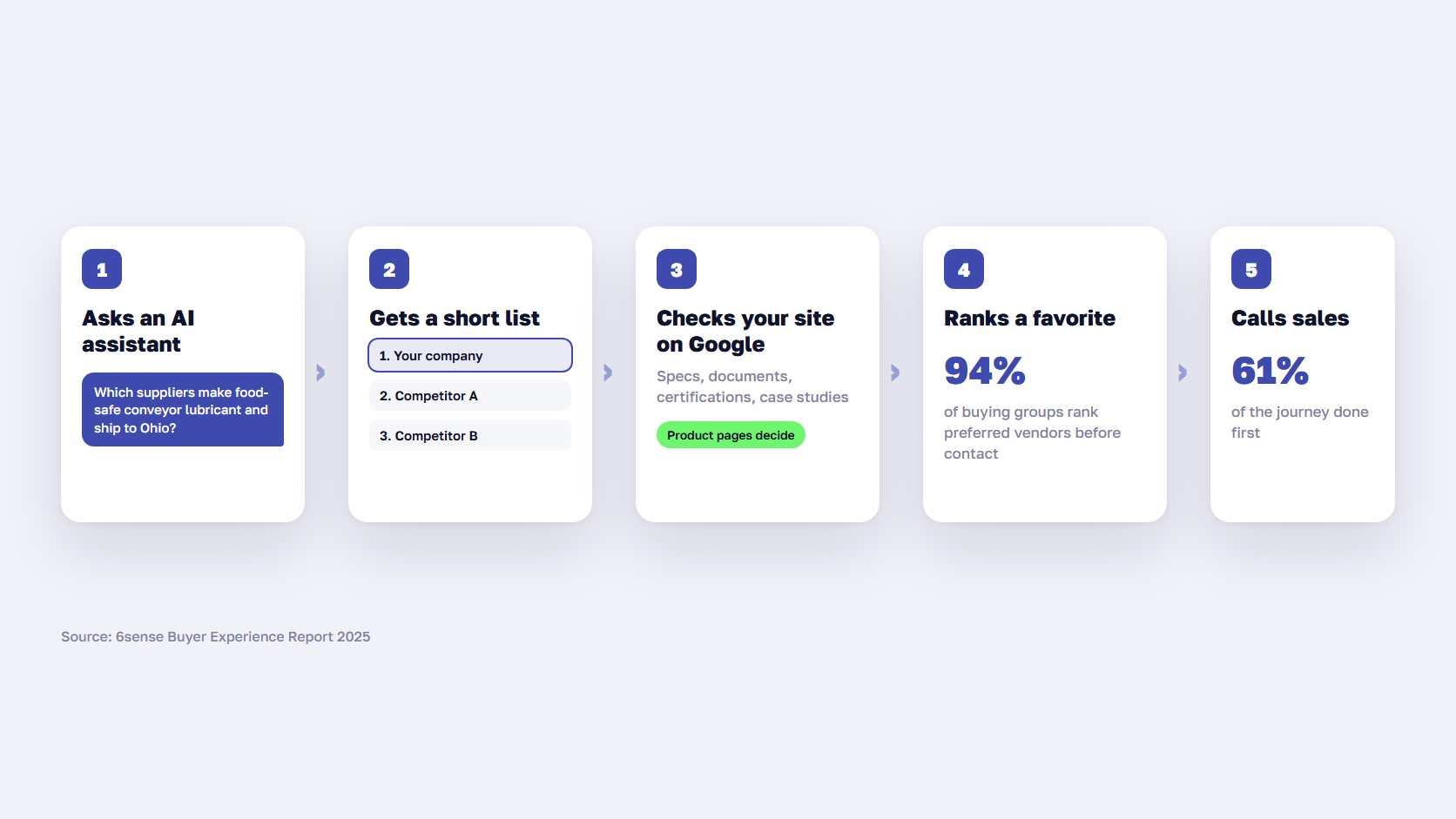
🚀 Quick takeaway
In B2B, AI answers decide who gets on the shortlist, and Google decides who gets checked. A supplier that only plans for one of them loses part of the buyer’s journey.
How B2B SEO differs from B2C SEO
B2B SEO targets fewer, more specific searches from buyers with long decision cycles, and it measures success in qualified leads, quotes, and reorders, with traffic as a supporting number. The catalog, the buying group, and the sales team all change what good SEO looks like.
| B2C SEO | B2B SEO | |
|---|---|---|
| Typical searches | High-volume product and category terms | Part numbers, specs, standards, applications, “supplier” and “manufacturer” terms |
| Search volume | Thousands per keyword | Often 10–500 per keyword, high value each |
| Who decides | One shopper | A buying group, plus procurement |
| Product pages | Public, with prices | Often behind a login, prices per customer |
| Content that converts | Reviews, comparisons, offers | Specs, compatibility, documentation, case studies |
| Success measure | Revenue per visit | Qualified leads, quote requests, reorders, assisted pipeline |
The biggest difference for manufacturers and distributors is the catalog. Many B2B stores hide specs, documents, and even product names behind a customer login. Google can’t rank what it can’t crawl, and an AI assistant can’t recommend a product it has never read.
🚀 Quick takeaway
B2B keywords look small in SEO tools. One search from a maintenance manager with a line down can be worth more than a thousand consumer visits, so judge each keyword by what that buyer is worth to you.
B2B SEO strategy for 2027: 8 steps
A B2B SEO strategy for 2027 starts with the product data that search engines and AI assistants read, then adds the answers, mentions, and technical basics that earn rankings and citations. These eight steps are the order we use with manufacturers and distributors.
1. Open your catalog to crawlers
Make product names, specs, compatibility, and documents public, and keep only customer-specific prices and ordering behind the login. That single change usually adds more search visibility than any content campaign, because it gives Google and AI assistants thousands of pages they couldn’t see before.
Supplier data is often what keeps the catalog closed. Wainbee, the largest distributor of Parker products in Canada, had only 10% of its 600,000+ products online because supplier data arrived as CSV and XLS files with no common structure. A Pimcore PIM connected to its ERP and supplier feeds standardized the formats and put the full catalog online.
Read more: Case Study: Unifying Product Information with Pimcore PIM
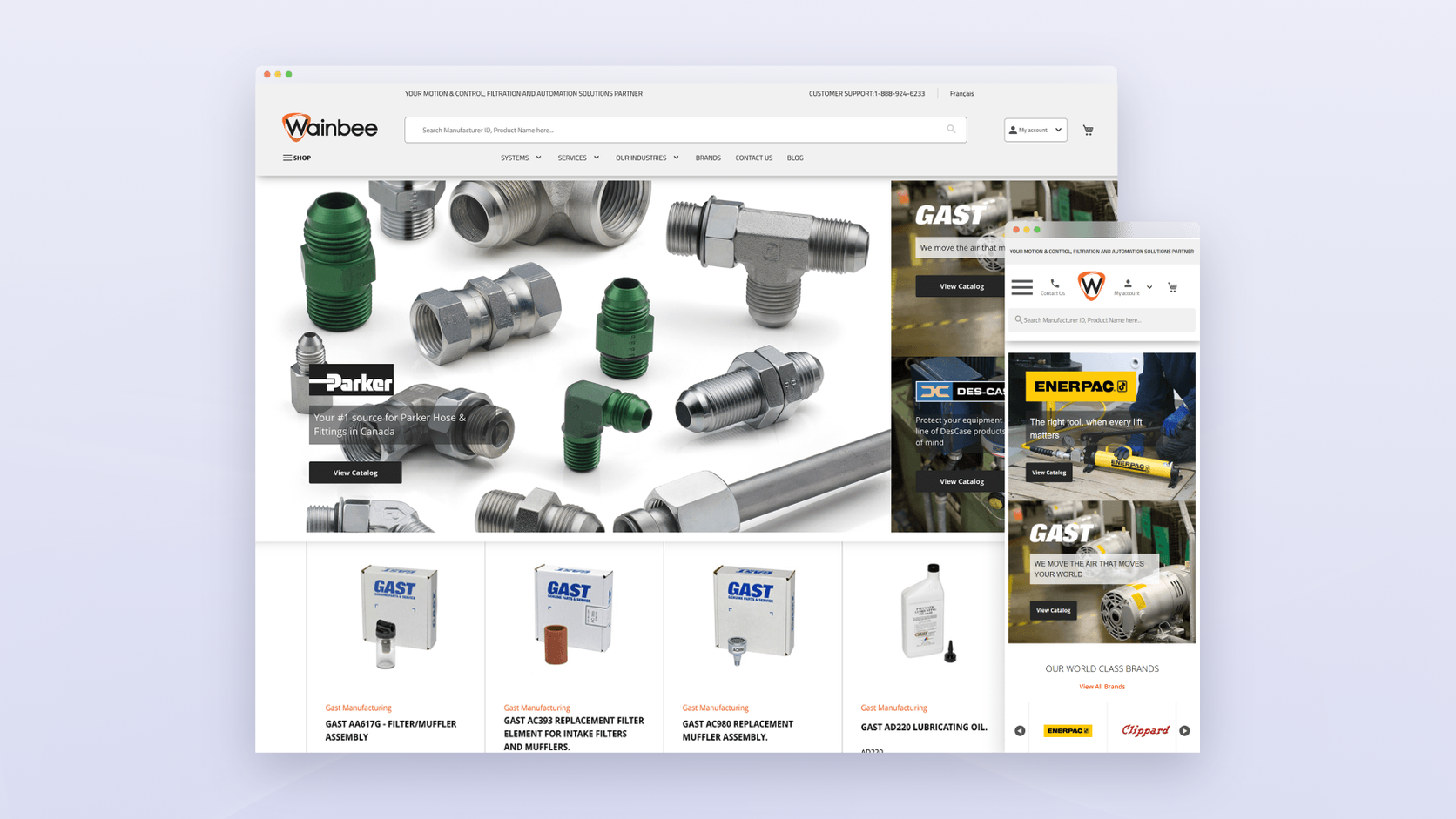
2. Build product pages for buyers and machines
A B2B product page should answer an engineer’s questions on the page itself: a full spec table, compatible and substitute products, certifications, downloadable documents, and lead time. Add product structured data so search engines and AI tools can read the same facts without guessing.
Those facts are also what AI assistants quote. When a buyer asks ChatGPT for a stainless fitting with a specific thread and pressure rating, the supplier whose page states both clearly has a far better chance of being named. Our guides to product structured data and product detail page best practices cover the details.
3. Answer the questions your sales team hears every week
Collect the questions your sales and support teams answer most, and publish clear answers on category pages, product pages, and guides. AI assistants pull answers from pages that state them directly, so a short, plain answer near the top of a page beats a long article that buries it.
This is also where AI visibility starts. Enviropack, a UK supplier of eco-friendly food packaging, aligned its SEO and Google Business Profile copy with the words buyers use when they shortlist suppliers. It started appearing in ChatGPT and Perplexity answers for prompts such as “eco-friendly food packaging suppliers in the UK,” and sessions from ChatGPT grew 110% in three months.
Read more: How AEO Helped Enviropack Become a Top AI Pick for Sustainable Packaging
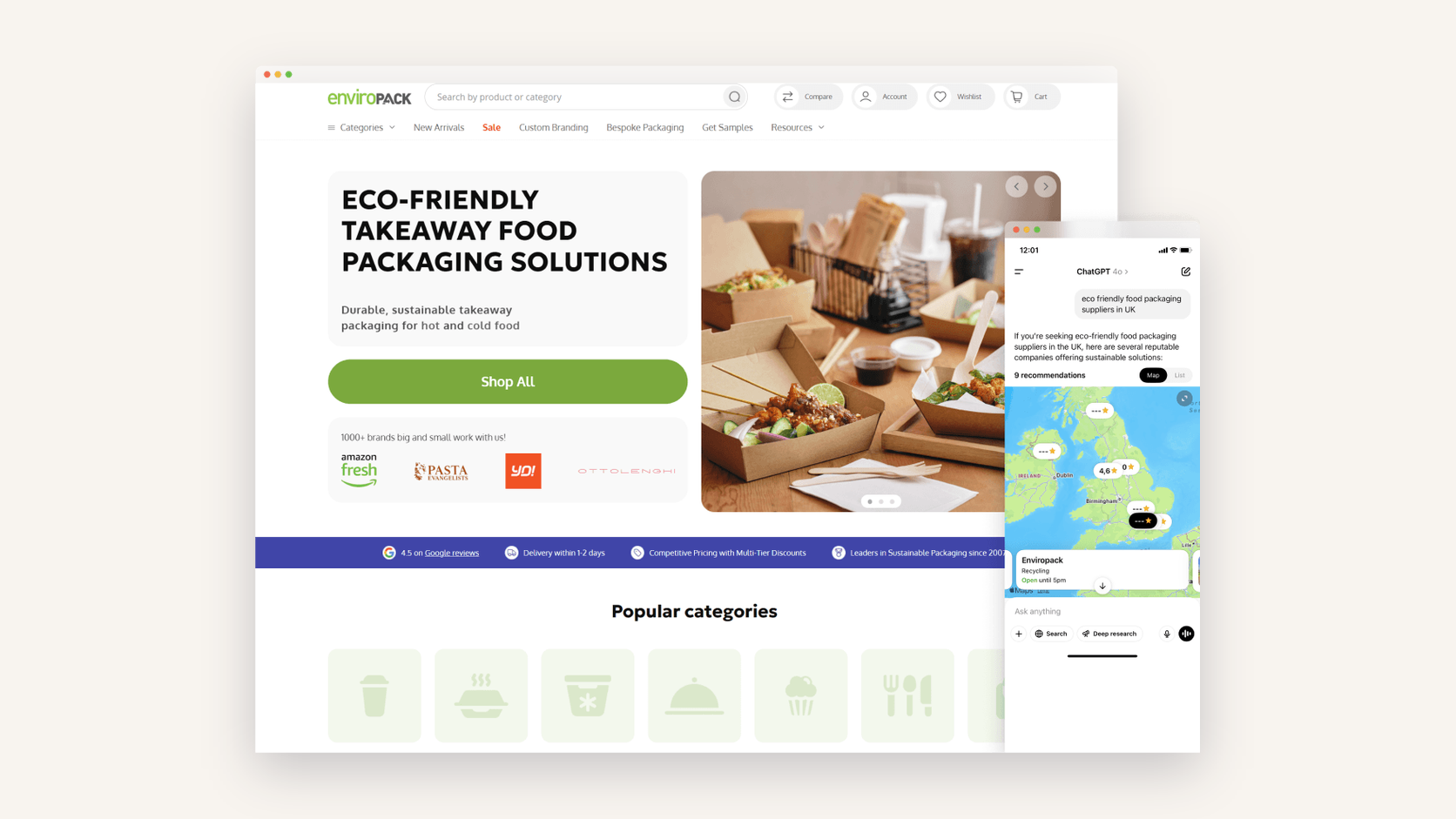
🚀 Quick takeaway
Your sales team already holds the best keyword list you have. Every question they answer twice a week is a page, a FAQ, or a spec field that search engines and AI assistants can use.
4. Target problems and applications as well as product names
B2B keyword research finds small searches with high value. Product and part-number terms matter, but so do the problems buyers describe before they know what to buy: “how to reduce downtime on a packaging line,” “food-safe lubricant for conveyors,” or “replacement for a discontinued valve.” Build category pages and guides around those applications and link them to the products that solve them.
Expect low numbers. A term searched 50 times a month by maintenance managers can be worth more than a consumer keyword searched 50,000 times. In AI assistants, these problem-style questions are how most buyers phrase their first prompt.
5. Get mentioned on the sites AI assistants trust
AI assistants build their answers from pages they consider reliable: industry directories, trade publications, review sites, comparison articles, forums, and your partners’ websites. Listings in the right directories, accurate partner and distributor pages, case studies with named clients, and expert quotes in trade press all raise the chance that you are named.
Treat these mentions like links in classic SEO. They tell both Google and AI models who you are, what you make, and where you sell. Our backlink building guide covers how to earn them without paying for low-quality placements.
6. Fix the technical basics for a large catalog
Large B2B catalogs break SEO in predictable ways: filtered category URLs that create millions of near-duplicate pages, slow product pages, broken parent-child product links, and redirects lost in a replatforming. Fix crawl waste first, so search engines spend their time on the pages that matter.
FELCO, the Swiss maker of professional pruning shears, shows how much the basics can return. We cleaned up its technical SEO and crawl paths, expanded the category tree, restructured navigation, rewrote category and product page content, and localized SEO for its European markets, with direct answers and structured data for AI engines. Its DTC revenue grew 107.87% YoY in 2025, and SEO revenue in Black Friday week rose 334.4%.
Read more: Case Study: Doubling DTC Revenue for a 75-Year-Old Swiss Tool Brand in 6 Months
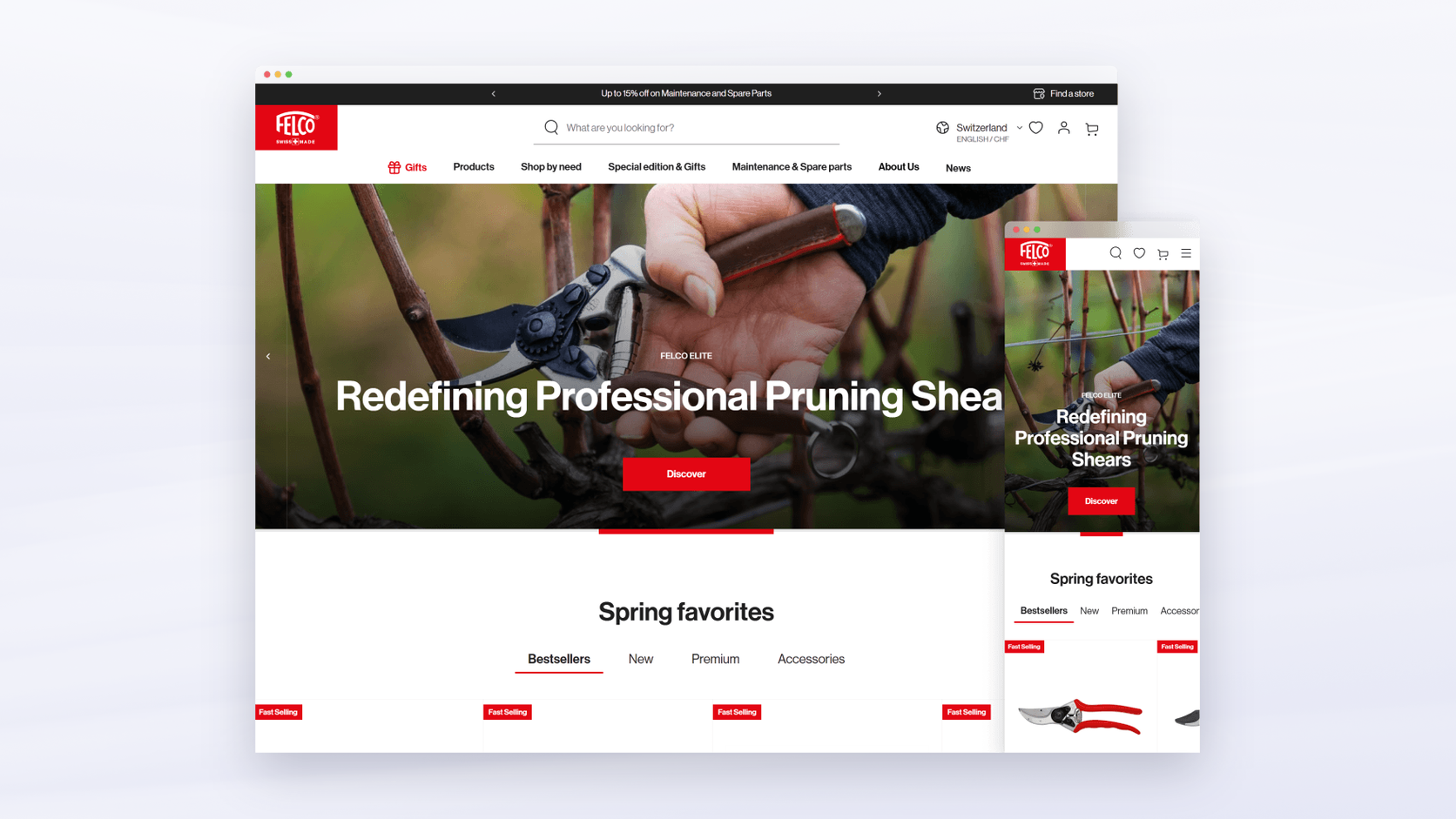
If you are planning a migration, our SEO migration checklist covers every step from the redirect map to the first 30 days, and our guides to a technical SEO audit and 301 redirect mapping go deeper on those two checks. If you are still deciding whether to replatform at all, our guide to a Magento upgrade or Shopify migration compares the costs and what data moves.
7. Let AI crawlers in and read your logs
Decide which AI crawlers may read your site, set that in robots.txt and in your CDN, and check that the search crawlers behind ChatGPT, Perplexity, and Google’s AI features are not blocked by accident. Many stores block them without knowing, often through a CDN bot rule.
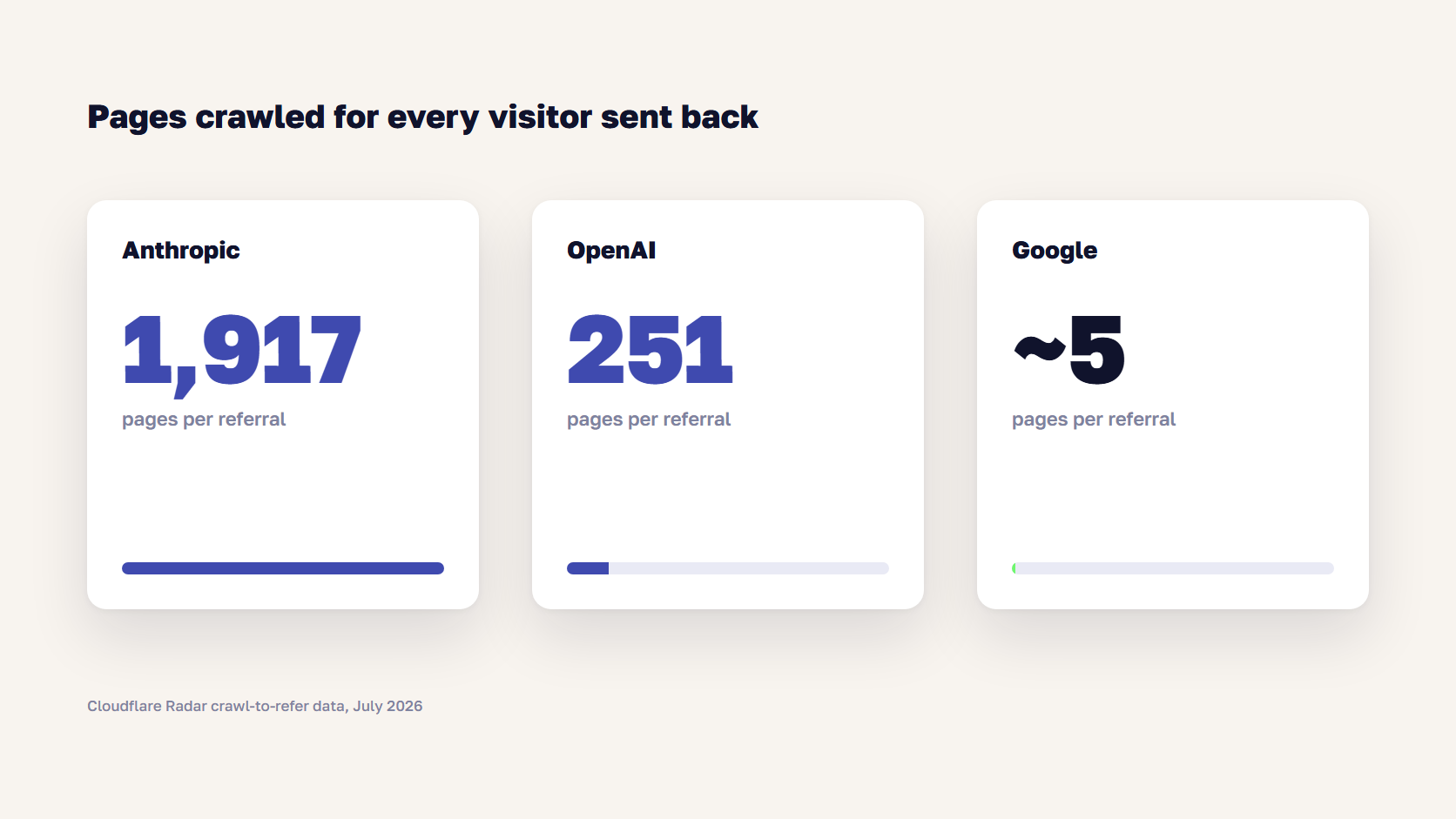
Then look at your server logs. AI crawlers read far more pages than they send visitors back: Cloudflare Radar data for July 2026 shows roughly 1,917 pages crawled per referral for Anthropic and 251 for OpenAI, against about 5 for Google, according to an analysis of Radar figures. That crawling is buyer research happening off your site. Your logs show which products AI systems read most, even when no click follows. Our ChatGPT shopping guide lists which bots to allow.
8. Measure AI visibility next to rankings
Track two sets of numbers. For Google, keep rankings, clicks, and conversions per page type. For AI, run a fixed set of buyer prompts in ChatGPT, Gemini, Perplexity, and Google AI Mode every month, record whether you are named and which page is cited, and track AI referral traffic in GA4.
Connect both to pipeline. In B2B, the visit that matters may be the third one, by a different person from the same company, weeks later. Ask new leads where they first heard of you, and add “AI assistant” as an option. Our guide to tracking brand mentions in LLMs shows a repeatable method.
🚀 Quick takeaway
A B2B SEO report in 2027 needs a second column. Rankings show whether Google sends buyers, and a monthly prompt check shows whether AI assistants name you at all.
How long B2B SEO takes
Most SEO work for B2B sites shows first results in three to six months, and catalog-wide changes take longer. Technical fixes and opening the catalog can lift visibility within weeks of being crawled. Content and mentions build over six to twelve months. AI assistants update at different speeds, so prompt results can move faster or slower than Google rankings.
Plan the work in that order. Fix what blocks crawling first, then improve product pages, then add answers and mentions. Each step makes the next one count for more.
FAQ about B2B SEO
Is SEO still worth it for B2B companies in 2027?
Yes. Google still sends a large share of B2B research traffic, and the pages that rank in Google are also the pages AI assistants read and cite. What has changed is the measure of success: fewer clicks per search, but better informed visitors, and a growing share of discovery inside AI answers that SEO work also influences.
What is the difference between B2B SEO and B2C SEO?
B2B SEO targets lower-volume, higher-value searches such as part numbers, specs, and applications, made by buying groups with long decision cycles. B2C SEO targets higher-volume product and category terms from individual shoppers. B2B success is measured in qualified leads, quotes, and reorders, while B2C is usually measured in revenue per visit.
What is AEO or GEO, and does a B2B company need it?
AEO (answer engine optimization) and GEO (generative engine optimization) mean getting your company named and cited in AI answers from ChatGPT, Gemini, Perplexity, and Google AI Overviews. B2B companies need it because buyers now form vendor shortlists with AI. Most of the work overlaps with good SEO: clear product data, direct answers, and trusted mentions.
Should B2B companies make their product catalog public?
In most cases, yes. Make product names, specs, compatibility, and documents public so search engines and AI assistants can read them, and keep customer-specific prices and ordering behind the login. A hidden catalog cannot rank in Google or be recommended by AI, so gated companies lose buyers at the research stage.
How do I know if ChatGPT recommends my company?
Ask it the questions your buyers ask. Build a list of 20 to 50 real buyer prompts, run them each month in ChatGPT, Gemini, Perplexity, and Google AI Mode, and record which suppliers are named and which pages are cited. Track AI referral traffic in GA4 and ask new leads whether they found you through an AI assistant.
What is the most important SEO task for manufacturers?
For most manufacturers, the most important task is putting complete product data on public, crawlable pages. Specs, compatibility, certifications, and documents are what buyers search for and what AI assistants quote. Without them, content and link building have little to point to.
B2B SEO in 2027 starts with your product data
B2B SEO in 2027 means ranking for the searches that still click through and being named in the AI answers where buyers now build their shortlists. Both run on the same foundation: an open, complete catalog, product pages that state the facts, answers to real buyer questions, and mentions on sites that AI assistants trust. Start with what blocks crawlers, then build out from there.
Asked ChatGPT about your product category and found your competitors instead? Tell us what you sell and where, and we'll show you where you stand in Google and in AI answers.