
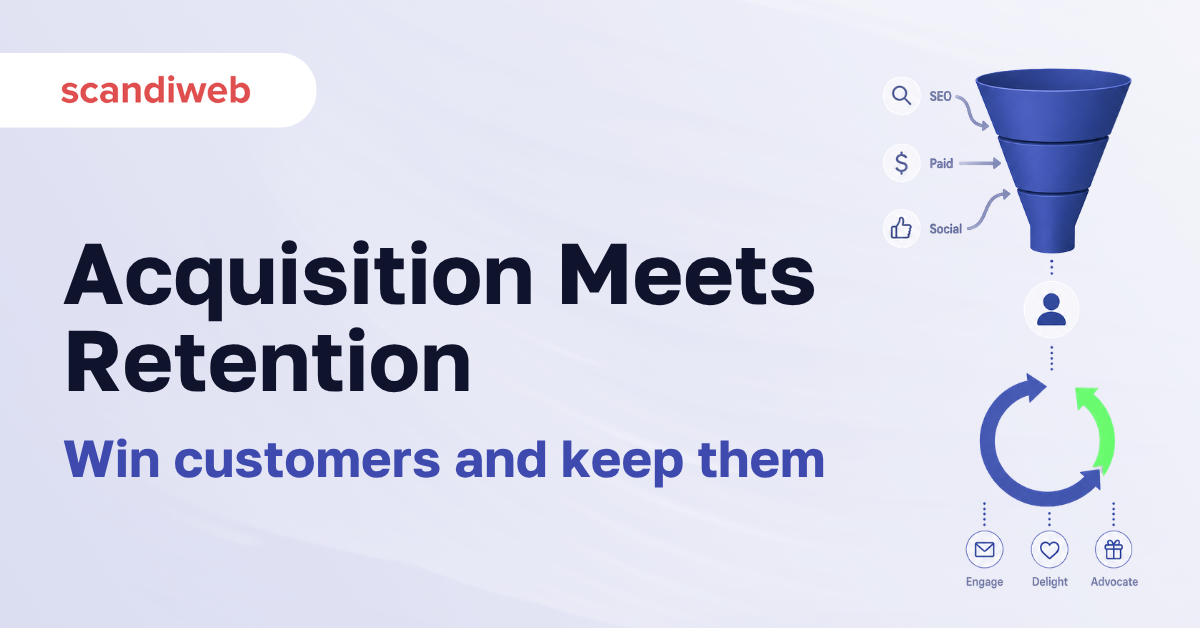
Acquiring a new customer costs five to 25 times more than keeping one you already have, depending on the industry (Bain & Company). Yet most eCommerce budgets still pour the majority of spend into the top of the funnel, chasing first purchases while the customers who already converted quietly lapse.
Acquisition and retention together make up the fourth pillar of eCommerce. Get one without the other and the model leaks: acquisition without retention is a bucket with a hole in it, retention without acquisition is a slowly shrinking base. This guide covers both, the math that decides how to split the budget between them, and the channels that move each.
Overview
- Acquisition brings in new customers, and retention turns them into repeat buyers. Sustainable growth needs both, in balance.
- The split is a math question, not a preference. CAC, CLV, and the CLV:CAC ratio tell you whether you are over-spending on acquisition or under-investing in keeping customers.
- The highest-return retention work (email and SMS, CRO, AI personalization, a loyalty program) usually costs less per dollar of revenue than buying the next new customer.
🚀 Quick takeaway
Acquisition and retention are not competing line items, they are two halves of one growth model. The question is never which to fund, it is how to split the budget, and CAC and CLV answer that.
What acquisition and retention actually cost
Most acquisition-versus-retention debates skip the only numbers that settle them. Three metrics do:
- CAC (Customer Acquisition Cost): total sales and marketing spend divided by the number of new customers it won. If you spent $10,000 to acquire 200 customers, your CAC is $50.
- CLV (Customer Lifetime Value): the total profit you expect from a customer across the whole relationship. A rough version is average order value multiplied by purchase frequency multiplied by the average customer lifespan.
- The CLV:CAC ratio: the health check. A ratio around 3:1 is the common benchmark for a sustainable eCommerce model. Closer to 1:1 means you are paying nearly as much to win a customer as they are worth. Much higher than 3:1 often means you are under-investing in growth and could afford to acquire more.
The reason retention earns its budget is in the same numbers. Research by Frederick Reichheld of Bain & Company found that increasing customer retention by just 5% can raise profits by 25% to 95%, because a retained customer buys again without a fresh acquisition cost each time. Every order after the first one improves the CLV side of the ratio without touching the CAC side.
🚀 Quick takeaway
Track the CLV:CAC ratio before you argue about channels. Near 1:1, fix retention before you spend another dollar acquiring. Comfortably above 3:1, you have room to acquire harder. The ratio tells you which problem you actually have.
Understanding acquisition in eCommerce
Customer acquisition is about reaching the right audience, the people who are your target market and ready to buy, through the channels that have the most impact: organic search, paid ads, and social. A few strategies carry most of the weight.
Search engine optimization (SEO)
SEO is the foundation for organic, high-intent traffic, the people actively searching for your products or solutions. The caveat that matters: write for humans, not crawlers. Content built only for algorithms reads as such and fails to convert. Effective SEO pairs keyword targeting and technical fixes with content that actually answers the reader. Learn how to do SEO for your eCommerce site.
Paid search and social advertising
Paid ads are the fast, measurable route to visibility across search and social. The skill is in targeting: audience demographics, behavior, and intent decide placement. Google Ads, LinkedIn, Facebook, and TikTok each reward content tuned to their own audience. See how paid search and social ads can work for you.
Emerging channels: TikTok and social commerce
Younger, highly engaged audiences are reachable through social commerce. TikTok Shop, user-generated content, and influencer partnerships extend reach and let brands meet people on platforms they already use. See TikTok for eCommerce brands.
🚀 Quick takeaway
New channels reward early movers, but only if the CLV:CAC math holds there too. A channel that acquires cheaply but attracts one-and-done buyers can look like a win and quietly drag down lifetime value. Judge every channel on the customers it keeps, not just the ones it brings.
Discover more from our success stories
- Case Study: Competitive Automotive SEO in Qatari Market
- PPC Case Study: +30% Conversions with Margin Tracking
- Macron Sees 539% Increase in SERP Visibility After Content Optimization
Retention: keeping customers engaged and loyal
Acquisition introduces customers, and retention is where sustainable growth actually happens. Retention turns one-time buyers into repeat customers, and repeat customers into advocates. A few channels do most of the work.
Email and SMS marketing
Email and SMS keep customers engaged with targeted messages, exclusive offers, and timely reminders. A well-built email strategy, combined with automation, reaches the right customer at the right moment with product updates, sales, or recommendations based on past purchases, and drives repeat orders. See how email and SMS marketing help retention.
Conversion rate optimization (CRO)
CRO serves retention as much as acquisition. A smooth, low-friction experience, from product discovery to checkout, is a reason customers come back. By analyzing behavior and testing design, CRO keeps the journey easy and the customer returning. Explore CRO services that improve UX and conversion.
AI marketing automation
AI has changed personalized engagement. Data-driven automation predicts behavior and personalizes at scale, so every touchpoint stays relevant. AI can recommend products from browsing history, adjust messaging by engagement, or trigger re-engagement emails after a quiet period, the kind of personalization that drives sales and makes customers feel recognized. See the impact of AI marketing automation on loyalty.
🚀 Quick takeaway
The cheapest revenue you will book this quarter is a second order from a customer you already paid to acquire. Email, SMS, CRO, and a loyalty program are how you book it, at a fraction of the cost of the first sale.
Learn more about retention strategies from our guides
- Strategies for Maximizing Engagement and Loyalty
- 20+ Great Customer Loyalty Program Examples by Industry
- Your Guide to Setting Up Loyalty Programs
Performance marketing that ties acquisition and retention together
A joined-up performance marketing approach uses data and multichannel coordination to drive engagement, conversions, and loyalty at once. Tools like product feed management and marketplace support extend reach and keep the brand consistent across platforms.
Marketplace and Amazon management
Marketplaces like Amazon reach new customers, but they punish poor management. Optimized listings, careful ad spend, and close performance monitoring are what separate a profitable marketplace presence from a leaky one. scandiweb’s marketplace management helps you raise visibility, win new customers, and keep existing ones. Learn more about eCommerce marketplaces.
Product feed management and ad creative
Accurate product feeds are the backbone of advertising across platforms. Feed management keeps inventory displayed correctly on channels like Google Shopping and social ads, and platform-specific ad creative grabs attention. Well-managed feeds plus engaging visuals lift click-through and conversion rates. Find out more about product feed management.
Social media management and social commerce
Social commerce is rising, and Facebook, Instagram, and TikTok are sales channels now, not just brand showcases. A coherent social media strategy raises awareness and interaction, while user-generated content and influencer marketing build the trust that turns followers into customers. Explore scandiweb’s social media management.
By coordinating these across the journey, you meet customers at multiple touchpoints and adapt to their habits, which lifts immediate sales and builds the foundation for repeat business.
🚀 Quick takeaway
Acquisition and retention run on the same data. The product feed that wins a new customer on Google Shopping is the same catalog that powers the personalized email bringing them back. Treat them as one system, not two budgets.
Hack your marketing strategy with these reads
- Digital Marketing and Traffic Acquisition Strategy in Apparel and Fashion
- Case Studies: SEO Support for Beauty Brands
- Email Marketing Best Practices for Revenue Growth
Frequently asked questions
Is it cheaper to acquire or retain customers?
Retaining is almost always cheaper. Acquiring a new customer costs five to 25 times more than keeping an existing one, depending on the industry (Bain & Company). Retained customers also buy more over time, so the same revenue costs less to earn.
What are the 3 R’s of customer retention?
The three R’s are commonly given as Retention (keeping existing customers), Related sales (cross-sell and upsell to them), and Referrals (existing customers bringing new ones). Together they describe how a loyal customer base compounds in value beyond the first purchase.
What is a good CLV to CAC ratio for eCommerce?
A CLV:CAC ratio around 3:1 is the common benchmark for a healthy eCommerce business. Near 1:1 means acquisition costs are eating your margin. Well above 3:1 can signal you are under-investing in growth and could afford to acquire more aggressively.
What is the difference between customer acquisition and retention?
Acquisition is winning new customers through channels like SEO, paid ads, and social. Retention is keeping the customers you already have and getting them to buy again through email, CRO, personalization, and loyalty programs. Acquisition grows the base, and retention grows its value.
How do you balance acquisition and retention spend?
Use the CLV:CAC ratio. If it is near 1:1, shift budget toward retention until repeat revenue improves the ratio. If it is comfortably above 3:1, you have room to invest more in acquisition. The right split is the one that keeps the ratio healthy while the base grows.
Why does a 5% increase in retention matter so much?
Because retained customers buy again without a new acquisition cost each time. Research by Frederick Reichheld of Bain & Company found a 5% lift in retention can raise profits by 25% to 95%, since the extra orders improve lifetime value without adding to acquisition spend.
Most growth problems are really a balance problem: too much spent winning customers, too little spent keeping them. If your funnel is leaking faster than you can fill it, tell us about your funnel and our Growth Team will help you rebalance it.
Explore our popular eCommerce services
Quickly jump to the other pillars of eCommerce here