


Magento + Akeneo PIM integration for centralized product data management
Integrate Magento with Akeneo PIM to centralize product data, streamline catalog management, and deliver consistent product information across all sales channels.








Magento and Akeneo integration in short
Most Magento (Adobe Commerce) stores connect to Akeneo PIM with the Akeneo Connector for Adobe Commerce, a Magento module from Akeneo that pulls categories, families, attributes, options, and products from the Akeneo REST API and writes them straight into the Magento database, on demand or on a schedule. The Community Edition connector is free, and the Enterprise Edition connector is quote based and adds assets and Reference Entities. Teams that need rules the connector does not cover build a custom integration on the Akeneo REST API and the Magento REST API.
The Magento + Akeneo PIM integration connects your ecommerce store with a centralized product information management system. Akeneo becomes the single source of truth for product data, while Magento focuses on storefront performance and customer experience.
With this integration, businesses can:
• Manage product attributes, descriptions, and assets in one central system
• Sync complete and enriched product data from Akeneo to Magento
• Maintain consistent product information across multiple Magento stores
• Accelerate catalog updates and new product launches
• Improve product data quality for better conversion and SEO
• Support multilingual and multi-market product catalogs


• Integration uses Akeneo REST APIs and Magento APIs
• Products, attributes, families, and values are exported from Akeneo to Magento
• Media assets such as images and documents are synced automatically
• Attribute mapping ensures Akeneo data aligns with Magento product structure
• Sync can run in real time or on scheduled batches
• Supports configurable, simple, and variant products
• Multi-store and multi-language catalogs are supported
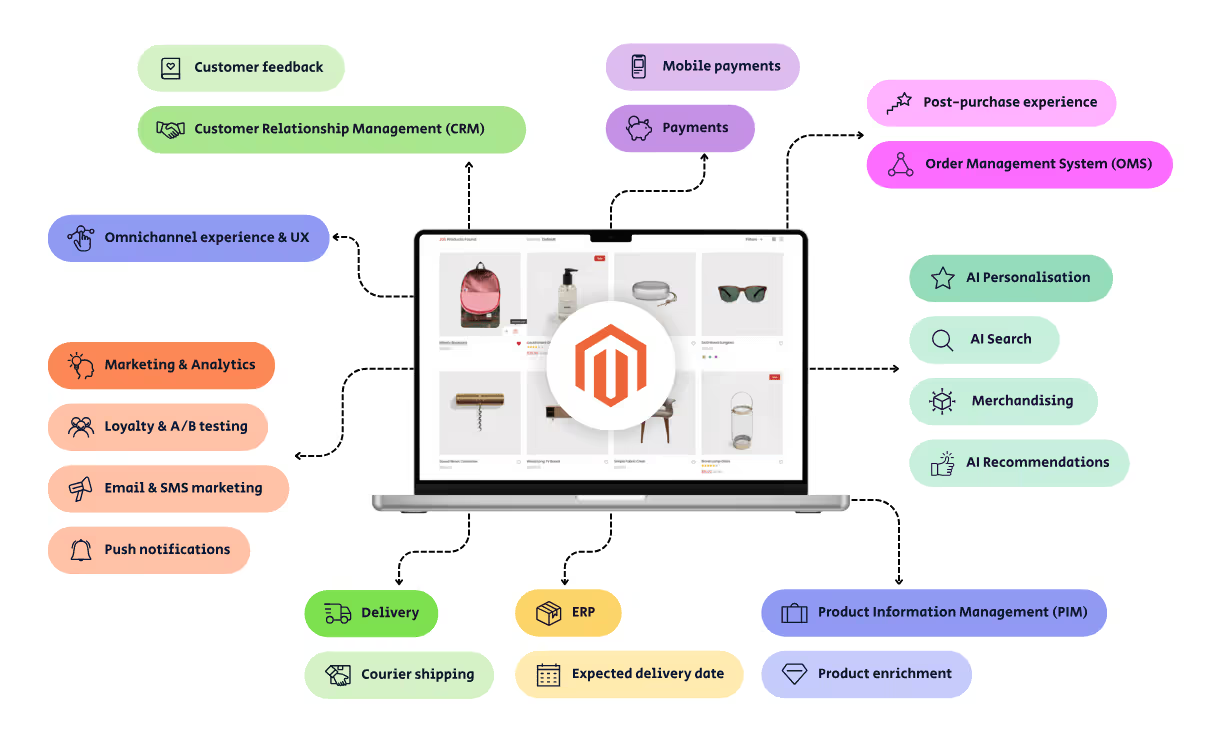
Ways to connect Magento and Akeneo
| Option | Type | Best for | Notes |
|---|---|---|---|
| Akeneo Connector for Adobe Commerce (PIM Community Edition) | Connector | Akeneo Community Edition users who want Akeneo's own module with no license fee | Listed as free on the Akeneo App Store. Exports categories, families, attributes, options, products, and product models from Akeneo into Magento through the Akeneo REST API. Only Akeneo Community Edition features are supported, and Akeneo does not offer support for this version. |
| Akeneo Connector for Adobe Commerce (Akeneo Enterprise) | Connector | Akeneo Growth, Advanced, or Premium customers who use Asset Manager or Reference Entities | Quote based. Assets and Reference Entities are Enterprise exclusive, and corrective maintenance comes from Akeneo Support. Connector 105.x needs Adobe Commerce 2.4.7 or later with PHP 8.2 or later; 104.x covers 2.4.4 up to 2.4.7 and is in maintenance-only mode. |
| Alumio Akeneo to Magento 2 template | Integration platform | A first catalog load, or teams already running other integrations on Alumio | Alumio's own guide says the template is designed for a one-time import and does not support repeated imports, so ongoing sync means building your own flows in Alumio. Reference versions listed: Akeneo API v1 and Magento 2.4.8-p1. |
| Custom integration on the Akeneo REST API and Magento REST API | Custom API | Catalogs with rules the connector cannot express, such as categories owned by Magento or middleware that merges ERP data into products | Akeneo allows up to 100 API requests per second and 10 concurrent calls per PIM instance, 4 per connection, and only 3 requests per second for creating or updating attribute options. On the Magento side, the asynchronous bulk endpoints (/async/bulk/V1/products) queue large writes for the async.operations.all consumer. |
What syncs between Magento and Akeneo
| Data | Direction | System of record | Timing |
|---|---|---|---|
| Channels, locales, and currencies | Akeneo to Magento | Akeneo (a channel maps to a website, a locale and currency to a store view) | Set once in the connector configuration |
| Categories | Akeneo to Magento | Akeneo (the main category tree maps to a Magento root category) | Category job, always a full import |
| Families | Akeneo to Magento | Akeneo (families become attribute sets) | Family job, before attributes |
| Attributes and options | Akeneo to Magento | Akeneo | Attribute job, then option job |
| Products and product models | Akeneo to Magento | Akeneo for content, Magento for deletions (product models become configurable products) | Product job, imported family by family |
| Asset collections | Akeneo to Magento | Akeneo | Asset job (Enterprise Edition, connector 105.1.0 and 104.4.0 onward) |
| Prices and stock | ERP to Magento, not through Akeneo | ERP | Direct ERP connection, as Akeneo recommends |
How a Magento Akeneo integration project runs
- Map the structure first: Akeneo channels to Magento websites, locales and currencies to store views, and families to attribute sets.
- Decide which system owns categories, category assignments, prices, and stock. The connector skips attributes named price, special_price, and cost by default.
- Clean the PIM data: give every attribute and option a label in the Magento admin locale, avoid attribute codes that start with a number, and link every product to a category in the channel tree.
- Install the connector, create the Akeneo API user, and run the jobs once in order: category, family, attribute, option, product, asset.
- Review the result on staging, including configurable products, store view values, and images, and check any extension that relies on product save events.
- Schedule the jobs with cron or bin/magento akeneo_connector:import, and alert on jobs that stay in Processing or end in Error.
Common problems and how to avoid them
Category assignments made in Magento get wiped
In a scandiweb project for a holiday decorations retailer, the Akeneo category job was switched off because each run overwrote category SEO fields. After that, every product import removed products from categories that had been filled in Magento. Akeneo also requires each product to be linked to a category in the channel tree, so pick one owner for categories and assignments before the first import.
The connector mapping table is production data
The connector keeps its Akeneo to Magento ID mappings in the akeneo_connector_entities table. On a scandiweb project for a sports retailer, a new environment threw import and product form errors until the family mappings in that table pointed at attribute set IDs that existed there. Never truncate that table, and keep category, family, and attribute mappings identical to live when you clone environments.
Option codes collide after cleanup
On one scandiweb project, middleware that created Akeneo option codes stripped special characters, so the sizes 5.5 and 55 produced the same code and the option import stopped on a duplicate. Slashes and inch marks in size values caused similar trouble. Agree a code convention, such as 5dot5, before loading options in bulk.
A wrong attribute type in Akeneo becomes a wrong type in Magento
The connector maps an Akeneo simple select to a Magento drop-down and a multiple select to a multiple select. On a scandiweb project for a Canadian retailer, a promotions attribute created as a simple select arrived as a drop-down, and the fix was to delete and recreate it in Akeneo with the right type, then rerun the sync.
Imports skip Magento save events
The connector loads data into temporary tables and inserts it with SQL, so Magento observers and plugins tied to product saves do not run for imported products. Any extension that reacts to a product save needs another trigger after each import.
Deleting in Akeneo does not delete in Magento
Standard connector jobs never delete data, and Magento stays master on deletion. Disable or remove discontinued products in Magento, or set up deletion through Akeneo's Event Platform.
Why choose scandiweb to handle Magento integration for you?
What product data is synced from Akeneo to Magento?
Product attributes, descriptions, images, categories, variants, and enriched content can be synced from Akeneo to Magento.
Can Akeneo manage multi-language product catalogs?
Yes. Akeneo supports multiple locales and channels, which can be mapped directly to Magento store views.
Does the integration support large product catalogs?
Yes. Akeneo is designed to handle large and complex catalogs, and the integration can be optimized for high data volumes.
Can product data be updated automatically in Magento?
Yes. Changes made in Akeneo can be pushed to Magento automatically based on real-time or scheduled synchronization.
Does this integration improve SEO and conversion?
Yes. Centralized and enriched product data improves product page quality, consistency, and search visibility.
Is Akeneo suitable for B2B and B2C catalogs?
Yes. Akeneo supports both B2B and B2C product structures and complex attribute models.
Is the Akeneo connector for Magento free?
The Community Edition connector is listed as free on the Akeneo App Store and supports only Akeneo Community Edition features. The Enterprise Edition connector, for Akeneo Growth, Advanced, and Premium plans, is quote based and adds assets, Reference Entities, and Akeneo support.
Does the Akeneo connector sync prices and stock to Magento?
Not by default. It skips attributes named price, special_price, and cost, and Akeneo recommends sending fast-changing data like prices and stock from the ERP straight to Magento.
Can Magento send product data back to Akeneo?
The connector is built to import from Akeneo into Magento, and Akeneo's documentation describes no return flow. A reverse load, such as moving existing Magento images into Akeneo at the start, is a separate job: on one scandiweb project the team scripted a one-time export of all Magento images with a CSV that linked each SKU to its Akeneo image attribute.
How do I run an Akeneo import from the command line?
Use bin/magento akeneo_connector:import --code=product, with several job codes separated by commas. Since connector 102.0.0 the command returns an error if that job is already scheduled or processing, which stops overlapping cron runs.
Which Magento versions does the Akeneo connector support?
Enterprise Edition connector 105.x needs Adobe Commerce 2.4.7 or later with PHP 8.2 or later, and 104.x covers 2.4.4 up to 2.4.7. Check Akeneo's compatibility page for the Community Edition version that matches your store.
How many API calls can an Akeneo integration make?
Akeneo allows up to 100 REST API requests per second and 10 concurrent calls per PIM instance, with 4 concurrent calls per connection. Creating or updating attribute options is capped at 3 requests per second, which matters when loading long option lists.
Sources
- Akeneo help: Synchronization, load and transfer data (Adobe Commerce connector)
- Akeneo help: Data model comparison and connector behaviors
- Akeneo help: Connector compatibility
- Akeneo App Store: Akeneo Connector for Adobe Commerce (PIM Community Edition)
- Akeneo App Store: Akeneo Connector for Adobe Commerce (Akeneo Enterprise)
- Akeneo REST API: Good practices and rate limits
- Alumio docs: Akeneo to Magento 2 template
- Adobe Commerce developer docs: Bulk endpoints
Last updated by the scandiweb integration team.







Akeneo integration on other platforms
More Magento integrations
1. Submit your integration request
2. Join a free strategy & discovery call
We’ll review your business systems, identify key challenges, and uncover actionable opportunities.
3. Get a tailored proposal
Trusted by 700+ leading brands worldwide