


Magento Facebook and Instagram Shop integration for synced products and sales
Connect Magento (Adobe Commerce) with Facebook and Instagram Shop to sync your catalog, prices, and inventory, and run product ads with cleaner tracking and fewer feed issues.








Magento and Facebook / Instagram Shop integration in short
Magento (Adobe Commerce) connects to Instagram and Facebook through Meta's official Facebook & Instagram extension, which sets up the Meta Pixel, Conversions API, and catalog sync from the Magento admin, or through a feed extension or existing feed module that Commerce Manager pulls as a scheduled feed. Since September 4, 2025, Facebook and Instagram Shops send shoppers to your own site to check out, so the work is catalog quality and conversion tracking rather than importing in-app orders.


• Magento product entities are mapped to a Meta catalog feed structure, including IDs, titles, descriptions, image URLs, product URLs, brand, GTIN/MPN where available, and category values.
• Price, sale price, currency, availability, and stock quantity signals are exported from Magento and reflected in the Facebook catalog used by Facebook Shop and Instagram Shopping surfaces.
• Configurable product relationships are handled through variant mapping so each simple SKU can be represented with its own size/color attributes and availability.
• Delta-based updates are supported by sending only changed records when product, price, or inventory attributes are modified, reducing feed churn and review delays.
• Feed generation and submission are executed on schedules or event triggers, with validation against required Meta fields before publishing.
• Sync jobs produce logs for rejected items, missing attributes, and image or URL errors, and error states are retained for reprocessing and audit trails.
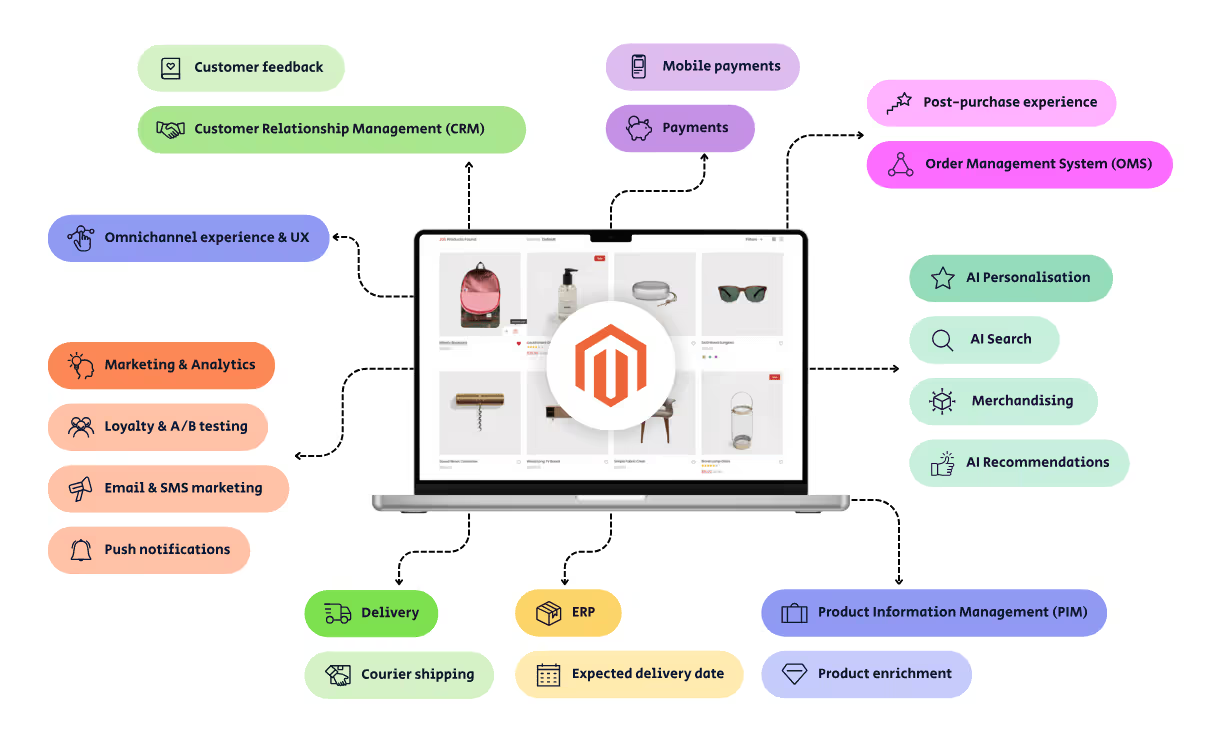
Ways to connect Magento and Facebook / Instagram Shop
| Option | Type | Best for | Notes |
|---|---|---|---|
| Facebook & Instagram for Magento (Meta's official extension) | Connector | Stores that want catalog sync, Meta Pixel, and Conversions API from one install maintained by Meta | Five modules (BusinessExtension, Catalog, Conversion, Promotions, and Sales). Version 1.7.1, released November 18, 2026, supports PHP 8.1 to 8.5 and Magento 2.4.4 or later, needs Magento's MSI modules, and is the last release for 2.4.4; the next release requires 2.4.5. Its Onsite Shops syncing is deprecated. |
| Magmodules Facebook & Meta Marketing Suite | Connector | Stores that want control over feed attributes and schedules, with Pixel and Conversions API in the same module | Generates a product feed for the Meta catalog on a Magento cron schedule and adds Pixel and server-side Conversions API tracking. The feed URL is added in Commerce Manager under the catalog's Data Sources as a scheduled feed. |
| Custom build on Meta's Catalog Batch API and Conversions API | Custom API | Large or multi-catalog setups that need near real-time price and stock updates | Meta's partner guidance asks for a full catalog sync at least every 24 hours, delta syncs every hour, and price and inventory updates within 15 minutes. One Batch API request takes up to 5,000 products, and variants are grouped with item_group_id. |
What syncs between Magento and Facebook / Instagram Shop
| Data | Direction | System of record | Timing |
|---|---|---|---|
| Product catalog | Magento to the Meta catalog | Magento | Extension sync or a scheduled feed; Meta asks partners for a full sync every 24 hours and deltas hourly |
| Price and availability | Magento to the Meta catalog | Magento | Meta asks partners to send changes within 15 minutes |
| Variants | Magento configurable children to Meta items | Magento | With catalog sync, grouped by item_group_id |
| Promotions | Magento to Meta | Magento | Through the Meta extension's Promotions module |
| Browsing and purchase events | Magento to Meta (Pixel in the browser, Conversions API from the server) | Magento | Real time; duplicates removed when event ID and name match within 48 hours |
| Orders | Placed on the Magento storefront | Magento | Checkout on Facebook and Instagram ended September 4, 2025 |
How a Magento Facebook / Instagram Shop integration project runs
- Audit what already exists: an old Facebook for Magento 2 module, a Meta Pixel fired through Google Tag Manager, or a Commerce Manager catalog left from an earlier Shops setup.
- Choose the path: Meta's extension when you want catalog, Pixel, and Conversions API in one install, or a scheduled feed (from a feed extension or an existing Google feed module) when you only need the catalog and product tagging.
- For Meta's extension, confirm Magento 2.4.4 or later (2.4.5 for the next release), PHP 8.1 to 8.5, MSI modules enabled, and at least 1 GB of PHP memory.
- Connect the Meta Business account under Facebook and Instagram > Overview in the Magento admin, on staging and production separately; if Meta asks for a login verification code, the account owner has to complete it.
- Clean catalog data before the first sync: images on every product, currency codes, no empty attributes, and no virtual products or memberships in the feed.
- Turn on Pixel and Conversions API in one place only, with matching event IDs, and check the ViewContent, AddToCart, and Purchase payloads, including currency.
- Review rejected items in Commerce Manager after each sync, and mark out-of-stock items as out of stock instead of deleting them.
Typical effort: 2 to 4 development days for a Meta-ready catalog feed built from an existing feed module, plus 1 to 2 days if Conversions API tracking is added. High-level estimate given before discovery for a Magento store that already produced a Google Shopping feed. Based on scandiweb project estimates.
Common problems and how to avoid them
In-app checkout on Instagram is gone
Meta ended checkout on Facebook and Instagram Shops on September 4, 2025; shoppers now discover products there and check out on your website. Meta's extension deprecated its Onsite Shops syncing and said order syncing will be removed, so plans to import Instagram orders into Magento need a new scope.
Most products rejected on the first sync
When we connected a retailer's Magento store to Meta, Facebook connected but Instagram showed as inactive at first, and 44 of 46 synced products had issues, all caused by missing images. The extension worked; the catalog was not ready.
Meta's feed spec is stricter than Google's
For a store that already produced a Google Shopping feed, our engineers found the feed needed currency codes added, empty tags omitted, and virtual products and memberships excluded before it could serve as a Meta scheduled feed. Budget for this clean-up even when a Google feed already exists.
Purchases counted twice
If a Meta Pixel already fires through Google Tag Manager, turning on a second Pixel in an extension double counts conversions. Meta deduplicates browser and server events only when the Pixel eventID matches the Conversions API event_id and the event names match, within 48 hours. In our review of that store's tag setup, the existing product view event was sending its currency as undefined.
The original Facebook module is still installed
Facebook's first facebook-for-magento2 extension was deprecated and archived on April 30, 2023, and points users to Meta's newer extension; Adobe has also removed the native Magento Social Facebook integration and no longer supports it. Check for either before installing the successor.
Magento 2.4.4 stores lose extension updates
Meta's release notes say 1.7.1 is the last version that installs on Magento 2.4.4, and the next release requires 2.4.5 or later. Stores on older Magento versions need an upgrade plan to keep receiving fixes.
Why choose scandiweb to handle Magento integration for you?
How do you connect Magento (Adobe Commerce) to Facebook Shop and Instagram Shop via Meta Commerce Manager?
We map your Magento catalog to Meta Commerce Manager, then set up a product feed and scheduled syncs. This keeps Magento as the source of truth for products shown on Facebook and Instagram.
What Magento product data gets synced to Facebook and Instagram Shop for social commerce listings?
Typically SKUs, titles, descriptions, images, categories, price, and inventory status. We also align variants, GTIN/MPN fields, and product URLs to reduce catalog errors.
How do you prevent Meta catalog disapprovals caused by Magento price, inventory, or variant mismatches?
We validate attributes, enforce consistent IDs, and fix formatting issues that trigger Commerce Manager errors. Then we monitor feed diagnostics and resolve recurring issues at the source in Magento.
Can Magento sync multiple store views, currencies, or languages to Facebook and Instagram Shop?
Yes, we can set rules per store view and generate market-specific feeds when needed. The goal is consistent pricing and availability across each Meta storefront.
Can scandiweb also set up GA4 and Meta Pixel tracking for Magento Facebook and Instagram Shop campaigns?
Yes, our analytics team can implement event tracking and dataLayer updates to support cleaner Meta and GA4 reporting. We have 60+ certified GA4 and Adobe Analytics experts and 575+ eCommerce BI dashboards delivered.
Is there an official Meta extension for Magento 2?
Yes. Meta publishes Facebook & Instagram for Magento on the Adobe Commerce Marketplace and GitHub. Version 1.7.1 (November 2026) covers catalog sync, Meta Pixel, and Conversions API for Magento 2.4.4 or later.
Can customers still check out on Instagram from a Magento store?
No. Since September 4, 2025, Shops customers no longer check out on Facebook or Instagram; they are sent to your website to buy, and the extension's Onsite Shops syncing is deprecated.
Does the Meta extension for Magento need MSI?
Yes. It requires Magento's Multi-Source Inventory modules, PHP 8.1 or later, and a PHP memory limit of at least 1 GB, with 2 GB or more preferred.
How often should Magento update the Meta catalog?
Meta's guidance for commerce platform partners is a full catalog sync at least every 24 hours, delta syncs every hour, and price and inventory changes within 15 minutes. Feed-based setups set their schedule in Commerce Manager.
Will the Meta Pixel and Conversions API double count purchases?
Not if they share an event ID. Meta deduplicates a Pixel event and a Conversions API event when the event ID and event name match and both arrive within 48 hours; a second Pixel fired through Google Tag Manager without matching IDs will double count.
Is the old Facebook for Magento 2 extension still supported?
No. Facebook archived the original facebook-for-magento2 repository on April 30, 2023, marked it deprecated, and directs users to Meta's newer extension.
Sources
- GitHub: meta/meta-for-magento2 (Facebook & Instagram for Magento)
- GitHub: Meta for Magento 2 release 1.7.1
- GitHub: Meta for Magento 2 release 1.6.1 (Shops checkout change)
- GitHub: facebookarchive/facebook-for-magento2 (archived)
- Magmodules: Facebook & Meta Marketing Suite quick start guide
- Meta for Developers: Catalog integration for commerce platform partners
- Meta for Developers: Deduplicate Pixel and server events
- Adobe Experience League: Social media and RSS feeds (Magento Social removed)
Last updated by the scandiweb integration team.







Facebook / Instagram Shop integration on other platforms
More Magento integrations
1. Submit your integration request
2. Join a free strategy & discovery call
We’ll review your business systems, identify key challenges, and uncover actionable opportunities.
3. Get a tailored proposal
Trusted by 700+ leading brands worldwide