


Magento to Mailchimp integration for real-time lifecycle segments
Sync Magento (Adobe Commerce) customer, order, and behavior events into Mailchimp in real time, so they can run accurate abandoned cart, post-purchase, and winback campaigns without manual exports.








Magento and Mailchimp integration in short
Most Magento (Adobe Commerce) stores use Mailchimp for Adobe Commerce, the extension Ebizmarts maintains as the mailchimp/mc-magento2 Composer package: it syncs subscribers, customers, orders, and products to a Mailchimp store tied to one audience, adds abandoned cart and two-way subscriber sync, and runs its sync jobs on Magento cron. Headless storefronts, unsupported product types, or ERP orders can go through Mailchimp's eCommerce API instead.
Do your Mailchimp segments lag behind what’s happening in Magento (Adobe Commerce) right now? Manual exports, duplicated contacts, and late order updates lead to misfired abandoned cart emails, messy re-engagement, and reporting you can’t really trust.
The Magento Mailchimp integration connects your store and your email automation so customer, order, and onsite behavior signals land in Mailchimp as they happen. That keeps audiences, tags, and event activity aligned with what shoppers actually do, so lifecycle campaigns can trigger off clean, current data instead of yesterday’s lists.
This fits if your team runs lifecycle email in Mailchimp and needs Magento data to drive segmentation beyond basic newsletter sign-ups.


• Customers, newsletter subscribers, and consent status are synchronized between Magento (Adobe Commerce) and Mailchimp, with email address as the primary identifier and merge fields mapped to customer attributes.
• Orders, line items, discounts, taxes, shipping, and order status updates are exported to Mailchimp as eCommerce purchase activity, with store views and currencies mapped consistently.
• Behavior events such as product views, add-to-cart, checkout start, and cart updates are tracked and sent to Mailchimp as event activity used for automation triggers.
• Delta sync logic sends only changed customer and order records after the initial export, with timestamps used to prevent duplicate processing.
• Guest checkouts are handled by creating or updating Mailchimp contacts based on checkout email, while preserving separation from registered account identifiers.
• Sync jobs validate required fields, log payloads and API responses, and route failed records to retry queues with error details for auditability.
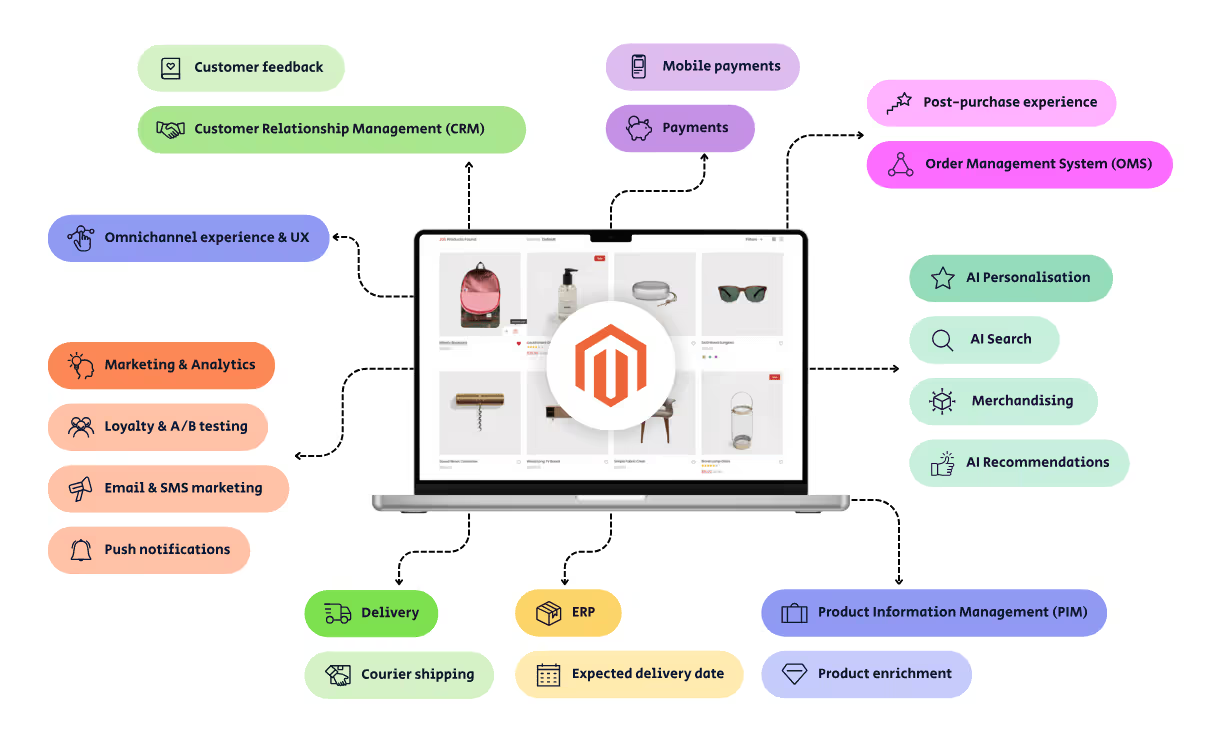
Ways to connect Magento and Mailchimp
| Option | Type | Best for | Notes |
|---|---|---|---|
| Mailchimp for Adobe Commerce (mailchimp/mc-magento2) | Connector | Magento stores that send newsletters and eCommerce automations from Mailchimp | Maintained by Ebizmarts Corp. Admin settings cover the API key, eCommerce data, abandoned carts, two-way sync, customer field mapping, and the Mailchimp pixel. Custom, bundled, grouped, and gift card products are not supported, and Site Tracking needs version 103.4.79 or later. |
| Newsletter-only setup of the same extension | Connector | Stores that only need Magento subscribes and unsubscribes in a Mailchimp audience | Leaves eCommerce and abandoned cart sync off and syncs subscription changes only. It is quicker to verify, but Mailchimp gets no order or cart data for automations. |
| Mailchimp Marketing API eCommerce endpoints | Custom API | Headless storefronts, ERP or in-store orders, and product types the extension skips | Models stores, customers, products and variants, carts, orders, and promo codes. Each store is tied to one audience and can't be moved. Every product needs at least one variant, and carts can't be converted straight into orders. |
What syncs between Magento and Mailchimp
| Data | Direction | System of record | Timing |
|---|---|---|---|
| Customers | Magento to Mailchimp | Magento | Cron-driven batches |
| Orders | Magento to Mailchimp | Magento | Cron-driven batches; each order shows a sync status in Magento |
| Products | Magento to Mailchimp | Magento or PIM | Cron-driven; custom, bundled, grouped, and gift card types are skipped |
| Abandoned carts | Magento to Mailchimp | Magento quote | Cron-driven, when abandoned cart sync is enabled |
| Newsletter subscribers | Two-way: Magento to Mailchimp by API, Mailchimp to Magento by webhook | Agree one owner | About 5 minutes in a scandiweb-tested setup, with cron running |
| Storefront events (product views, add to cart) | Browser to Mailchimp | Mailchimp pixel | Through the Mailchimp pixel; Site Tracking needs version 103.4.79 or later |
How a Magento Mailchimp integration project runs
- Install mailchimp/mc-magento2 with Composer and confirm Magento cron runs on every environment.
- Add the API key, then map each website or store view to its Mailchimp store and audience; a store stays tied to one audience.
- Enable eCommerce and abandoned cart sync only if you will use them.
- Turn on Two Way Sync and check the Mailchimp webhook can reach your site past any PWA router, firewall, or basic auth.
- Map customer fields, then test subscribe and unsubscribe from the footer, account page, checkout, and admin customer saves.
- Backfill subscribers that changed before two-way sync went live, then watch Mailchimp.log and order sync statuses for a week.
Common problems and how to avoid them
Customer saves push silent opt-outs
On a US toy brand's store, any customer save from a form without a newsletter checkbox made the connector send an opt-out to Mailchimp before Magento finished saving. Contacts looked subscribed in Magento but were opted out in Mailchimp, with the API key owner shown as the actor, so welcome and abandoned cart emails skipped them. The fix was a small override module that acts after Magento commits, estimated at about 8 hours.
Two-way sync never registered its webhook
On a multi-store B2B site, a PWA routing layer intercepted Mailchimp's webhook callback, and the cron job that processes incoming events crashed on one misconfigured store, blocking every store. Webhooks only carry new changes, so a one-time import of existing Mailchimp subscribers was also needed. The fix was estimated at 6 to 12 hours.
Orders stuck in Waiting
On a US subscription retailer's store, many orders sat in a Waiting or unsynced state for months. Ebizmarts support asked for Mailchimp.log and confirmation that cron was configured; updating the extension and monitoring the logs resolved it, within a 6 to 12 hour estimate.
Sync quietly stops feeding flows
On a mattress retailer's store, the integration had stopped syncing properly, so cart abandonment and product recommendation flows received no data and contacts never entered them. Resetting the Mailchimp settings in Magento and re-syncing subscribers and products restored daily updates and the abandoned cart flow, within a 4 to 8 hour estimate.
Some product types never sync
Mailchimp for Adobe Commerce does not support custom, bundled, grouped, or gift card product types. Product blocks and recommendations will miss them unless you send them through the API.
Why choose scandiweb to handle Magento integration for you?
How do you sync Magento (Adobe Commerce) customers and orders to Mailchimp in real time?
We map Magento entities and statuses to Mailchimp contacts, tags, and custom fields, then push updates via API on the events you choose. This keeps purchase history and customer profiles current without CSV exports.
Can a Magento to Mailchimp integration trigger abandoned cart and browse abandonment emails from behavior events?
Yes – we pass cart, product, and category interactions as tracked events, so Mailchimp automations fire on real shopper behavior. We also validate event deduplication to avoid double sends.
What Magento order data should be sent to Mailchimp for post-purchase and winback segmentation?
At minimum: order value, items, categories, discount use, and fulfillment status, plus customer lifetime metrics where available. That data powers replenishment, cross-sell, review requests, and re-engagement flows.
How do you prevent duplicate contacts and mismatched consent when integrating Magento with Mailchimp?
We implement a single source of truth for identity (email, customer ID), merge rules, and consent field mapping, then QA edge cases like guest checkout. This keeps deliverability and compliance stable as you scale.
Can scandiweb connect Magento, Mailchimp, and ERP or analytics tools for end-to-end lifecycle reporting?
Yes – we build integration layers across ERP, CRM, and analytics, then surface clean campaign inputs and revenue attribution in dashboards. Our team has delivered 575+ eCommerce BI dashboards and includes 60+ certified GA4 and Adobe Analytics experts.
Who maintains the Mailchimp extension for Magento 2?
Ebizmarts Corp maintains it as the mailchimp/mc-magento2 Composer package, and Mailchimp's help center calls it Mailchimp for Adobe Commerce.
Why are Magento subscribers opted out in Mailchimp?
On a store we fixed, the connector sent an opt-out whenever a customer record was saved from a form without a newsletter checkbox. Check the contact's activity in Mailchimp, enable extension logging, and test registration, account edits, and admin saves.
Does Mailchimp sync unsubscribes back to Magento?
Yes, with Two Way Sync: Mailchimp calls a webhook on your store and Magento cron processes the change. If the webhook URL is blocked or cron fails, changes made in Mailchimp never reach Magento.
Which Magento product types does Mailchimp not support?
Custom, bundled, grouped, and gift card product types, per Mailchimp's Adobe Commerce help article.
Can Magento store views use different Mailchimp audiences?
Yes. Each Mailchimp store is tied to one audience, and Mailchimp says stores on multiple domains can each connect to their own audience.
Sources
- Mailchimp help: Connect or disconnect Mailchimp for Adobe Commerce
- Packagist: mailchimp/mc-magento2
- Mailchimp developers: E-commerce documentation
- Ebizmarts wiki: Mailchimp Guide (part 2) Subscribers
- Ebizmarts wiki: Mailchimp Guide (part 3) Sync Ecommerce Data
Last updated by the scandiweb integration team.







Mailchimp integration on other platforms
More Magento integrations
1. Submit your integration request
2. Join a free strategy & discovery call
We’ll review your business systems, identify key challenges, and uncover actionable opportunities.
3. Get a tailored proposal
Trusted by 700+ leading brands worldwide