


Magento (Adobe Commerce) to Marketo integration for lifecycle email automation
Connect Magento 2 or Adobe Commerce with Marketo to sync customers, orders, and behavior events, so you can trigger accurate nurture, winback, and post-purchase flows.








Magento and Marketo integration in short
Magento (Adobe Commerce) connects to Marketo Engage through one of four routes: a connector such as Grazitti's Maginate, which turns customers into leads and syncs orders and abandoned carts into Marketo custom objects; Adobe's Data Connection into Experience Platform with the Marketo Engage destination for profiles and audiences; Adobe I/O Events with App Builder; or custom code on the Marketo REST API. Order data usually lands in custom objects, and Marketo's shared API limits shape the sync design.


• Customer, lead, and account fields are mapped between Magento (Adobe Commerce) and Marketo, with system-of-record rules controlling which side owns each attribute.
• Order data and line items are exported to Marketo as custom objects, linked back to the person record and keyed by stable identifiers (email and internal IDs).
• Signup, checkout, and account updates trigger event-based syncs, while scheduled delta syncs send only changed records to reduce API load.
• Consent, subscription status, and email opt-in flags are synchronized with validation to prevent overwriting newer preferences.
• Failed payloads are retried with backoff, and sync errors are logged with correlation IDs for traceability across systems.
• Multi-store and locale-specific values (store view, currency, language) are mapped to Marketo partitions, workspaces, or custom fields where applicable.
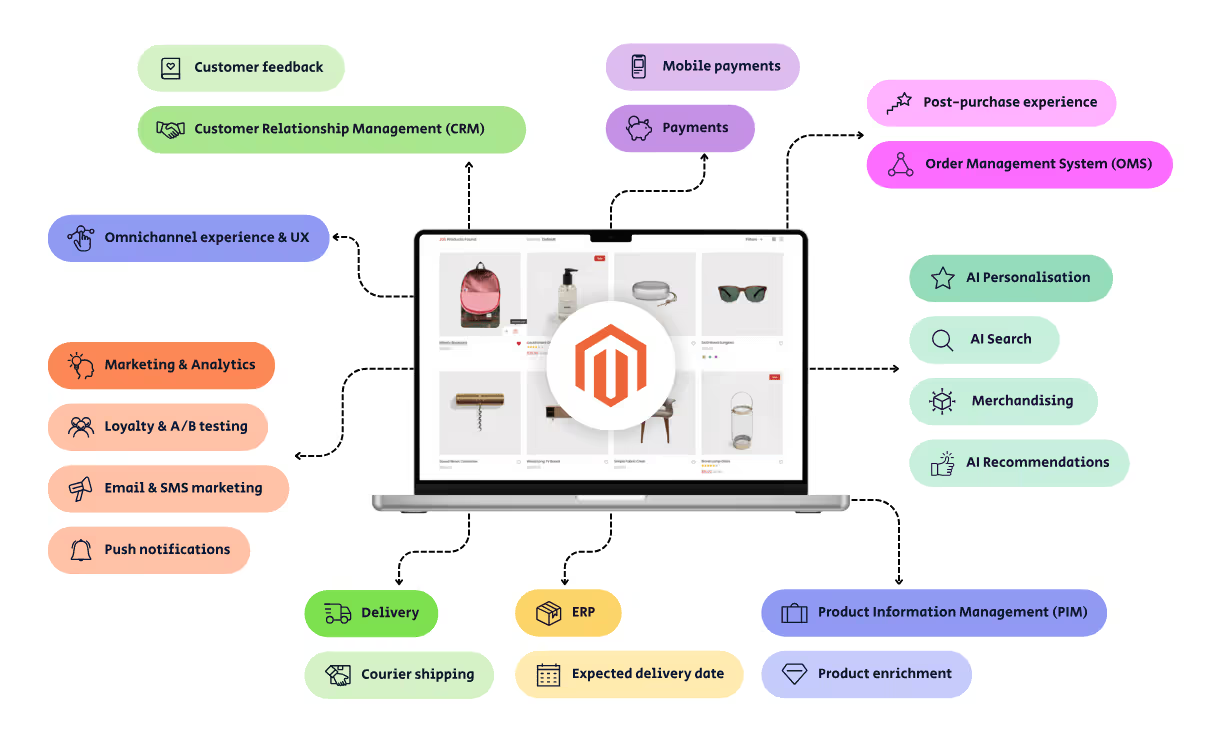
Ways to connect Magento and Marketo
| Option | Type | Best for | Notes |
|---|---|---|---|
| Maginate by Grazitti | Connector | Magento 2 stores that want orders and abandoned carts in Marketo without a custom build | Available for Magento 1 and Magento 2.x. Uses the Marketo REST API to convert Magento customers into leads and to sync order and abandoned cart data into Marketo custom objects. |
| Adobe Commerce Data Connection with the Marketo Engage destination | Integration platform | Adobe Commerce merchants already licensed for Experience Platform and Real-Time CDP | Data Connection (Adobe Commerce 2.4.4 or newer, Adobe Client Data Layer, Adobe DX entitlements) sends storefront, back office, and profile data to Experience Platform. The Marketo Engage destination then streams profile attributes and audience list membership to Marketo; Adobe's page describes no event or activity sync. |
| Adobe I/O Events and App Builder | Integration platform | Event-driven syncs on Adobe Commerce without custom modules in the store | Commerce sends events such as order placement to Adobe I/O Events, which routes them to an App Builder app. The app can read the full order from Commerce over REST or GraphQL and pass it on to a third-party system, such as Marketo's REST API. |
| Marketo REST API custom build | Custom API | Custom lead rules, B2B fields, and order objects designed for your smart campaigns | Leads plus custom objects linked to the lead for orders and carts; custom object sync takes up to 300 records per call. Each instance shares 100 calls per 20 seconds and 10 concurrent calls across all integrations, and a daily quota of 50,000 calls is common. |
What syncs between Magento and Marketo
| Data | Direction | System of record | Timing |
|---|---|---|---|
| Customers to leads | Magento to Marketo | Magento for account data | Connector or API schedule; streaming when using the Experience Platform destination |
| Orders and order lines | Magento to Marketo custom objects | Magento | Connector or API schedule, batched up to 300 records per call |
| Abandoned carts | Magento to Marketo custom objects | Magento quote | Through a connector such as Maginate or a custom build |
| Storefront, back office, and profile events | Magento to Experience Platform | Adobe Commerce | Through Data Connection; storefront events need the Adobe Client Data Layer |
| Audiences | Experience Platform to Marketo lists | Real-Time CDP | Streaming, as audience membership changes |
| Email preferences and unsubscribes | Marketo to Magento, if Magento shows preferences | Marketo | Custom; scheduled or webhook-driven |
How a Magento Marketo integration project runs
- Confirm edition and licenses: Data Connection is documented for Adobe Commerce 2.4.4 or newer with entitlements to other Adobe DX products; other setups use a connector or custom build.
- Agree the lead dedupe key, usually email, and how guest checkouts and form fills create leads.
- Design custom objects for orders and carts, including link and dedupe fields, before approval, because they can't be changed after.
- Create a dedicated Marketo API user for the integration and budget calls: batch up to 300 records and stay at or under 50 calls per 20 seconds.
- Backfill history with Marketo's bulk import, then switch to event-driven or scheduled deltas.
- Test lead creation, order linking, and preference changes with test records before go-live.
Common problems and how to avoid them
API limits are shared across every integration
Each Marketo instance has 100 calls per 20 seconds and 10 concurrent calls shared by all third-party services, and Adobe asks each integration to stay at 50 calls per 20 seconds or fewer. Daily quotas start at 10,000 calls and are commonly 50,000; going over the rate limit returns error 606.
Custom object schemas lock on approval
Once a custom object type is approved, you can't change its API name, add or remove a link field, or add or remove a dedupe field. Design order and cart objects, and their dedupe keys, before approving them.
The Experience Platform route does not carry orders
Adobe documents the Marketo Engage destination as profile attribute and list membership sync. Order history needs its own path, such as custom objects through a connector or the REST API. When several Marketo leads match a profile, only the most recently updated lead is updated.
Duplicate leads split preferences
On one Magento store, Marketo form fills in the customer account area created duplicate leads, and preference changes landed on only one record. scandiweb scoped a scheduled job that looks up leads by email and copies preference fields to every duplicate; merging duplicates at the source is the cleaner long-term fix.
Embedded Marketo forms need store-side logic
On the same store, a Marketo form loaded through Google Tag Manager needed Magento endpoints to remember who had submitted or dismissed it. Estimates were 9 to 18 hours through Tag Manager or 11 to 22 hours as a Magento module, and the form had to post to Marketo to keep lead scoring and CRM sync.
Why choose scandiweb to handle Magento integration for you?
How do you integrate Magento (Adobe Commerce) with Marketo for near-real-time customer and order sync?
We map Magento customer, order, and behavioral events to Marketo fields and programs, then sync via API with batching and retries. You get consistent segmentation signals for triggers and scoring.
Which Magento events can Marketo use for segmentation and email automation triggers?
Typical events include account creation, newsletter opt-in, product views, add-to-cart, checkout start, purchase, and refunds. We align events to your Marketo program logic and reporting needs.
Can Magento to Marketo integration support multi-store, multi-language, and multiple business units?
Yes, we can pass store view, locale, currency, and consent context into Marketo to keep audiences clean. This supports separate workspaces, partitions, or channel-level segmentation.
How do you prevent duplicate leads and bad data when syncing Magento contacts into Marketo?
We define a single unique key strategy, normalize email and customer IDs, and enforce field validation before write. We also set rules for guest checkout versus registered customers.
Who at scandiweb builds Magento (Adobe Commerce) to Marketo integrations, and how experienced are they?
Our certified engineers and data specialists handle the build, QA, and monitoring, backed by 22+ years in eCommerce delivery. We’ve shipped 2,100+ projects, including complex Magento (Adobe Commerce) integrations.
Is there an Adobe connector between Adobe Commerce and Marketo Engage?
Adobe's documented path is the Data Connection extension into Experience Platform plus the Marketo Engage destination in Real-Time CDP. It syncs profile attributes and audience list membership, so orders still need a connector or a custom build.
How do Magento orders get into Marketo?
Usually as custom objects linked to the lead, created by a connector such as Maginate or by your own code through the Marketo REST API, up to 300 records per call.
What are the Marketo API limits for a Magento integration?
A daily quota of 50,000 calls is common, and each instance allows 100 calls per 20 seconds and 10 concurrent calls, shared across all integrations. Adobe recommends 50 calls per 20 seconds or fewer per integration.
Can Marketo run abandoned cart emails for Magento?
Yes, if cart data reaches Marketo. Maginate, for example, syncs abandoned cart data into a Marketo custom object, and Marketo custom objects can be used in smart campaign triggers and filters.
Does Maginate support Magento 2?
Yes. Grazitti says Maginate is available for both Magento 1 and Magento 2.x and syncs through the Marketo REST API.
Sources
- Grazitti: Maginate FAQs
- Adobe Experience League: Data Connection introduction
- Adobe Experience League: Marketo Engage destination
- Adobe Developer: I/O Events for Adobe Commerce overview
- Adobe Experience League: Marketo custom objects (REST)
- Adobe Experience League: Marketo REST API
- Adobe Experience League: Marketo integration best practices
Last updated by the scandiweb integration team.







Marketo integration on other platforms
More Magento integrations
1. Submit your integration request
2. Join a free strategy & discovery call
We’ll review your business systems, identify key challenges, and uncover actionable opportunities.
3. Get a tailored proposal
Trusted by 700+ leading brands worldwide