


Magento Pimcore integration for centralized product data synchronization
Connect Magento with Pimcore PIM to centralize product data management and synchronize product catalogs automatically.








Magento and Pimcore integration in short
Magento (Adobe Commerce) connects to Pimcore through a third-party connector, such as Webkul's Pimcore Connector for Magento 2, or through a custom integration that reads product data from Pimcore's Datahub GraphQL API and writes it to the Magento REST API. Pimcore's own Data Importer handles the other direction, loading CSV, JSON, XML, or XLSX data, including the first export of an existing Magento catalog, into Pimcore objects.
Magento manages the storefront, product catalog display, checkout, and order processing. Pimcore manages product information, digital assets, and catalog structure. Connecting the two allows teams to manage product data in Pimcore while Magento uses that data to power the online store.
A properly implemented Magento Pimcore integration enables outcomes such as:
- managing product attributes, descriptions, and taxonomy in Pimcore
- synchronizing product data and variants to Magento catalogs
- distributing product data to multiple Magento store views
- publishing product images and assets from Pimcore DAM to Magento
- maintaining consistent product information across storefronts
- updating Magento catalogs automatically when product data changes
This integration is commonly used by brands managing large catalogs, multiple markets, or complex product data structures.


- Pimcore acts as the source of truth for product information and digital assets
- Product attributes, categories, and variants are mapped between Pimcore and Magento
- Product data is transferred through Pimcore APIs or a custom connector
- Magento receives product updates through scheduled sync jobs or event-based updates
- Digital assets stored in Pimcore DAM are exported to Magento product media
- Product changes in Pimcore trigger updates in Magento catalog data
- Large catalogs are synchronized using batch processing to maintain performance
- Separate environments and API credentials are used for testing and production
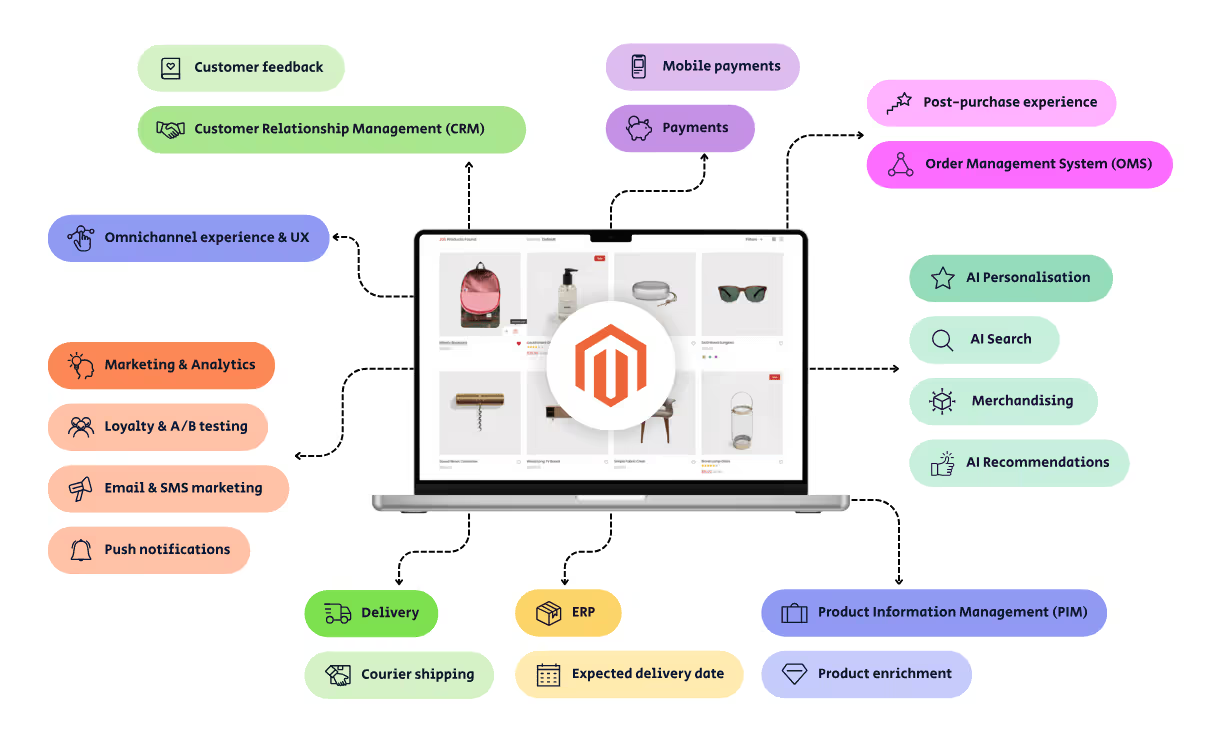
Ways to connect Magento and Pimcore
| Option | Type | Best for | Notes |
|---|---|---|---|
| Webkul Pimcore Connector for Magento 2 | Connector | Catalogs that fit Magento's standard product types and need two-way product, category, and attribute sync | Listed at $499, with paid add-ons for installation, cron setup, support, and Adobe Commerce editions. Imports and exports products, configurable products and variants, categories, attributes, and attribute sets through the Magento REST API. The changelog says it was rebuilt for Pimcore 12 and PHP 8.4. |
| Custom integration on Pimcore Datahub GraphQL and the Magento REST API | Custom API | Large or heavily customized catalogs, several store views, and teams that need control over batching and mapping | Datahub gives each configuration its own GraphQL endpoint (/pimcore-graphql-webservices/{configurationname}) secured with an API key, with queries and mutations for data objects, assets, and documents. Pair it with Magento's asynchronous bulk endpoints for large product writes. |
| Pimcore Data Importer | Native app | Loading a Magento export or ERP feed into Pimcore, including the first catalog migration | Adds import to Pimcore Datahub from asset, upload, HTTP, SFTP, push endpoint, and SQL sources in CSV, JSON, XML, XLSX, or SQL result format, with manual, scheduled, command line, and push-triggered runs. Resolver strategies decide whether a row updates or creates an object, and a delta check skips unchanged records. |
What syncs between Magento and Pimcore
| Data | Direction | System of record | Timing |
|---|---|---|---|
| Existing catalog (first load) | Magento to Pimcore | Magento until cutover, then Pimcore | One-time migration |
| Attributes and select options | Pimcore to Magento | Pimcore | Before products, so products land in the right attribute set |
| Categories | Pimcore to Magento | Pimcore | Scheduled sync |
| Simple products | Pimcore to Magento | Pimcore for product content | Scheduled batches, paged, for products flagged for sync |
| Configurable products and variants | Pimcore to Magento | Pimcore | Same batch as their children |
| Images and assets | Pimcore DAM to Magento | Pimcore | With the product sync |
| Prices | ERP to Magento, directly or through Pimcore | ERP | Scheduled sync |
How a Magento Pimcore integration project runs
- Audit the Magento attributes and decide whether to migrate all of them, only selected ones, or to clean up Magento first.
- Model the Pimcore classes against Magento: attribute sets, select options, website-scoped fields such as price, status, and visibility, and localized fields such as name and description.
- List every website, store view, and language that needs data before mapping starts.
- Run the initial migration from Magento into Pimcore, then stop editing product content in Magento.
- Map Pimcore fields to Magento attribute codes and sync attributes and options before products.
- Sync products in pages and test configurable products, images, and every store view on staging.
- Validate the data before connecting Pimcore production to Magento production, then schedule the sync and watch the logs.
Common problems and how to avoid them
Loading every product at once takes down the server
In a scandiweb project for an industrial distributor, the Pimcore to Magento import loaded all products in one pass and used all RAM and CPU within minutes. The team changed the import to page through the GraphQL results instead. Build pagination into any Pimcore sync from the start.
A field hidden in Pimcore but required in Magento stops variants
On a scandiweb project for a premium food brand, configurable products reached Magento without their children because weight was hidden, and so empty, on parent products in Pimcore while Magento requires it. The error fired at the default store level, where child assignment happens, so the configurable sync never finished. The fix set an empty weight to 0 on the Magento side.
Children link only through the right attribute set
In the same project, variants linked to their parent only when parent and children used an attribute set that contained the size attribute. Products created by hand in Pimcore got the default set and arrived as unlinked simple products, so the correct steps went into the client's product setup guide.
Empty status or website fails the product
The distributor's sync rejected products with an empty status or no website selected, and a text attribute longer than its Magento field allowed. Make status and website mandatory in Pimcore, or exclude such products from the sync, so they do not surface later as errors in the logs.
Adding a language later is a change request
On one scandiweb project, a new country website and language were added after the Pimcore scope was set. It had to be enabled in Pimcore and in every custom feature and integration, and the options were to delay that store's launch, move its data by CSV later, or customize the connector for a separate migration, estimated at 22 to 39 hours.
Pimcore upgrades break connector bundles
When a scandiweb team installed existing Pimcore import and export bundles on a newer stack, both needed code changes for Symfony 7.3 and PHP 8.3 before they would run. Budget connector maintenance into every Pimcore major upgrade.
Why choose scandiweb to handle Magento integration for you?
What is Magento Pimcore integration used for?
Magento Pimcore integration connects Magento storefronts with Pimcore PIM to manage product information centrally.
Does Pimcore replace Magento product catalog management?
No. Pimcore manages product data while Magento continues to manage catalog presentation and commerce functionality.
Can Pimcore synchronize product updates to Magento automatically?
Yes. Product data updates in Pimcore can be synchronized to Magento through scheduled or event-based synchronization.
Can Pimcore manage product images for Magento stores?
Yes. Pimcore DAM can store product images and publish them to Magento product pages.
Is Magento Pimcore integration suitable for large product catalogs?
Yes. Pimcore is commonly used to manage large catalogs with complex attributes and variants.
Can Pimcore support multiple Magento store views and languages?
Yes. Pimcore supports localized product data and multi-store catalog distribution.
What API does Pimcore offer for a Magento integration?
Pimcore Datahub provides GraphQL endpoints, one per configuration, protected by an API key, with queries and mutations for data objects, assets, and documents. A custom Magento integration reads product data there and writes it through the Magento REST API.
How do I move existing Magento products into Pimcore?
Export from Magento and load the files with Pimcore's Data Importer, which reads CSV, JSON, XML, and XLSX and decides per row whether to update or create an object. Audit the attributes first: on one scandiweb project the client chose between migrating every attribute, migrating only selected ones (extension attributes only if those product types would be managed in Pimcore), and cleaning up Magento first.
How much does a Pimcore connector for Magento cost?
Webkul lists its Pimcore Connector for Magento 2 at $499, with add-ons for installation, Pimcore installation, cron setup, support, and an Adobe Commerce edition. A custom build on Datahub GraphQL has no license fee but needs development and upkeep.
Does a Pimcore to Magento sync run in real time?
It depends on the build. Pimcore's Data Importer supports push-triggered runs for inbound data, while outbound product syncs are often scheduled; on scandiweb projects the Pimcore to Magento product sync ran as a cron job that picked up products flagged for sync.
Why do configurable products arrive in Magento without variants?
On scandiweb projects the two causes were an attribute set without the variant attribute, such as size, and a field Magento requires, such as weight, left empty on the parent in Pimcore. Check both before debugging the connector code.
Sources
- Pimcore docs: Datahub GraphQL
- Pimcore docs: Data Importer
- Webkul Store: Pimcore Connector for Magento 2
- Adobe Commerce developer docs: Bulk endpoints
Last updated by the scandiweb integration team.







Pimcore integration on other platforms
More Magento integrations
1. Submit your integration request
2. Join a free strategy & discovery call
We’ll review your business systems, identify key challenges, and uncover actionable opportunities.
3. Get a tailored proposal
Trusted by 700+ leading brands worldwide