


Magento to Klaviyo integration for better segmentation and email revenue
Connect Magento (Adobe Commerce) with Klaviyo to sync customers, orders, and product data, then use scandiweb’s CRO and analytics team to scale email and SMS performance.








Magento and Klaviyo integration in short
Install Klaviyo's Magento 2 extension with Composer and connect it to Klaviyo through a Magento OAuth integration; after an initial historical import, Klaviyo syncs orders and customers every 30 minutes, turns active carts into Started Checkout events, and tracks browsing and cart events onsite. Multi-brand setups use one Klaviyo account per brand, and headless or PWA storefronts must add Klaviyo's JavaScript tracking themselves and often a custom catalog feed.
Does your email team wait on developers to build “one more” segment, fix mismatched customer data, or explain why Magento (Adobe Commerce) revenue in reports never lines up with what campaigns show? Those delays add up, and they usually show up right when you need speed, like during BFCM, a product drop, or a pricing change.
The Magento Klaviyo integration connects your store data with Klaviyo so customer profiles, events, and catalog context stay consistent across marketing and merchandising. It enables a cleaner workflow for a Klaviyo email marketing integration for Magento, where targeting, automation logic, and reporting use the same source data instead of patchy exports and one-off syncs.
This setup fits if you run multiple campaigns per week, rely on lifecycle flows, or need dependable Magento to Klaviyo data for segmentation.


• Storefront and admin events (signup, checkout started, order placed, order refunded) are sent from Magento (Adobe Commerce) to Klaviyo as event payloads tied to an email or customer ID.
• Customer profiles are mapped between Magento customers and Klaviyo profiles, with identifiers normalized and merged where matching rules apply.
• Order, line item, discount, tax, shipping, and currency fields are mapped into Klaviyo’s order event schema, with amounts stored per transaction context.
• Product and variant attributes (SKU, name, URL, image, price, categories) are synced to Klaviyo catalog objects for use in dynamic blocks and recommendations where supported.
• Delta sync logic sends only changed customers, products, and orders after the initial backfill, with timestamps used to detect updates and prevent duplicates.
• Consent and subscription status values are mapped to Klaviyo lists and suppression rules based on the store’s opt-in model and locale requirements.
• Sync jobs write structured logs for processed, skipped, and failed records, with retries and idempotency handling applied to event delivery.
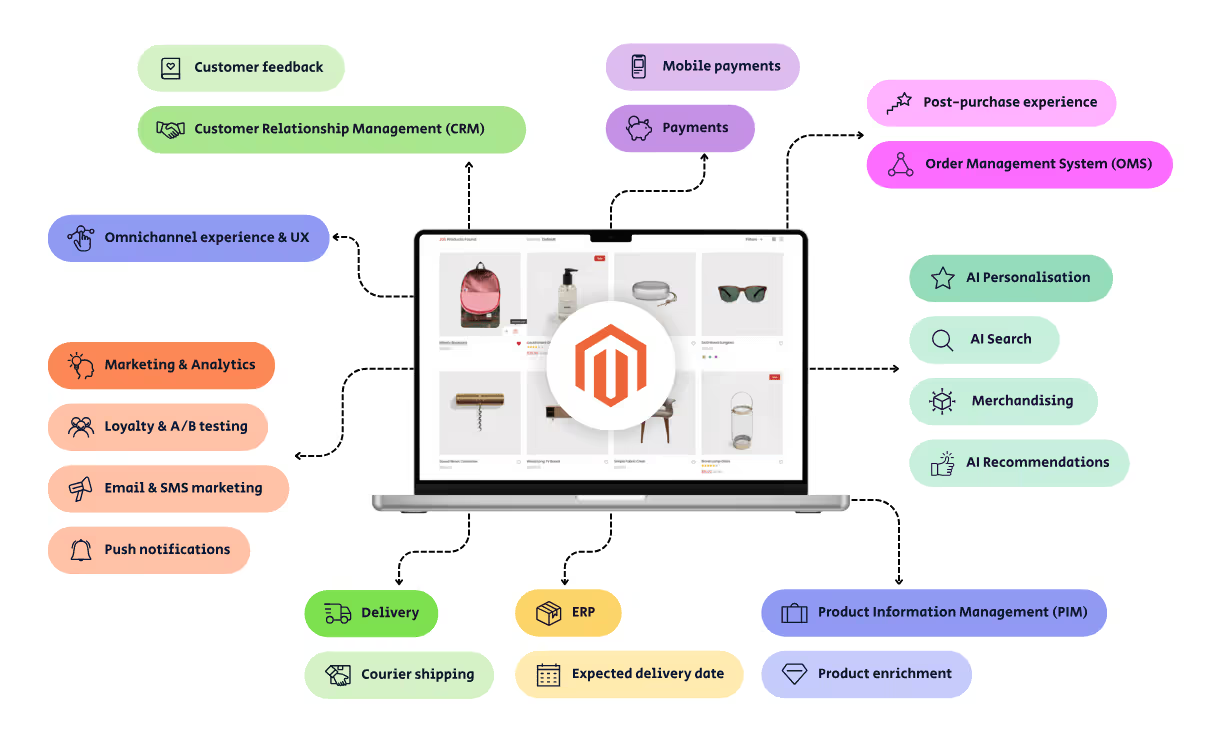
Ways to connect Magento and Klaviyo
| Option | Type | Best for | Notes |
|---|---|---|---|
| Klaviyo extension for Magento 2 | Native app | Magento (Adobe Commerce) stores with a standard Magento storefront | Installed with Composer by someone with SSH access, then connected through a Magento OAuth integration. The store needs a publicly reachable hostname over HTTPS. After the historical sync, orders and customers sync every 30 minutes. Klaviyo's setup guide states that Magento versions below 2.4.5 are not supported, and webhooks must be on for consent at checkout to work. |
| Store view scoping with separate Klaviyo accounts | Native app | Multi-brand or multi-country Magento instances | API keys are set at website and store view scope. Klaviyo recommends one shared account only for language versions of the same brand; a shared account adds MagentoStore and MagentoWebsiteID profile properties but cannot fully isolate each store's data. |
| Klaviyo JavaScript tracking for headless or PWA storefronts | Custom API | Headless Magento, PWA, or SPA front ends | Order, cart, catalog, and subscriber sync still run server side through the extension. Active on Site, Viewed Product, Added to Cart, and identify calls must be added to the front end, and Started Checkout needs the headless checkout to save the shopper's email on the Magento quote. |
| Klaviyo custom catalog feed | Custom API | Large catalogs that need product filtering or attribute-based categories | A hosted JSON or XML feed that Klaviyo resyncs every six hours, with each variant as its own item. Adding a field means deleting and re-adding the source, so the taxonomy is designed up front. |
| Klaviyo Events API for ERP and in-store data | Custom API | In-store purchases, loyalty tiers, and consent held in an ERP | Server-side events sent straight to Klaviyo, attached by email, phone number, or Klaviyo ID. A repeated unique_id for the same profile and metric is recorded once, which makes reruns safe. |
What syncs between Magento and Klaviyo
| Data | Direction | System of record | Timing |
|---|---|---|---|
| Orders (Placed Order, Fulfilled Order, Cancelled Order, Refunded Order) | Magento to Klaviyo | Magento | Every 30 minutes; orders in pending_payment status are skipped |
| Order lines (Ordered Product) | Magento to Klaviyo | Magento | Every 30 minutes; one event per unit, up to 100 per line item |
| Carts (Started Checkout) | Magento to Klaviyo | Magento quote | Active quotes with an email and items; can take up to 1 hour |
| Customers | Magento to Klaviyo | Magento | Every 30 minutes |
| Newsletter consent | Magento to Klaviyo through the extension; Klaviyo to Magento needs custom work | Agree one master (Klaviyo on one scandiweb project) | With the sync; reverse direction as built |
| Browse and cart events (Viewed Product, Added to Cart, Active on Site) | Storefront to Klaviyo | Klaviyo onsite tracking | Added to Cart needs extension 4.0.0 or later |
| Shipments (Fulfilled Shipment) | Magento to Klaviyo | Magento | When a shipment is created |
| Catalog | Magento to Klaviyo | Magento or PIM | Full historical re-sync on demand |
How a Magento Klaviyo integration project runs
- Map stores to Klaviyo accounts: one per brand, or one shared account only for language versions of the same brand.
- Prepare the server: public HTTPS hostname, Klaviyo's static IPs allowed through the firewall on every environment, and reachable /oauth/token endpoints.
- Install the extension with Composer, create the Magento OAuth integration, and set API keys at website and store view scope.
- Enable webhooks, choose email and SMS lists, and upload existing customers to the list, because that setting only syncs new customers.
- On headless or PWA storefronts, add klaviyo.js, identify, Viewed Product, and Added to Cart, and make Started Checkout links restore the cart.
- Run the historical sync, then test one order end to end against Magento: event names, values, tax, categories, and product URLs.
- Before go-live, reconcile newsletter status in both systems and agree which side wins a conflict.
Typical effort: 8 to 16 hours for the extension across three store views; 60 to 120 hours with PWA tracking, cart events, and a custom catalog feed. Magento-side development effort from a scandiweb scoping estimate for a three-storefront headless store; flows, segments, and ERP feeds are separate. Based on scandiweb project estimates.
Common problems and how to avoid them
Two consent tables, one wrong answer
On a sportswear retailer's store, consent lived in a GDPR module's log table while the Klaviyo sync only updated Magento's newsletter table. At checkout the stale checkbox state was sent to Klaviyo and unsubscribed customers. The fix kept both tables in step, and welcome flows were paused before the correct statuses were re-imported.
Sync stops when Magento returns errors
On one store, Varnish returned 503 errors to Klaviyo's order sync during slow periods. On another, a release that produced many 500 errors stopped sync on all of the store's country accounts until Klaviyo support restarted it and backfilled the missing days.
Headless storefronts lose cart events
On a PWA storefront, Added to Cart never fired until the front end was wired by hand, and Started Checkout carried a bare /checkout link, so abandonment emails opened an empty cart on another device. Klaviyo's headless guide confirms onsite events must be added manually.
Catalog links and sync need checking
Synced products used Magento's /catalog/product/view/id/ URLs, which need rewrite rules to resolve on a custom storefront, and the first catalog sync stalled for days.
Event values do not agree with each other
In testing, Ordered Product carried the line value after discount and without VAT, while Placed Order carried the VAT-inclusive total, and category names differed in case between browse and order events, which splits case-sensitive segments. Klaviyo also does not subtract canceled or refunded orders from Placed Order revenue.
OAuth fails behind store paths, firewalls, or 2.4.6 defaults
Klaviyo's OAuth needs a public site and reachable /oauth/token endpoints, and store subpaths can hide them. On Magento 2.4.6, 401 errors are fixed by allowing OAuth access tokens as stand-alone bearer tokens. On one project the team also allowlisted Klaviyo's IPs on staging and changed code so Klaviyo could reach the endpoint.
Why choose scandiweb to handle Magento integration for you?
How do you set up a Magento (Adobe Commerce) to Klaviyo integration for real-time customer and order events?
We map Magento events (product view, add to cart, checkout, purchase) to Klaviyo profiles and metrics, then validate timing and de-duping. If needed, we add server-side tracking and a clean data layer for consistent event payloads.
What Magento data can sync to Klaviyo for segmentation and product-driven email flows?
Typical sync includes customers, consent, orders, refunds, line items, and catalog data such as SKUs, categories, and inventory flags. That gives you segments like “high AOV buyers,” “back-in-stock watchers,” and “repeat purchasers by category.”
Can scandiweb fix Magento revenue mismatch issues between Klaviyo, GA4, and Adobe Commerce reports?
Yes—our analytics team audits attribution, tracking, and event definitions, then aligns source-of-truth logic across platforms. We have 60+ certified GA4 and Adobe Analytics experts and have delivered 575+ eCommerce BI dashboards.
Does Klaviyo integrate with Magento multi-store and localization setups?
Yes, we can separate data by store view, currency, language, and consent rules, then sync them into the right Klaviyo lists, profiles, and product feeds. This keeps localization clean for flows, reporting, and suppression logic.
Can you improve email and SMS conversion after the Magento Klaviyo integration is live?
Yes—our CRO and UX team tests signup, onsite capture, and checkout messaging to lift opt-ins and downstream revenue. Across our CRO program, clients average +48% conversion rate improvements after optimization work.
Which Magento versions does the Klaviyo extension support?
Klaviyo's setup guide states that Magento 2 versions below 2.4.5 are not supported. Its troubleshooting guide also lists a known OAuth activation failure on 2.4.2 and a bearer token setting needed on 2.4.6.
How often does Klaviyo sync with Magento?
After the historical sync, orders and customers sync every 30 minutes, and Started Checkout events can take up to an hour.
Does the Klaviyo extension work with headless or PWA Magento?
Partly. Orders, carts, catalog, and subscribers still sync server side, but Active on Site, Viewed Product, Added to Cart, and identify calls must be added to your front end with Klaviyo's JavaScript.
Do Klaviyo unsubscribes sync back to Magento?
Klaviyo's guide documents syncing newsletter subscriptions from Magento to Klaviyo. On scandiweb projects the reverse direction was built separately with Klaviyo flow webhooks, plus a one-off script for changes made before the sync went live.
Should each Magento store view have its own Klaviyo account?
For different brands, yes: Klaviyo says it is not optimized for multiple brands in one account, and a shared account cannot fully isolate each store's data. A shared account suits language versions of the same brand.
Why are some Magento orders missing in Klaviyo?
Orders in pending_payment status are skipped, and sync runs every 30 minutes. Check Klaviyo's sync error notices and your server logs for the failing API calls.
Sources
- Klaviyo help: Getting started with Magento 2
- Klaviyo help: Magento 2 data reference
- Klaviyo help: Supporting multiple Magento stores
- Klaviyo help: Troubleshooting your Magento 2 integration
- Klaviyo help: How to integrate a headless Magento 2 setup
- Klaviyo developers: Syncing a custom catalog feed
- Klaviyo API reference: Create Event
Last updated by the scandiweb integration team.







Klaviyo integration on other platforms
More Magento integrations
1. Submit your integration request
2. Join a free strategy & discovery call
We’ll review your business systems, identify key challenges, and uncover actionable opportunities.
3. Get a tailored proposal
Trusted by 700+ leading brands worldwide