


Shopify Klaviyo integration for lifecycle email flows that drive repeat sales
Connect Shopify and Klaviyo to track real purchase behavior, segment customers, and launch revenue-focused email and SMS automations, with scandiweb handling data, UX, and CRO.







Shopify and Klaviyo integration in short
Most Shopify stores connect Klaviyo with Klaviyo's own Shopify app, which syncs customers, orders, products, and consent in real time and adds onsite tracking through a theme app embed. Klaviyo supports one Shopify store per Klaviyo account, so multi-store brands run one account per store, and data the app does not send, such as B2B market data, loyalty, or offline orders, goes in through Klaviyo's Events API or a custom catalog feed.


• Shopify customer, order, and product catalog objects are synced into Klaviyo profiles and catalog items using platform identifiers (email, customer ID, SKU/variant ID).
• Storefront and checkout activity is captured as Klaviyo events (Viewed Product, Added to Cart, Started Checkout, Placed Order), with timestamps and monetary values passed in event payloads.
• Consent and subscription states are mapped to Klaviyo email and SMS profiles where available, with updates propagated when customers opt in, opt out, or change channels.
• Delta sync logic sends only changed records after the initial import; retries handle transient API failures, and duplicates are deconflicted through unique keys.
• Order and line-item data is normalized for segmentation and flows, including currency, discounts, shipping, taxes, and fulfillment status where exposed by Shopify.
• Sync activity and exceptions are logged for traceability, with payload validation to prevent malformed attributes from overwriting existing Klaviyo profile properties.
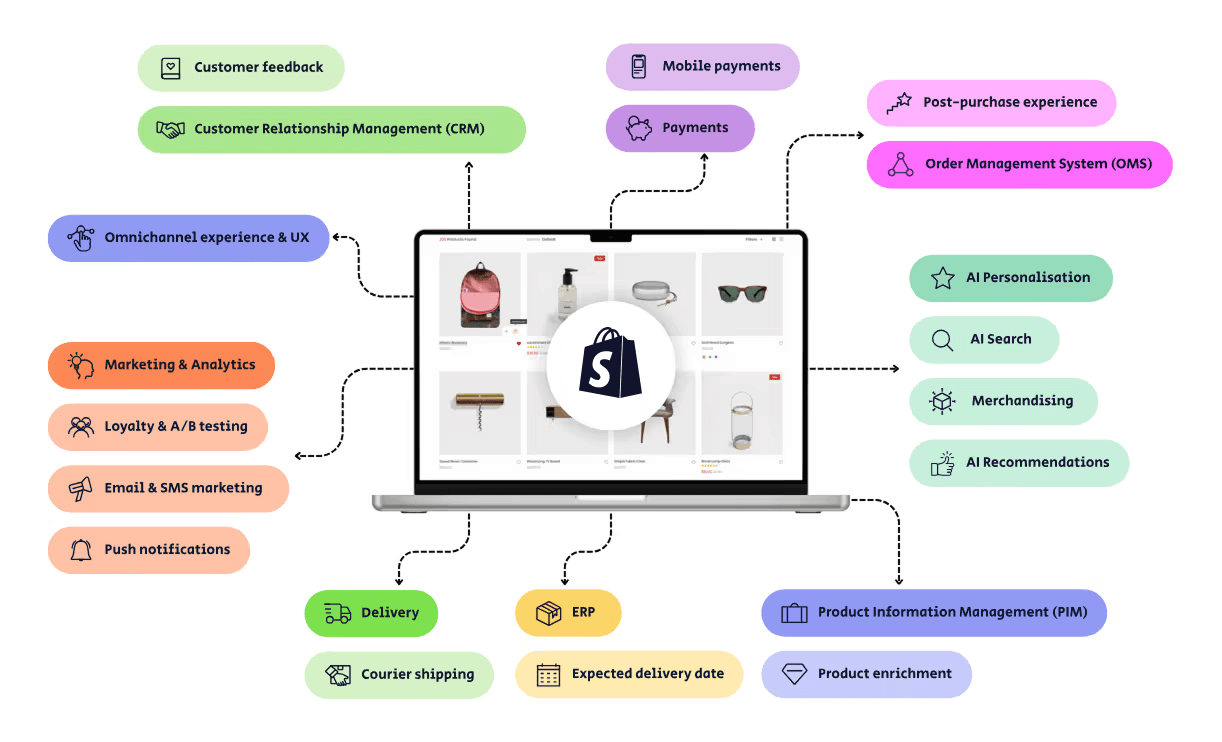
Ways to connect Shopify and Klaviyo
| Option | Type | Best for | Notes |
|---|---|---|---|
| Klaviyo: Email Marketing & SMS (Shopify app) | Native app | A single Shopify or Shopify Plus store on an Online Store theme | Built by Klaviyo. Metrics and profile properties sync in real time after a historical sync that loads the last 90 days first and then older data, up to 10 years by default. Onsite tracking runs through the app embed: Active on Site and Viewed Product by default, plus Viewed Collection, Submitted Search, and Added to Cart when behavioral tracking is on. It can also sync contact details, locale, consent, and custom properties back to Shopify. |
| One Klaviyo account per Shopify store | Native app | Brands running several Shopify stores for regions or brands | Klaviyo does not support more than one Shopify store per Klaviyo account, so each store connects to its own account. Shopify Markets sync can be on in only one Klaviyo account per Shopify account at a time. Reporting across stores then has to combine data from several accounts. |
| Klaviyo Events API (Create Event) | Custom API | Events the app does not send: B2B quotes, loyalty tier changes, subscriptions, and ERP or in-store orders | POST /api/events attaches an event to a profile by Klaviyo ID, email, or phone number and can create or update that profile. Repeating a unique_id for the same profile and metric records the event only once. Documented rate limits are 350 requests per second burst and 3,500 per minute steady. |
| Klaviyo custom catalog feed | Custom API | Catalogs that need product filtering, extra attributes, or items outside Shopify's product model | A hosted JSON or XML feed that Klaviyo resyncs every six hours, with files up to 100 MB each. There is no native variant support, so each variant is its own item. Adding a field later means deleting and re-adding the feed source. A custom catalog can run alongside the catalog synced by the Shopify integration. |
What syncs between Shopify and Klaviyo
| Data | Direction | System of record | Timing |
|---|---|---|---|
| Customers and profiles | Shopify to Klaviyo, with optional sync back to Shopify | Shopify for contact details (Klaviyo only fills empty Shopify fields) | Real time into Klaviyo; within 30 minutes back to Shopify |
| Orders (Placed Order, Ordered Product, Fulfilled Order, Cancelled Order, Refunded Order) | Shopify to Klaviyo | Shopify | Real time; an event is not re-synced after it is first recorded |
| Checkout Started | Shopify to Klaviyo | Shopify checkout | Real time, once Shopify sends the checkout with an email or phone number |
| Browsing events (Active on Site, Viewed Product, Viewed Collection, Submitted Search, Added to Cart) | Storefront to Klaviyo | Klaviyo onsite tracking | Real time, after consent for visitors in the EU, EEA, UK, and Switzerland |
| Email and SMS consent | Two-way | Agree one owner; Klaviyo suppressions do not sync to Shopify | Real time into Klaviyo; within 30 minutes back to Shopify |
| Products and Markets prices | Shopify to Klaviyo | Shopify | Ongoing; the first Markets catalog sync can take multiple days, depending on catalog size |
| Email and SMS engagement events | Klaviyo to Shopify | Klaviyo | Within 24 hours |
How a Shopify Klaviyo integration project runs
- Map stores to accounts first: one Klaviyo account per Shopify store, and decide which account, if any, gets Shopify Markets sync.
- If you are moving from another email platform, disconnect its Shopify integration before connecting Klaviyo.
- Install the Klaviyo app, connect the store, and pick the Klaviyo lists that receive Shopify email and SMS subscribers.
- Turn on the app embed, enable behavioral tracking and Shopify Network Intelligence if you need collection, search, and cart events, and check the consent banner for EU and UK visitors.
- Set the outbound sync: which profiles go back to Shopify, which custom properties become metafields, and which system owns consent.
- Let the historical sync finish, then compare Placed Order counts and revenue with Shopify for the same period.
- Add the Events API or a custom catalog feed only for data the app does not send.
Common problems and how to avoid them
One Shopify store per Klaviyo account
Klaviyo does not support more than one Shopify store per account, so regional or brand stores need separate Klaviyo accounts. On a scandiweb project, reporting revenue across several stores needed a data warehouse to join the accounts.
Klaviyo revenue drifts from Shopify
Klaviyo does not re-sync a metric after the first event, so later order edits and tags are not updated. Partial refunds do not trigger Refunded Order. Reconcile against Shopify and treat Klaviyo revenue as a flow signal, not a finance number.
Double opt-in emails when switching platforms
If the previous email platform's Shopify integration is still connected when Klaviyo goes live, existing subscribers can receive double opt-in emails. Disconnect the old integration before connecting Klaviyo.
Existing SMS subscribers do not come across
SMS consent syncs to Klaviyo only when a person subscribes to SMS in Shopify for the first time. Existing SMS subscribers need Klaviyo's separate historical procedure, and text messaging must be set up in Klaviyo before the sync.
B2B and Retail markets are not synced
Klaviyo's Markets sync covers Shopify region markets and does not currently sync B2B or Retail markets. B2B prices, company data, or POS context have to reach Klaviyo another way, for example as profile properties or events through the API.
Browse events go missing or arrive anonymous
Onsite tracking may not run for visitors in the EU, EEA, UK, or Switzerland until they consent. Viewed Collection, Submitted Search, and Added to Cart need Shopify Network Intelligence turned on, or Shopify may send them without the shopper's identity.
Why choose scandiweb to handle Shopify integration for you?
How do you set up Shopify Klaviyo event tracking so checkout, refunds, and subscription events are accurate?
We audit Shopify, Klaviyo, and pixels, then align events, IDs, and consent so flows trigger on the right customer actions. If needed, we add server-side tracking and QA with test orders to confirm reporting.
Can Shopify Klaviyo integration support multi-store, multi-currency, and localization without breaking segmentation?
Yes – we map store, currency, language, and market attributes into Klaviyo properties so segments stay clean across regions. This keeps flows and reporting consistent as you add new storefronts.
What data should sync from Shopify to Klaviyo for better lifecycle email and SMS automation?
Typically: customer profiles, product and variant data, order history, refunds, discounts, browsing events, and consent states. We also add custom properties when you need tighter targeting, like loyalty tier or margin bands.
How do you fix duplicate profiles and attribution gaps in a Shopify Klaviyo integration?
We diagnose identity and consent mismatches, then standardize profile keys and tracking sources to reduce duplicates. For attribution, we reconcile Klaviyo metrics with GA4 and ad platforms to spot where data diverges.
Why choose scandiweb for Shopify Klaviyo integration services when you also need CRO and analytics support?
You get one team covering integration, GA4 and BI, and CRO, so targeting, measurement, and onsite UX work as one system. scandiweb has delivered 2,100+ eCommerce projects since 2003, and our CRO program averages +48% conversion rate improvements.
Is the Klaviyo Shopify app free?
The app is free to install, and Klaviyo's free tier covers up to 250 active profiles and 500 emails a month. Per the Shopify App Store listing, paid email plans start at $20 a month and SMS at $15 a month.
Can I connect two Shopify stores to one Klaviyo account?
No. Klaviyo does not support more than one Shopify store per Klaviyo account, so each store needs its own account.
How far back does Klaviyo import Shopify order history?
Klaviyo syncs the last 90 days of orders and customers first, then older data, covering up to 10 years by default. Klaviyo says this takes from a few minutes to several days, depending on store size.
Do Klaviyo unsubscribes sync back to Shopify?
Yes, when outbound sync is on: email and SMS subscribes and unsubscribes in Klaviyo update Shopify, usually within a minute and at most 30 minutes. Klaviyo suppressions do not sync to Shopify.
Why doesn't Klaviyo revenue match Shopify?
Klaviyo records each order event once and does not re-sync it after edits, and partial refunds do not trigger Refunded Order. Compare by order count and date range, and use Shopify for finance figures.
Does Klaviyo work with Shopify B2B?
Klaviyo's Markets sync supports region markets and does not currently sync B2B or Retail markets. B2B company and price data usually goes to Klaviyo as profile properties or events through Klaviyo's API.
Sources
- Klaviyo help: Getting started with Shopify
- Klaviyo help: Shopify data reference
- Klaviyo help: Troubleshooting your Shopify integration
- Klaviyo help: How to use Shopify Markets with Klaviyo
- Klaviyo help: How to sync data from Klaviyo to Shopify
- Klaviyo API reference: Create Event
- Klaviyo developers: Syncing a custom catalog feed
- Shopify App Store: Klaviyo: Email Marketing & SMS
Last updated by the scandiweb integration team.







Klaviyo integration on other platforms
More Shopify integrations
1. Submit your integration request
2. Join a free strategy & discovery call
We’ll review your business systems, identify key challenges, and uncover actionable opportunities.
3. Get a tailored proposal
Trusted by 700+ leading brands worldwide