


Shopify + NetSuite Accounting integration for accurate, automated financials
Connect Shopify with NetSuite Accounting to sync orders, refunds, taxes, payouts, and customers, so your books close faster and your team stops fixing data in spreadsheets.







Shopify and Netsuite Accounting integration in short
For accounting, a Shopify and NetSuite integration posts each order as a cash sale or invoice, each refund as a cash refund or credit memo, and each Shopify Payments payout as a NetSuite deposit with the fees as deposit lines. Oracle's NetSuite Connector does this with its Shopify Payout Report Sync, Celigo offers payout report import as an add-on, and a custom build can read fees and net amounts per payout from the Shopify GraphQL Admin API.
Are you reconciling Shopify orders in NetSuite with exports, manual journal entries, and “quick fixes” at month-end? That’s how duplicates, tax mismatches, and timing gaps sneak in, and why Finance and Operations end up arguing about whose numbers are right.
The Shopify – NetSuite Accounting integration connects your storefront and ERP so sales, payments, refunds, discounts, shipping, and tax totals flow into NetSuite in a consistent posting structure. It turns daily order activity into accounting-ready records, keeping settlement logic and revenue timing aligned with how you actually sell.
This setup fits if Shopify is your sales engine and NetSuite is your source of truth for financial reporting.


• Orders are pulled from Shopify via API and transformed into NetSuite transactions (typically Sales Orders, Invoices, or Cash Sales) based on the agreed posting model.
• Payouts and payment gateways are mapped to NetSuite payment methods and clearing accounts, with settlement batches linked back to underlying order groups.
• Refunds, cancellations, and partial returns sync as credit transactions, with line-level amounts and tax adjustments preserved where available.
• Discounts, gift cards, shipping charges, and tips are mapped to dedicated NetSuite items or accounts to maintain consistent GL impact.
• Taxes are transferred as summarized or line-level values (implementation-dependent) and routed to the correct tax codes, subsidiaries, and nexus rules.
• Customer records are matched on unique identifiers (email, external ID), with rules for create-vs-update to prevent duplicates.
• Delta syncs send only changed records, while sync logs capture timestamps, payload references, and error details for reprocessing.
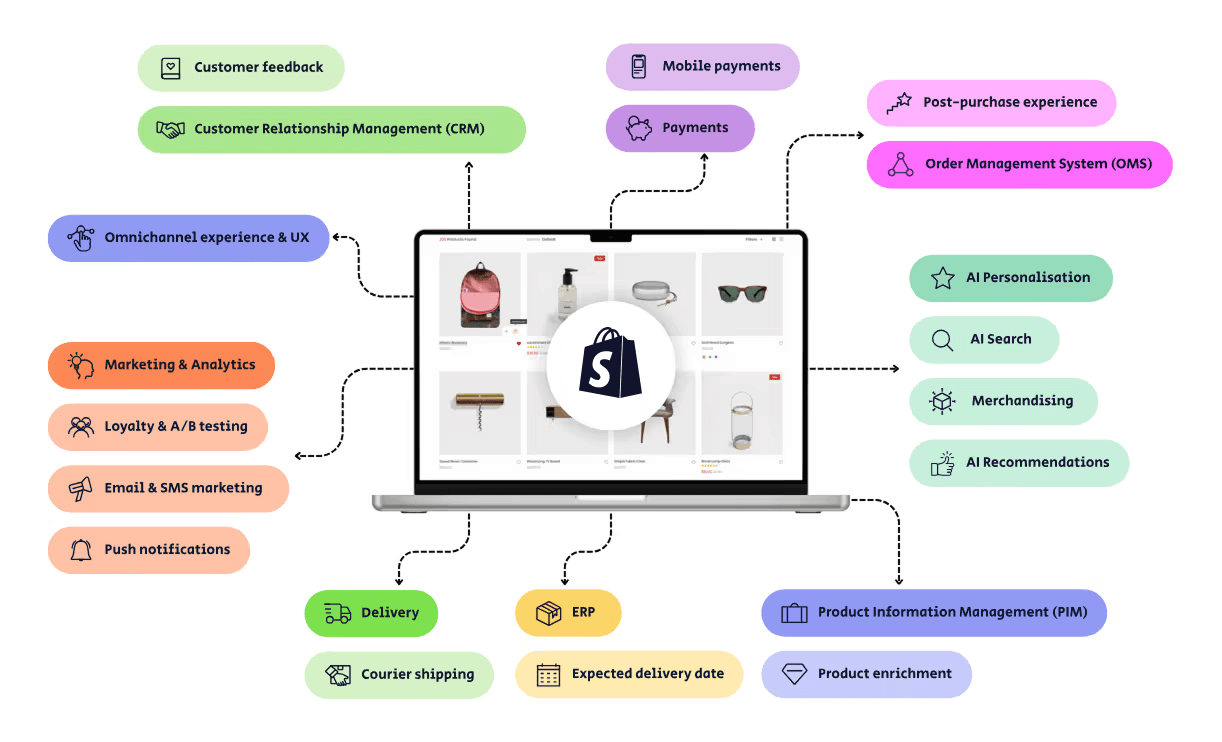
Ways to connect Shopify and Netsuite Accounting
| Option | Type | Best for | Notes |
|---|---|---|---|
| NetSuite Connector with Shopify Payout Report Sync | Connector | Finance teams that want payouts matched to NetSuite deposits automatically | The sync creates a deposit record, deposits the matching cash sales and cash refunds, and adds Shopify fees as deposit lines, optionally summed into one fee line. It runs every 24 hours and needs Shopify sales billed as undeposited cash sales, not invoices. |
| Celigo Shopify NetSuite integration app with payout reports | Connector | Merchants already on Celigo for orders who need payout data in NetSuite | Orders can post as sales orders, cash sales, or invoices, with customer deposit transactions. Redeemed gift cards can be tracked as a line on the NetSuite sales order, and payout report import is listed as an add-on. |
| Custom payout sync on the Shopify GraphQL Admin API | Custom API | Posting rules the connectors do not support, such as custom clearing accounts or several entities | Each ShopifyPaymentsBalanceTransaction returns amount, fee, net, the associated payout, the associated order, and the source order transaction ID. Reading it requires the view_payouts permission. |
What syncs between Shopify and Netsuite Accounting
| Data | Direction | System of record | Timing |
|---|---|---|---|
| Paid orders | Shopify to NetSuite | NetSuite for revenue | With order sync, billed as cash sales or invoices |
| Refunds | NetSuite to Shopify, or Shopify to NetSuite (one direction per account) | NetSuite | Scheduled; NetSuite Connector default is every 90 minutes |
| Shopify Payments payouts | Shopify to NetSuite | NetSuite deposit | Every 24 hours, after a configurable delay |
| Processing fees | Shopify to NetSuite | NetSuite deposit lines | With each payout |
| Gift card redemptions | Shopify to NetSuite | NetSuite | With the order |
| B2B invoices and payments on terms | Shopify to NetSuite | NetSuite | Invoice on order sync, payments linked as Shopify records them |
How a Shopify Netsuite Accounting integration project runs
- Agree the posting model with finance: which orders become cash sales and which become invoices, and which refunds become cash refunds or credit memos.
- Set up NetSuite items or accounts for discounts, a default discount item, gift cards, shipping, and Shopify fees.
- Configure the payout accounts (base, cash back, other, and undeposited) and a delay so cash sales exist before payouts import.
- Run a full test month in a sandbox, then reconcile every payout to its deposit and every tax total to Shopify before go-live.
- After go-live, review unmatched payout lines and variance postings every week, not only at month-end.
Common problems and how to avoid them
Payout sync needs undeposited cash sales
Oracle's Shopify Payout Report Sync only links payouts to cash sales and cash refunds that are still undeposited. If Shopify orders are billed as invoices, or someone deposits the cash sales by hand, the payout cannot be matched. Decide the billing transaction before the first payout imports.
Payouts arrive before the cash sales
If a payout imports before its orders are billed, its lines have nothing to match. NetSuite Connector has a delay factor in hours so the cash sales exist first, and an option to add non-imported transactions as standalone lines. Unmatched amounts post to the payout undeposited account, so someone must review that account.
Tax recalculated on cash sales
NetSuite Connector sets tax rates so the NetSuite tax total matches Shopify, but NetSuite recalculates tax when it creates the cash sale. Oracle's fix is the Match Line-Item Tax Rates With Tax Rates Created From Transaction setting, and tax plug-ins such as Avalara can overwrite rates too. Compare tax amounts, not rates, in testing.
Order-level discounts spread across every line
On a NetSuite build we support, the integration sent a cart's discounts as one order-level discount item. Order totals looked close, but discount and tax per line were wrong, and a gift card on the same order made the gap visible. Send discounts per line wherever the connector allows it.
Unmatched promo codes fall into one bucket
When NetSuite Connector cannot find a NetSuite coupon code that matches a Shopify promo code, it falls back to the default discount item. Revenue still balances, but discount reporting by campaign is lost. Create the codes in NetSuite before each promotion goes live.
Why choose scandiweb to handle Shopify integration for you?
How do you integrate Shopify with NetSuite Accounting for automated order-to-GL posting?
We map Shopify orders, discounts, shipping, taxes, and refunds to NetSuite customers, items, and accounts, then automate posting via APIs or a middleware layer. The output is accounting-ready transactions, not raw exports.
Can a Shopify + NetSuite Accounting integration handle payouts, fees, and reconciliation by settlement date?
Yes – we can import gateway payouts and fees, and post them in NetSuite so deposits match settlements. This helps your team reconcile faster and reduce timing gaps.
What Shopify data fields sync to NetSuite Accounting for tax, refunds, and multi-currency reporting?
Typical sync includes tax totals, tax-inclusive pricing flags, refund reason and amounts, and currency, plus exchange rate handling rules. The exact field list depends on your chart of accounts and reporting needs.
Does Shopify integrate with NetSuite Accounting for multi-store and international entities?
Yes – we can route multiple Shopify stores to separate NetSuite subsidiaries, classes, locations, or segments. It keeps reporting clean even when you sell across markets.
How long does a Shopify NetSuite Accounting integration take, and what affects scope?
Timeline depends on posting complexity, tax rules, and whether you need payout reconciliation, returns, or custom item mapping. Most delays come from unclear accounting rules, so we document them upfront before build.
Do Shopify sales have to be cash sales in NetSuite to reconcile payouts?
For NetSuite Connector's Shopify Payout Report Sync, yes. Shopify orders must be billed as cash sales, not invoices, and the cash sales must still be undeposited when the payout imports.
How are Shopify Payments fees recorded in NetSuite?
NetSuite Connector adds the fees as lines on the deposit it creates for each payout, and it can sum them into one fee line with your own memo text. A custom integration can read the fee and net amount of every balance transaction from the Shopify GraphQL Admin API.
Why does tax in NetSuite not match Shopify?
Small rate differences come from rounding, and NetSuite can recalculate tax on cash sales. Oracle says the tax amount is the number that must match, and lists the line-item tax settings and tax plug-ins to check.
How do Shopify gift cards show up in NetSuite?
With Celigo, redeemed Shopify gift cards can be tracked as a line item on the NetSuite sales order. Oracle's connector plans also list gift certificate sync.
How are Shopify B2B orders on payment terms invoiced in NetSuite?
NetSuite Connector creates the invoice in NetSuite when the B2B order syncs and links later Shopify payments to it. With customer deposits enabled, it posts the order as a sales order pending approval with a customer deposit instead.
Sources
- NetSuite help: Shopify payout report sync
- NetSuite help: NetSuite Connector order sync FAQ
- NetSuite help: Refunds and exchanges in NetSuite Connector
- NetSuite help: Shopify B2B
- NetSuite help: Sync frequency and directional flows
- Celigo: Shopify NetSuite integration app
- Shopify App Store: NetSuite ERP Connector
- Shopify: ShopifyPaymentsBalanceTransaction (GraphQL Admin API)
Last updated by the scandiweb integration team.







Netsuite Accounting integration on other platforms
More Shopify integrations
1. Submit your integration request
2. Join a free strategy & discovery call
We’ll review your business systems, identify key challenges, and uncover actionable opportunities.
3. Get a tailored proposal
Trusted by 700+ leading brands worldwide