4.9
commercetools migration services for enterprise brands
Replatform onto commercetools in phases, with your current storefront selling throughout and each capability proven in production before the next one is decomposed.
.svg)

Trusted by 700+ leading brands worldwide


Trusted by 700+ leading brands worldwide
What our commercetools migration services cover
Every enterprise replatform we take on starts from the same constraint: the business cannot stop trading while it happens. That rules out a single cutover and makes the sequence of capability replacement the central design decision.

Decomposition planning
A capability-by-capability plan naming what leaves the monolith first and what stays until last.

Catalog and data migration
Products, variants, prices, and customers restructured onto the commercetools data model and reconciled.

Order history migration
Historical orders carried across so support and finance keep working the day after cutover.

Headless storefront build
A React or Next.js storefront calling the commercetools APIs, built while your current site takes orders.

SEO and redirect mapping
Every URL mapped to its new address before launch, so the rankings you have earned carry over.

Phased cutover and rollback
Traffic shifted capability by capability, each phase with a tested route back to the previous state.
Wondering which capability should move first?
Platforms we migrate to commercetools
The starting platform changes the data work and the sequencing far more than it changes the destination. A Hybris estate and a Magento estate reach the same commercetools model along noticeably different routes.

Magento and Adobe Commerce
Catalog and customer data restructured off Magento by the world's most certified Adobe Commerce team.
.svg)
SAP Commerce Cloud and Hybris
Hybris estates carry deep custom extensions. The same team handles SAP Commerce Cloud migration in both directions.

Salesforce Commerce Cloud
SFCC catalogs and cartridge logic remapped onto commercetools, by the team behind our Salesforce migration practice.

Shopify and Shopify Plus
Brands outgrowing Plus checkout limits. If Shopify still fits you better, we also handle Shopify migration.

Custom and in-house builds
Bespoke platforms one team understands, where undocumented business logic carries more risk than data volume.

Other composable stacks
Consolidation onto commercetools from a composable estate assembled from vendors that no longer fit together.
Why we migrate in phases
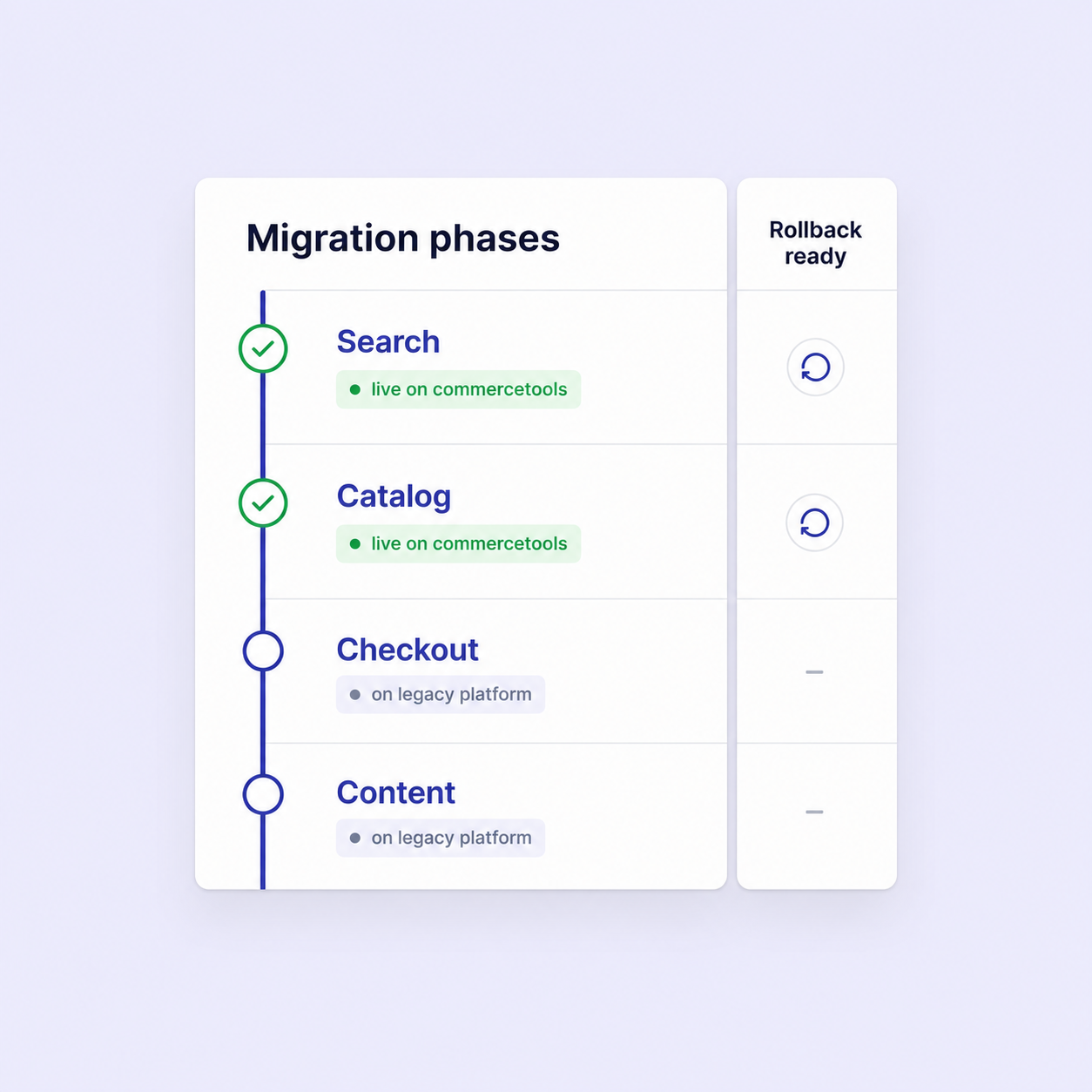
A single cutover asks you to replace catalog, checkout, search, and content on one night, then discover what broke with customers watching. Replacing one capability at a time means each phase has a small enough surface to test properly and a route back if it fails.
The connective work each phase depends on is scoped in the same project: see our commercetools integration page.

One capability replaced per phase, proven in production
The monolith stays authoritative until its replacement is signed off
A tested rollback route at every phase, not only at cutover
Redirect map written and approved before any URL changes
How a migration to commercetools works

Readiness audit

We read your current platform, its custom logic, and its integrations, then produce a capability inventory. You get that inventory as a document whether or not we build anything.

Decomposition sequence
Together we decide the order capabilities leave the monolith, weighing business risk against how tangled each one is. This is where the project is won or lost.

Foundation phase
The commercetools project is modeled, the first capability is rebuilt, and its data is reconciled against the source before any customer traffic reaches it.

Phase-by-phase replacement
Each remaining capability is rebuilt, tested at production volume, and switched over behind a rollback route, with the monolith authoritative until sign-off.

Decommissioning and support
Once the last capability is served by commercetools, the legacy platform is retired on a dated plan and the same engineers stay on the store.

Replatforms we have delivered
Five migrations off legacy systems, onto Magento, Adobe Commerce, and Hyvä. The destination differs. The redirect mapping and data reconciliation do not.
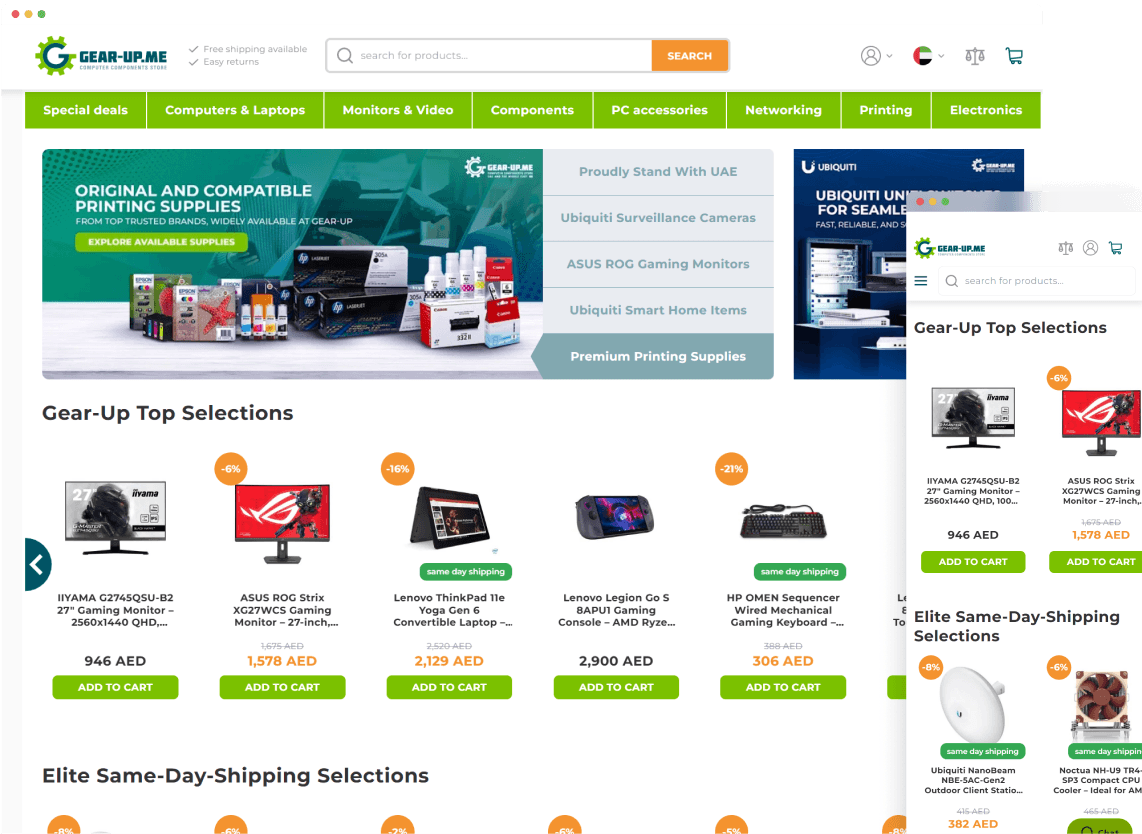

A decade of order history carried across in one overnight launch
+110.9%
Revenue year over year
+47.7%
Orders year over year
8 hours
Migration and launch window
Learn more


A mobile-first rebuild lifted basket size for a 70% mobile audience
+27.3%
Average order value year over year
+23.9%
Checkout starts
+15.5%
Product page views
Learn more


A publisher left its legacy system with 21,000 redirects mapped
+52%
Users after launch
+36.75%
Sessions after launch
1,631
New keywords ranking
Learn more


Five store views across two domains rebuilt on one platform
+227%
Organic traffic year over year
100,000+
Redirects mapped
10,000+
Products per store view
Learn more


120,000 redirects created and not one market taken offline
59
Countries served after migration
44
Market storefronts
8
Languages supported
Learn more
Who you would be replatforming with
700+
Brands served to date
2,100+
Commerce projects delivered
45
Countries our engineers work from
%20(1).png)


What a commercetools migration costs
The count of phases sets the number. A brand replacing search and catalog while keeping its existing checkout for a year pays for two phases, not for a full replatform, and that is a legitimate end state rather than a half-finished project.
We price each phase after the readiness audit, so you commit to the first one and decide on the next with real delivery data behind you. commercetools licenses its platform to you directly, and that cost is separate from what we invoice.
Is commercetools the right destination?
Composable earns its cost when several teams need to release independently, or when one storefront serves markets with genuinely different commerce rules. A single-market brand with a standard catalog is usually better served by a packaged platform, and we will tell you so on the call.
commercetools fits when

Reconsider if

What our clients say

.webp)



.png)


Frequently asked questions about commercetools migration services
How long does a commercetools migration take?
A single-capability first phase typically reaches production in two to three months. A full replatform off a large monolith usually spans twelve to eighteen months, because each capability is proven in production before the next begins. That is longer than a single cutover on paper and shorter than the same project attempted twice.
Will we lose search rankings migrating to commercetools?
Not when the redirect map is written before any URL changes. A replatform only damages rankings when new URL structures go live without their predecessors mapped to them. We produce the map during the phase that changes the storefront, get it approved, and monitor rankings daily through the weeks after each switch.
What happens to our order history?
Historical orders are migrated, not archived off to a separate system your support team has to learn. Finance and customer service open the same records the day after cutover as the day before. Where a legacy schema holds data commercetools has no home for, we agree during the audit whether it is mapped to custom fields or deliberately retired.
Do we need our own engineers after migrating?
A composable estate needs someone accountable for it, though that does not have to be your team. Brands with in-house engineers usually take ownership and keep us on the harder services. Brands without them keep the whole estate under our support. Deciding which model you want belongs in the readiness audit, because it changes how we build.
Can we migrate to commercetools without downtime?
Yes, and phasing is what makes it possible. Because one capability is replaced at a time, your current platform stays authoritative for everything not yet migrated, so there is no night when the whole estate changes hands. Each phase switches behind a rollback route that we test before traffic reaches it.
Which platforms do you migrate to commercetools from?
Any platform whose data can be extracted, including Magento and Adobe Commerce, SAP Commerce Cloud and Hybris, Salesforce Commerce Cloud, Shopify Plus, and in-house builds. The starting platform shapes the data work and the sequencing far more than the destination model, which is the same wherever you begin.
Can we migrate only part of our platform?
Yes, and many brands should. Replacing search and catalog while keeping an existing checkout is a legitimate end state rather than an unfinished migration. Because each phase is priced and delivered on its own, you can stop when the remaining capabilities no longer justify their replacement cost, without stranding the work already done.
What does a commercetools migration cost?
Each phase is priced separately after the readiness audit, so the commitment is to the first phase rather than to a number covering eighteen months of work. Phase count and how much undocumented logic your current platform carries drive the total more than catalog size does. commercetools bills you for its platform directly.

Tell us what you are replatforming
Describe your current platform and the thing it makes hardest. We come back with a capability inventory and a proposed order for decomposing it, so the first conversation produces a plan rather than a pitch.

Book a call straight away or email us at: [email protected]

Related services
Considering a commercetools migration? Let's sequence it together.
commercetools migration services from an official partner, starting with one phase rather than an eighteen-month commitment.