


Shopify–NetSuite integration for real-time orders, inventory, and finance sync
Connect Shopify or Shopify Plus with NetSuite to sync orders, customers, products, inventory, taxes, and payouts, so your team stops reconciling spreadsheets and closes faster.







Shopify and Netsuite integration in short
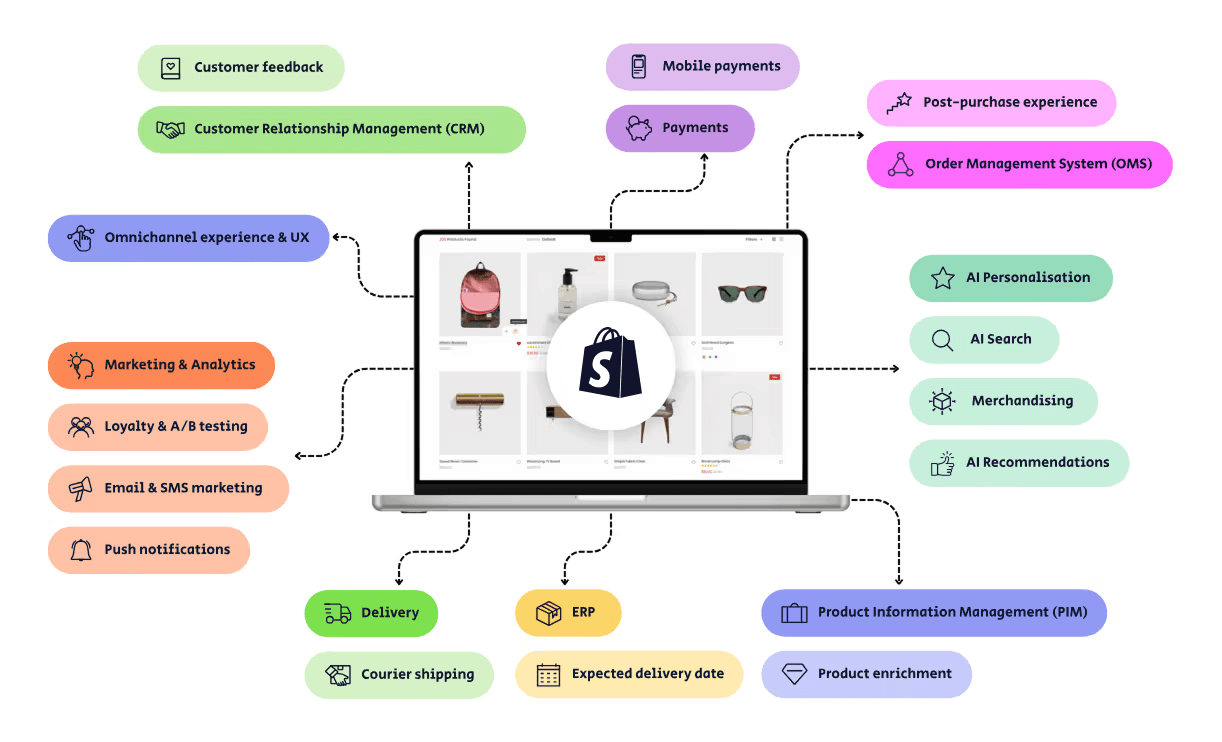
You can integrate Shopify with NetSuite through Oracle's NetSuite ERP Connector app on the Shopify App Store, through Celigo's NetSuite integration app, through an integration platform such as Patchworks with its Shopify and NetSuite blueprint, or with a custom build on the Shopify GraphQL Admin API and NetSuite web services. Shopify usually sends orders, customers, and B2B companies to NetSuite, while NetSuite sends back items, prices, available inventory, fulfillments with tracking, and refunds.


• Shopify orders are pulled via Admin API on create/update events and mapped to NetSuite Sales Orders, including line items, taxes, discounts, shipping, and payment status.
• Customer records are matched on email and external IDs, with new Shopify customers created in NetSuite when no match is found and duplicates flagged in logs.
• SKU, variant, barcode, and unit-of-measure fields are mapped between Shopify products and NetSuite items, with ownership defined per object (ERP-led, Shopify-led, or split).
• Inventory availability is synced from NetSuite locations to Shopify inventory levels, with delta syncs sending only changed quantities and timestamp-based conflict handling.
• Fulfillment, tracking numbers, and shipment status are pushed from NetSuite to Shopify fulfillments; cancellations and refunds are routed back to NetSuite as credit memos when supported.
• Sync jobs validate required fields, retry transient API failures with backoff, and write structured logs for each record, including payload snapshots and error reasons.
Ways to connect Shopify and Netsuite
| Option | Type | Best for | Notes |
|---|---|---|---|
| NetSuite ERP Connector by Oracle NetSuite | Connector | NetSuite customers who want Oracle's own connector, including Shopify POS and Shopify B2B | The Shopify App Store listing says it syncs product, pricing, inventory, sales order, and fulfillment data for B2C and B2B storefronts and Shopify POS. Listed plans in November 2026: B2C Standard $199.92 a month, B2C Premium and POS $249.92 a month, B2B $916.58 a month, with possible external charges from Oracle NetSuite. |
| NetSuite Integration by Celigo | Connector | Merchants who want prebuilt flows plus room for custom flows on Celigo's integrator.io platform | Syncs customers, items, orders, cancellations, refunds, returns, and B2B, including matrix items and kits, and clones settings across several stores. Celigo's page lists payout report import as an add-on. Listed plans in November 2026: Starting Package $7,800 a year (2 endpoints, 10 flows) and Standard Edition $18,900 a year (3 endpoints, 20 flows). |
| Patchworks Shopify and NetSuite blueprint | Integration platform | B2B and D2C merchants who want editable process flows and other systems in the same layer | Thirteen ready-made flows cover locations, products, companies and contacts, sales orders, fulfillments, refunds, price lists, catalogs, payments, and inventory in both directions. Patchworks notes that NetSuite is highly customizable, so each flow needs review against your own setup. |
| Custom app on the Shopify GraphQL Admin API and NetSuite web services | Custom API | Order logic, subsidiaries, or B2B rules that prebuilt flows do not cover | Shopify made the REST Admin API legacy on October 1, 2024, and new public apps must use GraphQL from April 1, 2025, so new builds should use GraphQL. GraphQL Admin API limits are 100 points per second on Standard, 200 on Advanced, 1,000 on Shopify Plus, and 2,000 on Commerce Components. |
What syncs between Shopify and Netsuite
| Data | Direction | System of record | Timing |
|---|---|---|---|
| Orders | Shopify to NetSuite | Shopify at checkout, NetSuite after import | Optional real-time sync webhook, or scheduled (NetSuite Connector default every 20 minutes) |
| Customers and B2B companies | Shopify to NetSuite | NetSuite for B2B accounts and terms | With each order, or scheduled |
| Items and prices | NetSuite to Shopify | NetSuite | Scheduled; NetSuite Connector product sync runs every 60 minutes |
| B2B catalogs and price levels | NetSuite to Shopify | NetSuite | Scheduled |
| Inventory | NetSuite to Shopify | NetSuite (available quantity) | Real time where enabled, otherwise hourly by default |
| Fulfillments and tracking | NetSuite to Shopify | NetSuite | Scheduled; NetSuite Connector default is every 90 minutes |
| Refunds | One direction per connector account; Oracle recommends NetSuite to Shopify | NetSuite | Scheduled; NetSuite Connector default is every 90 minutes |
| Shopify Payments payouts and fees | Shopify to NetSuite | NetSuite | Daily; NetSuite Connector payout sync runs every 24 hours |
How a Shopify Netsuite integration project runs
- List the Shopify stores, markets, POS locations, and B2B companies in scope, and map each to a NetSuite subsidiary, location, and customer structure.
- Agree with finance how orders post in NetSuite (sales order, then cash sale or invoice), and which system issues refunds.
- Choose the connector or platform, and check it against your plan, B2B needs, and the number of stores and flows you will run.
- Map SKUs to NetSuite items, then map discounts, gift cards, shipping, tax, and payment methods to NetSuite items and accounts.
- Test real order types in a NetSuite sandbox: multi-location fulfillment, partial refunds, B2B orders on payment terms, and POS orders if used.
- Go live with failure notifications switched on for each connector and error type, and a daily check that every Shopify order exists in NetSuite.
Common problems and how to avoid them
Reusing a connector built for another market
When a manufacturer we work with opened new Shopify Markets, it planned to reuse a NetSuite connector another team had built. Before reuse we asked whether it is a custom Shopify app or an API and webhook connector, whether it can filter orders by market (tag, metafield, or ship-to country), whether it can manage stock per market location, and whether it retries and alerts on failures. Ask the same questions of any existing connector before you add stores or markets to it.
Refunds can only sync one way per account
NetSuite Connector syncs refunds either from the storefront to NetSuite or from NetSuite to the storefront, not both for one account. For carts such as Shopify, Oracle recommends issuing the refund in NetSuite and letting the connector push it to Shopify. Pick one direction and train support staff to use it.
Changing order number formats after go-live
Oracle warns not to change order numbers that NetSuite Connector has already retrieved and not to reuse old order numbers on new orders. Orders imported into NetSuite by CSV are unknown to the connector, so their fulfillments never sync back to Shopify. Settle the order name prefix and any migration of historical orders before go-live.
B2B catalogs apply per company, not per location
NetSuite Connector syncs B2B companies with their buyers as sub-customers and syncs catalogs with NetSuite price levels, but catalogs are assigned at the company level and per-location assignment is not supported. Catalogs without a mapping are skipped. Model price lists before you promise location-specific pricing to B2B buyers.
Real-time order sync can change the subscription
Oracle's setup page for real-time Shopify order sync warns that it may increase the NetSuite Connector subscription. To turn it back on later, the previous webhook has to be removed in Shopify first. Confirm pricing before you switch from the scheduled sync.
Why choose scandiweb to handle Shopify integration for you?
How do you integrate Shopify or Shopify Plus with NetSuite for real-time order sync?
We connect Shopify checkout and fulfillment events to NetSuite sales orders, invoices, and payments using APIs and queued jobs. Sync rules cover taxes, discounts, shipping, cancellations, and refunds.
Can a Shopify–NetSuite integration keep inventory accurate across warehouses and locations?
Yes – we sync available-to-sell stock from NetSuite locations to Shopify, with safety buffers and channel rules. This helps prevent overselling during promotions and back-in-stock swings.
What product and pricing data can be synced from NetSuite to Shopify catalogs?
Typically SKUs, titles, variants, barcodes, attributes, pricing, and customer-specific price levels. We also support item bundles, kits, and mapping for Shopify collections and tags.
How do payouts, fees, and taxes flow from Shopify into NetSuite accounting?
We reconcile Shopify Payments and other gateways into NetSuite deposits, fees, and tax totals based on your accounting logic. This reduces manual journal entries and speeds up month-end close.
Does scandiweb handle custom Shopify–NetSuite integration development and ongoing support?
Yes – we build, monitor, and support ERP integrations as part of broader eCommerce delivery, with 2,100+ projects shipped since 2003. You get a stable sync, clear logging, and fast fixes when edge cases show up.
Is there an official NetSuite app for Shopify?
Yes. Oracle NetSuite publishes the NetSuite ERP Connector on the Shopify App Store, with B2C Standard, B2C Premium, POS, and B2B plans. Celigo also lists a NetSuite integration app there.
How much does a Shopify NetSuite connector cost?
In November 2026 the Oracle listing starts at $199.92 a month, with the B2B plan at $916.58 a month and possible external charges from Oracle NetSuite. Celigo lists $7,800 a year for its Starting Package and $18,900 a year for Standard Edition. Implementation work is separate.
Does the NetSuite connector support Shopify B2B?
Yes. NetSuite Connector syncs B2B companies with their buyers as sub-customers, payment terms such as Net 30, and invoices on order sync, and it pushes NetSuite catalogs and price levels to Shopify companies. Catalogs cannot be assigned per company location.
Can Shopify POS orders sync to NetSuite?
Yes. Oracle's app has a dedicated POS plan with real-time price and quantity sync, and Celigo imports Shopify POS orders, including buy online, pick up in store.
Should a custom Shopify NetSuite integration use REST or GraphQL?
GraphQL. Shopify's REST Admin API has been legacy since October 1, 2024, and new public apps must be built on the GraphQL Admin API.
Sources
- Shopify App Store: NetSuite ERP Connector
- Shopify App Store: NetSuite Integration by Celigo
- Celigo: Shopify NetSuite integration app
- Patchworks: Shopify and NetSuite blueprint
- Patchworks: Available process flows (Shopify and NetSuite)
- Shopify: GraphQL Admin API rate limits
- Shopify: REST Admin API reference
- NetSuite help: Sync frequency and directional flows
- NetSuite help: Troubleshooting inventory sync issues in NetSuite Connector
- NetSuite help: NetSuite Connector order sync FAQ
- NetSuite help: Refunds and exchanges in NetSuite Connector
- NetSuite help: Shopify B2B
- NetSuite help: Setting up real-time order sync for Shopify
- NetSuite help: Shopify payout report sync
Last updated by the scandiweb integration team.






Netsuite integration on other platforms
More Shopify integrations
1. Submit your integration request
2. Join a free strategy & discovery call
We’ll review your business systems, identify key challenges, and uncover actionable opportunities.
3. Get a tailored proposal
Trusted by 700+ leading brands worldwide