


Magento NetSuite integration for unified eCommerce and ERP data
Connect Magento with NetSuite to synchronize orders, inventory, customers, and financial data across systems








Magento and NetSuite integration in short
You can integrate Magento (Adobe Commerce) with NetSuite through Celigo's prebuilt NetSuite Magento 2 integration app, through Oracle's own NetSuite Connector (which lists Magento 2 as a supported storefront), through an integration platform such as Patchworks that has prebuilt Magento and NetSuite connectors, or with a custom build on the Magento REST API and NetSuite web services. In a typical setup Magento sends customers and sales orders to NetSuite, and NetSuite sends back item data, available inventory, fulfillments with tracking, cancellations, and refunds.
Disconnected eCommerce and ERP systems create delays in order processing, inventory updates, and financial reporting. Teams rely on exports, duplicated data, and manual fixes to keep systems aligned.
Magento NetSuite integration connects your storefront with your ERP, synchronizing orders, customers, products, inventory, and financial data so both systems reflect the same business activity.
This setup is relevant for merchants managing complex catalogs, multiple sales channels, or growing operational scale that requires tight ERP alignment.


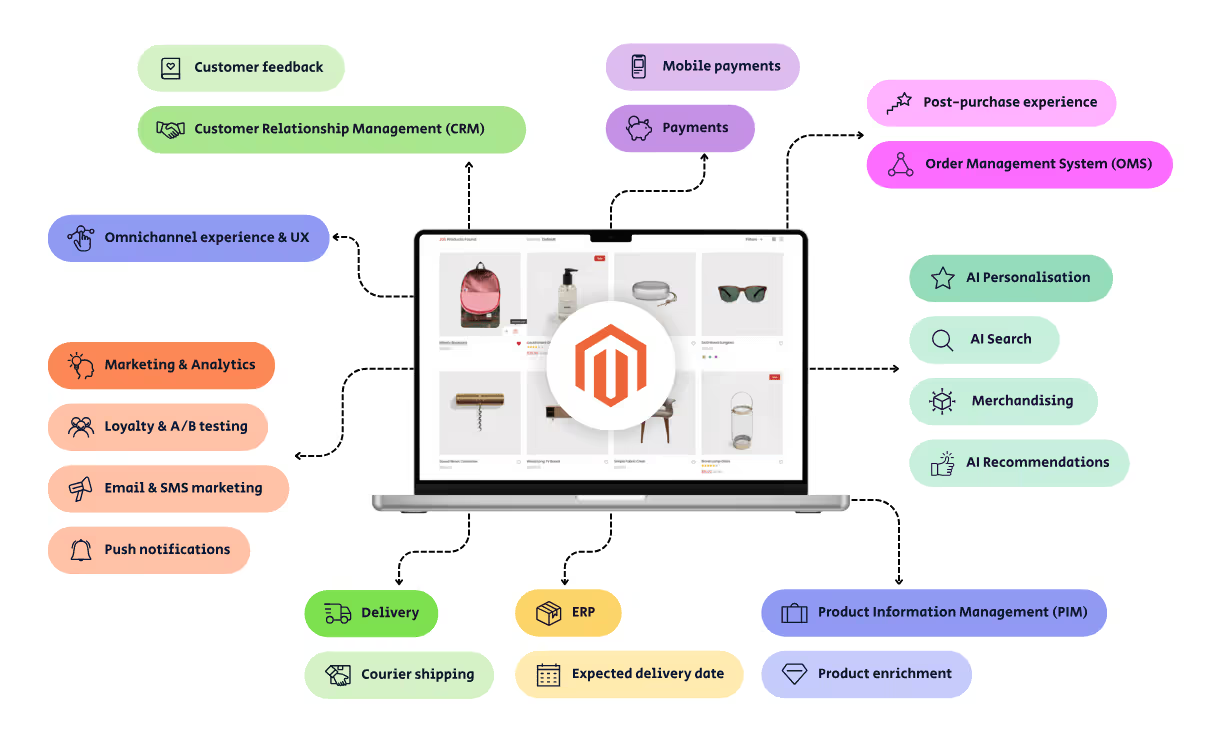
Ways to connect Magento and NetSuite
| Option | Type | Best for | Notes |
|---|---|---|---|
| Celigo NetSuite Magento 2 integration app | Connector | Merchants who want prebuilt flows without writing integration code | Prebuilt flows send customers and sales orders from Magento to NetSuite, and send fulfillments, inventory levels, item data, billing information, cancellations, and refunds from NetSuite to Magento. Several Magento websites, stores, and store views can connect to one NetSuite account. |
| NetSuite Connector by Oracle NetSuite | Connector | NetSuite customers who prefer Oracle's own scheduled connector | Magento 2 is on Oracle's list of supported storefronts. Oracle documents order sync every 20 minutes, product sync every 60 minutes, and fulfillment and refund sync every 90 minutes. Inventory uses real-time price and quantity sync on most connectors, or an hourly run. |
| Patchworks iPaaS with prebuilt Adobe Commerce and NetSuite connectors | Integration platform | Teams that need custom process flows or more systems in the same layer (3PL, PIM, marketplaces) | The Adobe Commerce connector authenticates with a token from an integration created in the Magento admin, and on Magento 2.4.4 or later the OAuth setting that allows access tokens as standalone bearer tokens must be on. The NetSuite connector needs token-based authentication prepared in NetSuite first. |
| Custom integration on the Magento REST API and NetSuite web services or RESTlets | Custom API | Complex B2B, multi-subsidiary, or heavily customized order logic that prebuilt flows do not cover | You own the mapping, retries, and monitoring. NetSuite governs web services and RESTlet concurrency at the account level, so the store integration shares one limit with every other integration on the account. |
What syncs between Magento and NetSuite
| Data | Direction | System of record | Timing |
|---|---|---|---|
| Sales orders | Magento to NetSuite | Magento at checkout, NetSuite once the order is imported | Scheduled or webhook; NetSuite Connector runs every 20 minutes |
| Customers | Magento to NetSuite, optionally NetSuite to Magento | Agreed per field, usually NetSuite for B2B accounts | With each order, or scheduled |
| Items and product data | NetSuite to Magento | NetSuite for SKUs and prices, Magento for web content | Scheduled; NetSuite Connector product sync runs every 60 minutes |
| Inventory | NetSuite to Magento | NetSuite (available quantity, not quantity on hand) | Real time on most NetSuite Connector setups, otherwise hourly |
| Fulfillments and tracking | NetSuite to Magento | NetSuite | Scheduled; NetSuite Connector runs every 90 minutes |
| Refunds and cancellations | NetSuite to Magento | NetSuite | Scheduled; NetSuite Connector runs every 90 minutes |
| NetSuite sales order number | NetSuite to Magento | NetSuite | Written back after the order is imported |
How a Magento NetSuite integration project runs
- Agree with finance which NetSuite transaction each Magento order becomes (sales order, then cash sale or invoice) and which system owns each record and field.
- Choose the connector or platform, and check that it covers your Magento version, store views, and NetSuite subsidiaries.
- Create a dedicated Magento integration with only the API resources it needs, and set up token-based authentication in NetSuite.
- Map items, line discounts, shipping discounts, gift cards, tax, and payment methods, then test with real order types: configurable products, free gifts, gift card redemptions, partial shipments, and refunds.
- Run sandbox orders end to end and reconcile totals and tax line by line against NetSuite before go-live.
- Go live with alerts on the last successful order import and a daily count of Magento orders missing in NetSuite or still waiting for a fulfillment.
- Re-test the order and fulfillment flows after every Magento upgrade, security patch, or connector mapping change.
Common problems and how to avoid them
Line discounts arrive as one order-level discount
Magento's order API returns both a header discount_amount and a discount_amount on each line. On a Magento and Celigo build we support, the header total was imported as one discount item, so NetSuite spread it across every line, including lines that had no discount, and tax per line came out wrong. The fix is in the mapping: send each sellable line's discount, take shipping discounts from shipping_discount_amount, use the configurable parent row rather than the child row, and map a gift card redemption only once.
Fulfillments that never post back keep stock on hold
Magento holds a reservation against salable quantity from order placement until a shipment is created. When NetSuite fulfillments stop syncing back, orders stay in Processing and their units stay reserved, so the storefront shows less stock than the warehouse has. On one store this built up over months to thousands of orders, and closing them in bulk would have sent old shipment emails and triggered marketing and review tools, so those had to be switched off first.
Order sync stops without an alert
On one store a connector that checked Magento for new orders about every 15 minutes stopped after a change on the connector side. Magento kept saving every order, so nothing looked broken until staff noticed orders missing in NetSuite. The recovery was a replay from the last imported order, with a duplicate check first, and the lasting fix is an alert on the time of the last successful import.
Comparing the wrong stock numbers
NetSuite Connector syncs available quantity from NetSuite locations, not quantity on hand, and inventory only flows to the storefront. Magento then shows salable quantity, which is its quantity minus open reservations. Reconciliation reports should compare available in NetSuite with salable quantity in Magento, or the gap will look like a sync error when it is not.
Orders keyed into NetSuite never reach Magento tools
Phone and trade orders created directly in NetSuite do not pass through Magento, so a marketing platform fed only from Magento never sees those customers or orders. On a B2B Magento store we support, the answer was a sync from NetSuite itself; Dotdigital, for example, documents an integration that syncs NetSuite contacts, orders, and products.
Why choose scandiweb to handle Magento integration for you?
How does Magento NetSuite integration sync orders and inventory
Orders from Magento are created in NetSuite as sales orders, while inventory levels are updated from NetSuite back to Magento.
Can Adobe Commerce connect to NetSuite for real-time data sync
Yes, Adobe Commerce can integrate with NetSuite using APIs or middleware to support near real-time synchronization.
Does Magento 2 NetSuite integration support multi-store setups
Multi-store setups are supported with proper mapping of stores, subsidiaries, and currencies within NetSuite.
How are customers managed in Magento NetSuite integration
Customer data is synced or matched between systems to maintain consistent profiles across Magento and NetSuite.
Is NetSuite the source of truth in Magento ERP integration
In most implementations, NetSuite acts as the system of record for products, inventory, and financial data.
Does NetSuite have a native Magento connector?
Oracle's NetSuite Connector lists Magento 2 among its supported storefronts. Celigo also sells a prebuilt NetSuite Magento 2 integration app, and integration platforms such as Patchworks offer prebuilt Adobe Commerce and NetSuite connectors.
How often does NetSuite Connector sync Magento orders?
Oracle documents order sync from the storefront to NetSuite every 20 minutes, product sync every 60 minutes, and fulfillment sync back to the storefront every 90 minutes. Inventory can sync in real time on most connectors, otherwise it runs hourly.
Can customers see the NetSuite sales order number in their Magento account?
It can be done. On a store we support, the connector writes the NetSuite number back to a custom Magento order attribute, and the account pages show it instead of, or next to, the Magento number. Decide what customers see before NetSuite returns the number.
What happens to Magento orders when the NetSuite sync stops?
They stay saved in Magento. Once the connector is fixed, re-import from the last order NetSuite received and check for duplicates before any bulk replay.
Should refunds be issued in Magento or in NetSuite?
Oracle's guidance for carts such as Magento and Shopify is to create the refund in NetSuite and let NetSuite Connector sync it to the storefront. Celigo's Magento app also sends refunds and cancellations from NetSuite to Magento.
Which NetSuite stock figure should Magento show?
Available quantity. When syncing from NetSuite locations, NetSuite Connector syncs available quantity, not quantity on hand.
Sources
- Celigo: NetSuite Magento 2 integration app
- NetSuite help: NetSuite Connector supported storefronts and 3PLs
- NetSuite help: Sync frequency and directional flows
- NetSuite help: Troubleshooting inventory sync issues in NetSuite Connector
- NetSuite help: NetSuite Connector order sync FAQ
- NetSuite help: Refunds and exchanges in NetSuite Connector
- NetSuite help: Web services and RESTlet concurrency governance
- Patchworks: Adobe Commerce (Magento) prebuilt connector
- Patchworks: NetSuite prebuilt connector
- Adobe Commerce: Reservations
- Adobe Commerce: Integrations
- Dotdigital: NetSuite integration overview
Last updated by the scandiweb integration team.







NetSuite integration on other platforms
More Magento integrations
1. Submit your integration request
2. Join a free strategy & discovery call
We’ll review your business systems, identify key challenges, and uncover actionable opportunities.
3. Get a tailored proposal
Trusted by 700+ leading brands worldwide