


Magento Sage ERP integration for real-time orders, inventory, and invoicing
Connect Magento (Adobe Commerce) with Sage ERP (Sage 100, Sage X3) to sync products, stock, prices, customers, orders, and invoices, so finance and fulfillment stay accurate.








Magento and Sage integration in short
How you integrate Magento (Adobe Commerce) with Sage depends on which Sage product you run, because each has its own interface. Sage X3 connects through its SOAP web services, either via connectors such as CertiPro's E-Link or via a custom module; Sage 100 exposes sales orders, customers, and contacts through eBusiness Web Services; Sage Intacct is covered in our separate guide. Magento usually sends orders and customers to Sage, and Sage sends items, prices, stock, invoices, and shipments back.
When Magento (Adobe Commerce) and finance live in separate worlds, order handoff turns into spreadsheets, manual re-keying, and “why doesn’t this total match?” conversations. It slows fulfillment, creates posting errors, and makes returns, tax adjustments, and partial shipments harder to close out cleanly.
The Magento – Sage ERP integration connects your storefront with Sage ERP so sales, payments, customer records, and inventory move through a consistent flow. It aligns what happens at checkout with how you invoice, ship, and reconcile in Sage ERP (Sage 100, Sage X3), so operational teams work from the same source of truth.
This setup fits best if your finance or ops team relies on Sage ERP for AR, invoicing, inventory, or fulfillment control.


• Orders are exported from Magento to Sage ERP as sales orders, with line items, discounts, shipping, tax, and address data mapped to Sage fields.
• Customer and company accounts are matched by a shared external ID, with create-or-update logic used when new buyers appear in Magento.
• SKU-level product identifiers are aligned so Sage item codes map to Magento SKUs, including configurable and simple product relationships where applicable.
• Inventory availability is synchronized from Sage ERP to Magento on a schedule or via delta updates, with warehouse and stock status mappings handled per channel rules.
• Shipment confirmations and invoice statuses are pulled from Sage ERP and written back to Magento as shipment and invoice records, including tracking numbers when provided.
• Returns and credit memos are exchanged using referenced order and document IDs, with validation and error logs captured for failed or partial postings.
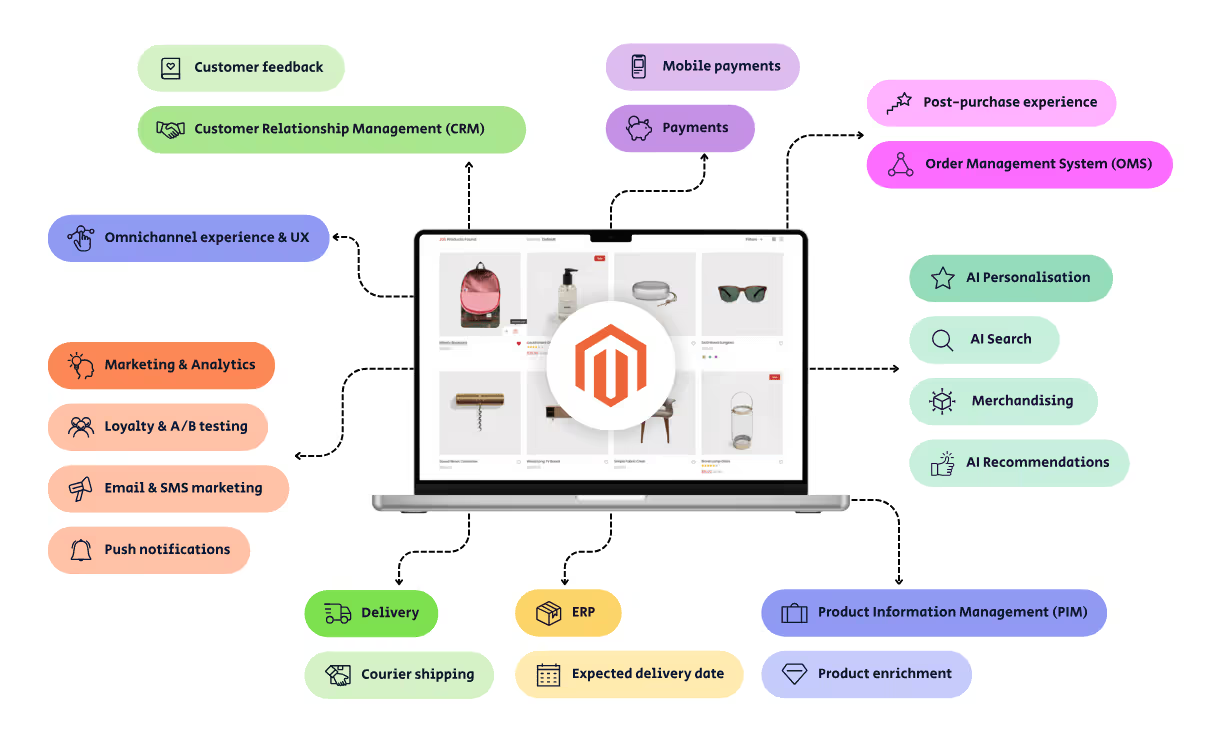
Ways to connect Magento and Sage
| Option | Type | Best for | Notes |
|---|---|---|---|
| E-Link Sage X3 eCommerce Integration by CertiPro Solutions | Connector | Sage X3 companies that want a packaged real-time connector | Listed on the Sage Marketplace for Sage X3 with Magento Adobe Commerce, WooCommerce, Shopify, and Shopify Plus. Real-time two-way sync covers products, pricing, inventory, and orders; new web orders flow into Sage X3, and order history and customer information flow to the store, with customer-specific pricing. No price is listed. |
| Custom module on Sage X3 SOAP web services | Custom API | Sage X3 setups with custom screens, order types, or pricing rules | Each Sage X3 web service is paired with an X3 program or subprogram and can read, create, update, and delete objects. Programs must be published as web services before they can be called, and every call names a classic SOAP pool by its alias. |
| Custom module on Sage 100 eBusiness Web Services | Custom API | Sage 100 companies that need web orders and customers created in Sage directly | Sage's SOAP service exposes sales orders (get, preview, create, update, delete, and next order number), customers, and customer contacts, plus card vault and pre-authorization calls. Sage recommends a dedicated user for an eCommerce site with Enable Web Services turned on, and SSL on every connection. |
What syncs between Magento and Sage
| Data | Direction | System of record | Timing |
|---|---|---|---|
| Sales orders | Magento to Sage | Magento at checkout, Sage once the order is created and numbered | Real time or scheduled, depending on the connector |
| Customers | Magento to Sage for new web customers, Sage to Magento for B2B accounts | Sage for B2B accounts, terms, and credit | With the first order, or scheduled |
| Items and product data | Sage to Magento, often through a PIM | Sage for item codes, units, and sales status; Magento or the PIM for web content | Scheduled delta sync |
| Prices | Sage to Magento | Sage | Scheduled, with customer-specific prices for B2B accounts |
| Inventory | Sage to Magento | Sage by warehouse | Scheduled or real time |
| Order status, invoices, and shipments | Sage to Magento | Sage | Scheduled, plus a manual resync from the Magento admin |
How a Magento Sage integration project runs
- Confirm which Sage product, version, and region you run (Sage X3, Sage 100, Sage 300, Sage 200, Sage 50, or Sage Intacct), and whether Sage is your ERP or only the ledger that another system feeds.
- List the interfaces you can use: Sage X3 web services published for your objects, Sage 100 eBusiness Web Services, a connector, or an API layer your IT team already maintains.
- Choose the connector, integration platform, or custom module, and confirm it supports your Magento version and your Sage version.
- Map Sage item codes and units of measure to Magento SKUs, plus customers, price lists, warehouses, tax codes, and order types for B2B and B2C.
- Define order statuses in both directions, including partial invoicing, cancellations, and direct-ship orders.
- Test with real orders against a Sage test company, then go live with alerts on failed exports and on syncs that have not run.
Common problems and how to avoid them
One Magento SKU per Sage unit of measure
On a Magento and Sage X3 project we support for a distributor, invoice lines come back from Sage with the item reference (ITMREF) and sales unit (SAU) as separate fields. Magento SKUs are built as item reference plus sales unit, so each invoiced line matches the right product and quantity.
Invoiced orders are locked in Sage
On the same project, once an invoice exists in Sage the sales order can no longer be updated. The status sync sets the Magento order to complete when Sage shows it fully invoiced, aligns paid and due amounts, and marks any uninvoiced remainder as canceled, without touching customer, address, or payment data.
B2C orders stayed pending after delivery
The first status sync covered B2B orders only, so direct-ship B2C orders showed as pending in customers' Magento accounts after they were delivered. Sage's order and invoice endpoints did not distinguish B2B from B2C, so the fix was to run the same status logic for both.
Sage may only be the ledger
On a project for a wholesaler, discovery showed that another order system was the master for invoices, credits, and payments and exported them to Sage, which issued customer statements. The storefront needed no direct Sage connection, so check which system really owns orders before scoping a Sage integration.
Retrying a create after a timeout
Sage's guide for Sage 100 eBusiness Web Services says that after a connectivity error, calling a create operation again with the same key can return WS_AlreadyExists, which means the first call succeeded. Treat that response as success, or the retry logic will report failures for orders that are already in Sage.
Sage X3 only exposes published web services
Sage X3 web services call X3 programs that must be published as web services first, and each call goes through a configured SOAP pool. Ask your Sage partner to publish and test every object the integration needs, such as sales orders, customers, and stock, before Magento development starts.
Why choose scandiweb to handle Magento integration for you?
How do you connect Magento (Adobe Commerce) to Sage ERP (Sage 100, Sage X3) without custom exports and imports?
We typically connect via Sage ERP APIs or a middleware layer, then map master data and transaction objects to Magento. Syncs run on schedules or near real time, with retries and logging for failed records.
What data is synced in a Magento Sage ERP integration for accounting and fulfillment workflows?
Common flows include customers, products, price lists, inventory, orders, shipments, invoices, credit memos, and tax-related fields. The exact scope depends on how Sage ERP is used for AR, inventory, and posting rules.
Can a Magento Sage ERP integration handle multi-store, multiple currencies, and localized tax rules?
Yes, if you design mappings per website, store view, currency, and tax jurisdiction, and keep Sage ERP as the financial source of truth. We also align SKU, warehouse, and price list logic per market.
How do you prevent inventory overselling and pricing mismatches between Magento and Sage ERP?
We use a clear source-of-truth model, fast inventory updates, and validation rules for price lists, rounding, and customer groups. For high-volume catalogs, we also optimize sync payloads and update frequency.
Who builds and supports Magento Sage ERP integrations for enterprise catalogs and high order volume?
scandiweb has delivered 2,100+ eCommerce projects since 2003 and processes $4 billion+ for clients per year, so we’re used to complex ERP-led operations. We build the integration, document it, and support it post go-live.
Which Sage products can Magento integrate with?
Sage sells several separate products, including Sage X3, Sage 100, Sage 300, Sage 200, Sage 50, and Sage Intacct, and each has its own interface and connectors. For Magento, Sage X3 has SOAP web services and connectors such as E-Link, and Sage 100 has eBusiness Web Services, so check connector support for your exact product and version.
Does Sage 100 have an API for Magento?
Sage documents eBusiness Web Services, a SOAP service for Sage 100 sales orders, customers, and customer contacts. It needs a dedicated Sage user with Enable Web Services turned on and should only be used over SSL.
Can Magento show Sage customer-specific prices?
Yes. CertiPro's E-Link lists customer-specific pricing for Sage X3, and a custom build can sync Sage price lists to Magento customer groups.
What if Sage only handles our accounting?
Then Magento may not need to talk to Sage at all. If another order or ERP system already sends invoices and payments to Sage, integrate Magento with that system and let it keep feeding the Sage ledger.
How do customers created in Sage reach Magento?
Through a scheduled customer sync from Sage. On one project, customers marked as B2B users in Sage are synced to Magento, so check that flag and the time of the last customer sync when a customer does not appear.
Sources
- Sage Marketplace: E-Link Sage X3 eCommerce Integration
- Sage X3 online help: SOAP web services
- Sage 100 eBusiness Web Services guide: APIs
- Sage 100 eBusiness Web Services guide: Administration
- Shopify App Store: Sage Fields by Commercient (supported Sage products)
Last updated by the scandiweb integration team.





Sage integration on other platforms
More Magento integrations
1. Submit your integration request
2. Join a free strategy & discovery call
We’ll review your business systems, identify key challenges, and uncover actionable opportunities.
3. Get a tailored proposal
Trusted by 700+ leading brands worldwide