


Magento integration with Business Central for clean orders, stock, and finance sync
Moving from Dynamics NAV to Microsoft Dynamics 365 Business Central? We connect Magento 2 / Adobe Commerce with Business Central so orders, inventory, customers, and invoices stay accurate across both systems.








Magento and Business Central integration in short
Magento (Adobe Commerce) connects to Dynamics 365 Business Central through Business Central's REST API v2.0, custom API pages for fields the standard APIs lack, and webhooks that announce changed records. Teams install a connector such as i95Dev Connect, run the flows through an integration platform such as Alumio, or build a custom Magento module. Business Central online requires OAuth 2.0 and enforces per-user request limits, so the design has to page, pace, and retry.


• Orders placed in Magento are posted to Dynamics 365 Business Central as sales orders, with customer, addresses, payment, tax, shipping method, and line items mapped to BC fields.
• Item master data syncs from Business Central to Magento, including SKU, descriptions, barcodes where used, units of measure, status, and attribute mappings aligned to your catalog model.
• Inventory availability is synchronized per location, mapping BC locations/warehouses to Magento sources or stock buckets; reservations and backorders are handled based on agreed ownership rules.
• Pricing and discounts are mapped from BC price lists and customer groups to Magento price rules, with currency and VAT/tax class mappings applied per store view.
• Shipment and invoice updates created in Business Central are written back to Magento to close the order lifecycle, including tracking numbers and capture/paid status when supported by the payment flow.
• Delta sync logic sends only changed records, with validation, retries, and error logs for mapping mismatches, missing SKUs, and blocked customers.
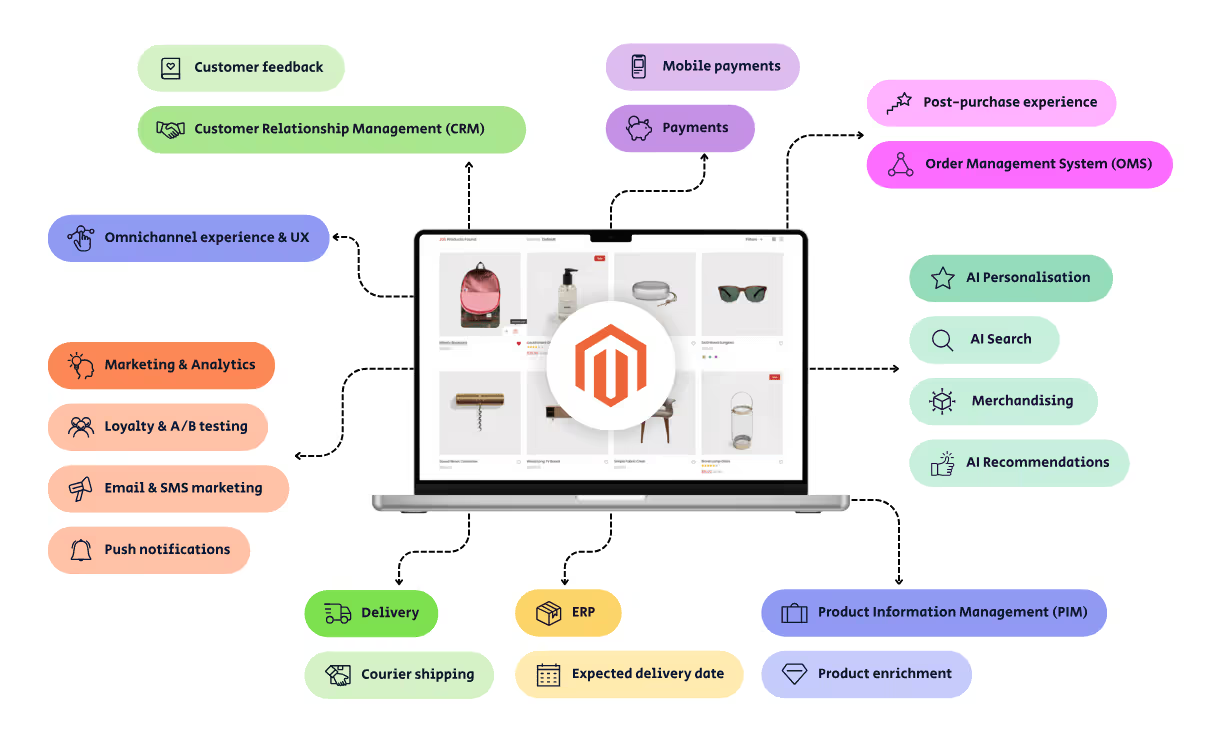
Ways to connect Magento and Business Central
| Option | Type | Best for | Notes |
|---|---|---|---|
| i95Dev Connect for Business Central | Connector | Merchants who want a packaged connector instead of a custom build | Check the Magento and Business Central versions you will run at go-live with i95Dev before you commit. |
| Alumio integration platform | Integration platform | Teams that want order, stock, and price flows managed outside Magento | Alumio's page lists orders, products, inventory levels, pricing, customers, and invoices, with each Magento order created in Business Central and variant-level stock and pricing sent back to the store. |
| Custom Magento module on Business Central API v2.0 | Custom API | B2B stores with sales-rep orders, ERP-side order edits, or custom fields | Standard API v2.0 endpoints cannot be extended with extra fields, so web-specific data goes into a custom API page in an extension. Custom APIs can also be subscribed to with webhooks. |
What syncs between Magento and Business Central
| Data | Direction | System of record | Timing |
|---|---|---|---|
| Items, attributes, and units of measure | Business Central to Magento | Business Central | Webhook-triggered pull plus a scheduled full check |
| Inventory by location | Business Central to Magento | Business Central | Near real time; webhooks wait 30 seconds by default after a change |
| Price lists and customer discounts | Business Central to Magento | Business Central | Scheduled |
| Web orders | Magento to Business Central | Magento until the Business Central order exists, then Business Central | Queued, near real time |
| Orders entered in Business Central by sales reps | Business Central to Magento | Business Central | Notification, then a pull of the full order |
| Order edits made in Business Central | Business Central to Magento | Business Central | Only while the Magento order is still pending |
| Shipments, tracking, and invoices | Business Central to Magento | Business Central | Webhook or scheduled |
How a Magento Business Central integration project runs
- Confirm Business Central online or on-premises, and for online register a Microsoft Entra app so Magento can authenticate with OAuth 2.0.
- Map each flow to a standard API v2.0 endpoint, list the fields those endpoints lack, and build custom API pages for them in an extension.
- Agree one cross-system key per record, such as the Business Central order number stored on the Magento order.
- Subscribe to webhooks for items, customers, and sales documents, renew them before they expire after three days, and keep a scheduled reconciliation pull.
- Map shipping, fees, and gift cards to item or G/L account lines and test them in a Business Central sandbox.
- Load-test against per-user limits and handle HTTP 429 responses with backoff.
- For a NAV migration, plan a parallel run and a one-switch rollback before cutover.
Common problems and how to avoid them
Webhooks say what changed, not the new data
A Business Central notification carries the resource URL and change type, not the record. Notifications wait 30 seconds by default, more than 1,000 changes in that window collapse into one collection notification, and subscriptions expire after three days unless renewed.
One integration user hits throttling
Business Central online limits OData per user: 6,000 requests in a 5-minute sliding window, 5 processed at once, and 100 simultaneous requests counting queued ones, with HTTP 429 above that. A page returns at most 20,000 records and a $batch request holds at most 100 operations, so bulk catalog loads need paging and pacing.
Orders created in Business Central need a permanent link
On a scandiweb B2B build for a Nordic sports wholesaler, orders entered in Business Central are imported into Magento with the Business Central order number as the cross-system key, never the Magento increment ID. A repeated notification must not create a duplicate, and an order line without a SKU, price, or quantity fails the whole import.
ERP-side edits after shipment
In the same project, edits made in Business Central (quantities, prices, fees, and discounts) are applied to the Magento order only while it is pending. Once it has a shipment or invoice, Magento rejects the update and logs why, so totals never disagree with posted documents.
Missing fields show up in test orders
During a scandiweb NAV to Business Central migration for a Nordic multi-store retailer, the Business Central side asked late for checkout method, customer segment (B2C, B2B, or B2G), payment transaction ID, currency, and parcel shop details, and early test orders arrived with a unit price of 0 on every line. Agree the full field list before the build.
Cutover without a rollback path
That go-live sent every Magento order to both NAV and Business Central for about a day of production checks, then stopped the NAV export with one configuration switch that could be flipped back. Master data sync moved to a later phase outside peak season.
Why choose scandiweb to handle Magento integration for you?
How do you integrate Magento 2 (Adobe Commerce) with Microsoft Dynamics 365 Business Central during a NAV migration?
We map NAV-era custom fields and item logic to Business Central objects, then rebuild the sync layer around Business Central APIs so Magento keeps its storefront behavior while back-office definitions change.
What data is typically synced in a Business Central Magento integration for order-to-cash?
Most builds cover items, inventory by location, customers, orders, shipments, invoices, and payments, with clear ownership rules so finance data does not get overwritten by Magento.
Can a Magento Business Central integration support multi-warehouse inventory and location-based fulfillment?
Yes — we sync availability per Business Central location and route orders using rules such as ship-from-store, split shipments, or backorder handling to match your operations.
How do you prevent overselling with real-time stock sync between Business Central and Magento?
We combine scheduled sync with event-based updates where needed, plus reservations and safety stock rules so Magento shows sellable quantity, not raw on-hand numbers.
What happens to pricing, discounts, and customer-specific price lists in a Business Central Magento integration?
We translate Business Central price lists and customer groups into Magento pricing logic, then validate edge cases like tier pricing, tax-inclusive prices, and promotions before Go-live.
Does Business Central support webhooks for Magento integrations?
Yes. API v2.0 webhooks cover items, customers, sales orders, sales invoices, and other entities. Subscriptions expire after three days unless renewed, and each notification only points to the changed record, so Magento still has to fetch it.
What are the Business Central API rate limits?
In Business Central online, each user can send 6,000 OData requests in a 5-minute sliding window, with 5 processed at the same time; above that the API returns HTTP 429. Microsoft suggests spreading heavy workloads across several users or service principals.
Can Magento connect to Business Central online with basic authentication?
No. Web service access keys stopped working for Business Central online on October 1, 2022, and OAuth 2.0 is the only option there. On-premises Business Central still accepts access keys for now.
Can Magento show orders that sales reps enter in Business Central?
Yes, if the integration imports them. The usual pattern is a notification carrying the Business Central order number, then a pull of the full order, stored with that number so later edits update the same Magento order.
Can I add custom fields to the standard Business Central APIs?
Not directly. Microsoft states that standard API v2.0 endpoints cannot be extended with fields, so you copy the API page's AL code into an extension and publish it as a custom API.
Sources
- i95Dev: Magento and Dynamics 365 Business Central integration
- Alumio: Adobe Commerce (Magento) and Business Central
- Microsoft Learn: Business Central API v2.0
- Microsoft Learn: Working with webhooks in Business Central
- Microsoft Learn: Business Central operational limits
- Microsoft Learn: Business Central deprecated platform features
Last updated by the scandiweb integration team.







More Magento integrations
1. Submit your integration request
2. Join a free strategy & discovery call
We’ll review your business systems, identify key challenges, and uncover actionable opportunities.
3. Get a tailored proposal
Trusted by 700+ leading brands worldwide