


Magento – Oracle ERP integration for real-time orders, inventory, and financials
Connect Magento (Adobe Commerce) with Oracle ERP to sync orders, inventory, customers, and invoices across Oracle Fusion Cloud ERP, Oracle E-Business Suite, and Oracle NetSuite.








Magento and Oracle ERP integration in short
Magento (Adobe Commerce) connects to Oracle Fusion Cloud ERP through Oracle Integration, which includes a Magento Commerce Cloud Adapter, or through middleware that posts orders to the Fusion Cloud SCM salesOrdersForOrderHub REST API. Oracle E-Business Suite exposes APIs such as OE_ORDER_PUB as REST services through Integrated SOA Gateway, and Oracle NetSuite uses its own connectors. In each case Magento sends orders, and Oracle sends back customer accounts, prices, stock, order numbers, and status.
Orders in Magento often hit a wall once they reach finance and operations. Someone exports CSVs, someone else retypes, and suddenly inventory, invoicing, and fulfillment are working off different versions of the truth. The bottleneck shows up as delayed shipping, mismatched taxes, and month-end cleanup nobody has time for.
The Magento – Oracle ERP integration connects your store to your Oracle back office so transactional data moves in a controlled, traceable way. It supports common “Magento Oracle ERP integration” and “Magento Oracle Fusion Cloud ERP integration” use cases by aligning how items, customers, inventory, orders, invoices, and status updates flow between systems, so each team works in their system of record without constant manual handoffs.
This setup fits if Magento needs to follow Oracle ERP processes for fulfillment, invoicing, and stock, and your teams can’t rely on spreadsheets anymore.


• Products, customers, pricing, tax attributes, and inventory identifiers are mapped between Magento and Oracle ERP to keep master data consistent across systems.
• Order export from Magento sends header, line, discount, shipping, tax, payment, and address data into Oracle ERP, with store views and websites mapped to Oracle orgs, business units, or subsidiaries.
• Inventory availability is synchronized back to Magento using SKU-level and, when applicable, location-level quantities, with allocation rules governed by Oracle ERP.
• Shipment, invoice, and credit memo events from Oracle ERP are reflected in Magento as status updates and documents, keeping order state aligned for customer service and reporting.
• Delta-based syncs pass only created or changed records, with idempotent processing and correlation IDs to prevent duplicates during retries.
• Validation rules enforce required fields and data types at the boundary, while failed records are routed to an error queue with structured logs for audit and reprocessing.
• The Oracle side can be Oracle Fusion Cloud ERP, Oracle E-Business Suite, or Oracle NetSuite, with the connector layer handling API differences while preserving a consistent Magento integration contract.
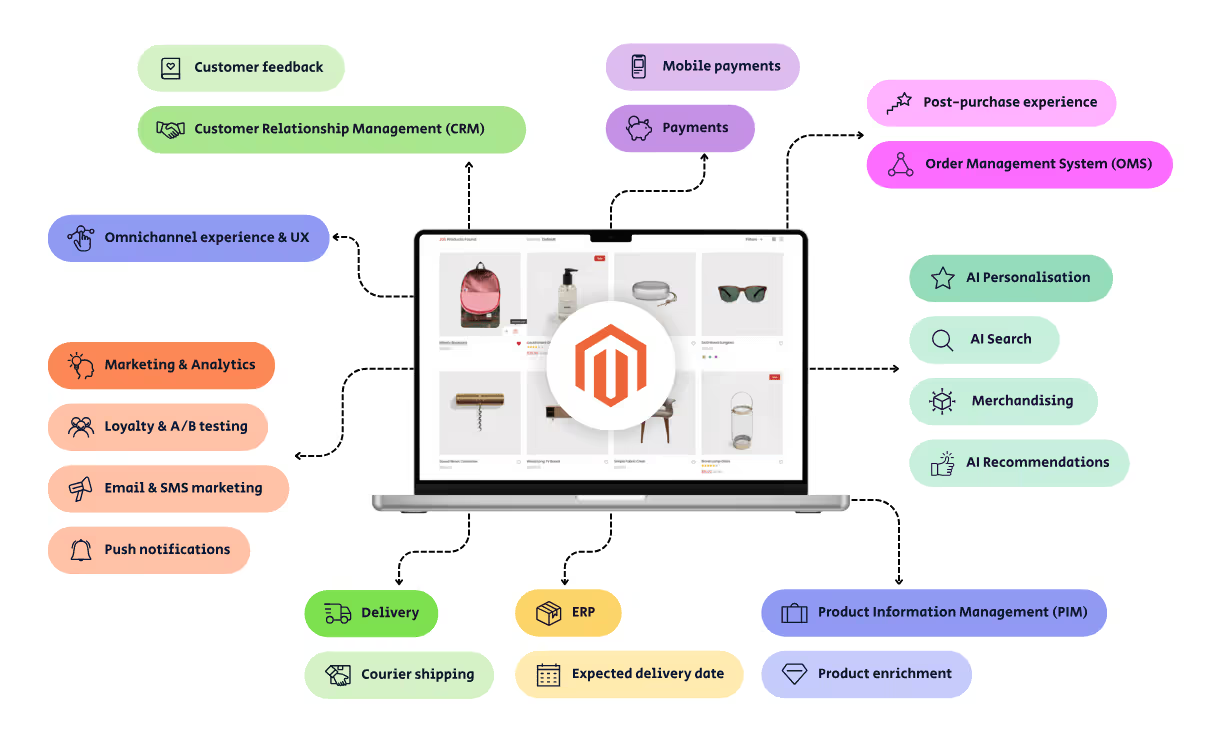
Ways to connect Magento and Oracle ERP
| Option | Type | Best for | Notes |
|---|---|---|---|
| Oracle Integration with the Magento Commerce Cloud Adapter | Integration platform | Companies that already run Oracle Integration for their Oracle Cloud applications | Oracle documents the adapter as an invoke connection that can create, update, query or search, and delete Magento records, with support for custom modules, custom Customer and Customer Address attributes, and calls to a specific store ID. It supports Magento APIs protected with OAuth 1.0 client credentials authentication. |
| Middleware or custom service on the Oracle Fusion Cloud SCM REST API | Custom API | B2B order flows with custom charges, payment rules, or approval steps | Orders are created with a POST to salesOrdersForOrderHub. Required fields are BusinessUnitId, SourceTransactionId, SourceTransactionNumber, SourceTransactionRevisionNumber, and SourceTransactionSystem, and the source system must be set up in Oracle first. |
| Oracle E-Business Suite REST services through Integrated SOA Gateway | Custom API | Merchants still running Oracle E-Business Suite on premises | Oracle's E-Business Suite adapter guide has you deploy the Order Management API OE_ORDER_PUB (Process Order) as a REST service, grant only the methods the integration user needs, and set the profile option OM: Raise Status Change Business Event to Yes. |
| NetSuite Connector or Celigo, when the Oracle ERP is NetSuite | Connector | Oracle NetSuite customers | NetSuite is a separate product with its own Magento connectors. Oracle's NetSuite Connector lists Magento 2 as a supported storefront. |
What syncs between Magento and Oracle ERP
| Data | Direction | System of record | Timing |
|---|---|---|---|
| Sales orders | Magento to Oracle | Oracle once the order is accepted | Near real time, with the Oracle order number returned in the response |
| Customer accounts and addresses | Oracle to Magento | Oracle for B2B accounts | Scheduled or on change |
| Items and prices | Oracle or a PIM to Magento | Oracle for price, PIM for content | Scheduled |
| Inventory availability | Oracle to Magento | Oracle | Scheduled |
| Order status, shipments, and invoices | Oracle to Magento | Oracle | Event-based where the ERP raises status events, otherwise scheduled |
How a Magento Oracle ERP integration project runs
- Confirm which Oracle product you run (Fusion Cloud ERP and SCM, E-Business Suite, or NetSuite) and which middleware the ERP team owns.
- Register the store as a source system in Oracle Fusion, or deploy the needed E-Business Suite APIs as REST services with least-privilege method grants.
- Agree one versioned mapping document per interface (orders, customers, prices, stock, status) with a sample payload for each payment method and charge type.
- Create a dedicated Magento integration with only the API resources it needs.
- Test in Oracle's development instance with real customer accounts, freight charges, payment types, change orders, and cancellations.
- Go live with a queue of rejected orders that someone owns, and a daily reconciliation of Magento orders against Oracle orders.
Common problems and how to avoid them
The payload spec changes after the workshops
On a B2B Magento build connected to Oracle Fusion Cloud ERP through middleware, the ERP team's API document and field mapping changed after the on-site workshops, and a sample payload from another channel's sales order interface was shared as a reference. Mapping stalled until everyone agreed which version applied. Keep one signed-off mapping per interface and treat every change to it as a change request.
Freight and payment details decide the payload
On the same build, the Oracle side needed Magento's freight charges mapped to its charge columns and clarity on card payment details, and the request payload differed by payment type and charge code. Decide early who captures the card payment and when, because it changes both the order payload and the status flow back to Magento.
Line and order identifiers must stay stable
The middleware required a line number on every Magento order line. In Fusion Cloud SCM, SourceTransactionId and the source system form the key Oracle uses for change orders, and Oracle says each change order must reuse the value the original order used. Map Magento order and item IDs once and never regenerate them.
Orders land in draft
The salesOrdersForOrderHub SubmittedFlag decides whether Oracle validates and submits the order; when it is false the order stays in draft. Oracle's field description and schema metadata disagree on the default, so set the flag explicitly in every request.
Why choose scandiweb to handle Magento integration for you?
How does Magento (Adobe Commerce) integrate with Oracle ERP for two-way order and invoice sync?
Orders, payments, and customer data can flow to Oracle ERP, while invoice numbers, credits, and status updates sync back to Magento. The mapping follows your chart of accounts, tax rules, and fulfillment states so finance does not reconcile by hand.
Can Magento sync real-time inventory from Oracle Fusion Cloud ERP or Oracle E-Business Suite?
Yes, stock, reservations, and backorder rules can be pulled from Oracle on a schedule or near real time, then exposed in Magento by website, source, or warehouse. This keeps PDP availability and checkout validations aligned with your ERP.
What product and price data can be synced between Magento and Oracle ERP without breaking catalog logic?
SKU masters, UOMs, attributes, cost, price lists, and customer-specific pricing can be synchronized with clear ownership rules per field. We add validation so bad data does not cascade into storefront errors or incorrect margins.
Does a Magento – Oracle ERP integration support multi-store, multi-currency, and localization?
Yes, we map store views to Oracle organizations, ledgers, and price books, including currency conversion and localized tax handling where needed. The goal is one Magento build that still respects Oracle’s market-specific processes.
How do you keep a Magento Oracle ERP integration maintainable during Magento upgrades and Oracle changes?
We isolate the integration layer, version the contracts, and add monitoring and replayable queues so changes are traceable and low-risk. scandiweb has delivered 2,100+ eCommerce projects since 2003, so we design integrations for long-term ownership, not quick fixes.
Is there an Oracle Integration adapter for Magento?
Yes. Oracle Integration includes the Magento Commerce Cloud Adapter, an invoke connection that can create, update, query, and delete Magento records and supports Magento APIs protected with OAuth 1.0 client credentials.
Which Oracle Fusion API creates sales orders from Magento?
The salesOrdersForOrderHub resource in the REST API for Oracle Fusion Cloud SCM. A POST needs BusinessUnitId, SourceTransactionId, SourceTransactionNumber, SourceTransactionRevisionNumber, and SourceTransactionSystem.
Can Magento integrate with Oracle E-Business Suite?
Yes. E-Business Suite APIs such as OE_ORDER_PUB (Process Order) can be deployed as REST services through Integrated SOA Gateway and called by Magento, middleware, or Oracle Integration's E-Business Suite adapter.
How does Magento get the Oracle sales order number?
On the Oracle build we worked on, the middleware returned the Oracle order number in its response to Magento's order call, and Magento stored it on the order.
Is Oracle NetSuite integrated the same way as Oracle Fusion Cloud ERP?
No. NetSuite has its own connectors, including Oracle's NetSuite Connector, which lists Magento 2 as a supported storefront, and Celigo's Magento app.
Sources
- Oracle Integration: Magento Commerce Cloud Adapter capabilities
- REST API for Oracle Fusion Cloud SCM: Create sales orders (salesOrdersForOrderHub)
- Oracle Integration: Prepare Oracle E-Business Suite instances
- Oracle E-Business Suite Integrated SOA Gateway Implementation Guide
- NetSuite help: NetSuite Connector supported storefronts and 3PLs
- Celigo: NetSuite Magento 2 integration app
- Adobe Commerce: Integrations
Last updated by the scandiweb integration team.




Oracle ERP integration on other platforms
More Magento integrations
1. Submit your integration request
2. Join a free strategy & discovery call
We’ll review your business systems, identify key challenges, and uncover actionable opportunities.
3. Get a tailored proposal
Trusted by 700+ leading brands worldwide