


Magento SAP integration for real-time orders, stock, and pricing sync
Connect Magento (Adobe Commerce) with SAP ERP to sync orders, inventory, pricing, and customer data across SAP ECC, SAP S/4HANA, and SAP Business One for accurate operations.








Magento and SAP integration in short
Magento (Adobe Commerce) connects to SAP S/4HANA or SAP ECC through an integration layer, such as SAP Integration Suite or Boomi with its SAP JCo connector, that calls standard SAP APIs, BAPIs, or IDocs, or through a custom Magento module that posts to SAP's OData APIs. SAP Business One is a separate ERP product with its own Service Layer API and prebuilt Magento connectors from vendors such as Webkul and APPSeCONNECT. Magento usually sends orders, customers, and payments to SAP, and SAP sends items, prices, stock, deliveries, and invoices back.
Are orders stuck in limbo because Magento and SAP don’t agree on stock, prices, or customer data? That usually shows up as overselling, manual order fixes, and support teams chasing the ERP for answers, especially once you add multiple warehouses, currencies, or B2B pricing.
Magento SAP integration connects Magento (Adobe Commerce) with SAP ERP so product, inventory, pricing, customers, and orders flow between systems in a controlled way. SAP remains the system of record for ERP processes, while Magento stays focused on storefront and checkout, reducing duplicate data entry and keeping operations aligned across channels.
This setup fits if SAP ERP (SAP ECC, SAP S/4HANA, or SAP Business One) runs your fulfillment, finance, or pricing, and Magento needs to reflect it reliably.


• Master data ownership is defined per domain, with SAP ERP acting as the source for items, stock, pricing, customer accounts, and credit-related attributes, while Magento owns storefront content and cart/checkout state.
• Product and item identifiers are mapped between SAP material numbers and Magento SKUs, with attribute sets and units of measure aligned to avoid conversion and rounding conflicts.
• Inventory is synchronized from SAP plants and storage locations into Magento sources or stock views, with warehouse-to-website mappings handling region-specific availability.
• Price conditions from SAP ERP are translated into Magento price data, with customer group or account-level pricing mapped where B2B catalogs or negotiated terms apply.
• Customer accounts and addresses are matched via stable external IDs, with updates handled as upserts to prevent duplicates when data changes in SAP.
• Orders are exported from Magento to SAP ERP with payment, tax, shipping, and line details, then order status, shipment, and invoicing updates are returned to Magento for customer-facing tracking.
• Delta-based synchronization sends only changed records where possible, while failed messages are logged with payload metadata for reprocessing and traceability.
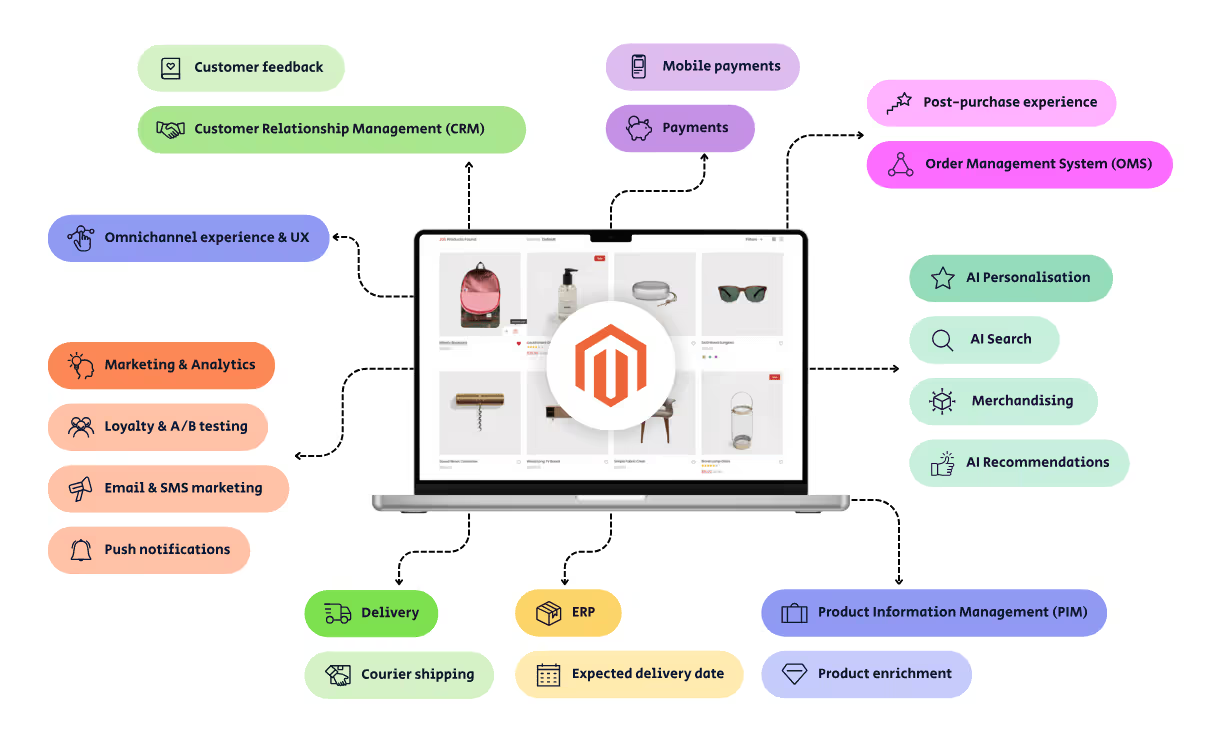
Ways to connect Magento and SAP
| Option | Type | Best for | Notes |
|---|---|---|---|
| SAP Integration Suite | Integration platform | SAP S/4HANA landscapes where the SAP team wants to own and monitor the integration layer | On a Magento project we support for a retailer, the SAP team publishes sales order, customer, address, goods issue, and pickup in store endpoints through Integration Suite, and the first of them, goods issue posting, used standard S/4HANA APIs with no custom code on the SAP side. |
| Boomi with the SAP JCo connector | Integration platform | Merchants that already run Boomi between Magento, SAP, and logistics or document systems | The connector executes BAPIs and remote function modules and sends or receives IDocs. Boomi's public runtime cloud does not support it, so it needs a runtime you host or a private runtime cloud with the SAP Java Connector 3.0 or 3.1 libraries loaded, plus a database for transaction IDs when receiving IDocs. |
| Custom Magento module on SAP OData APIs | Custom API | S/4HANA setups with a small number of well defined flows and an in-house SAP team that exposes the APIs | S/4HANA exposes sales orders through the Sales Order (A2X) OData API. SAP's knowledge base notes that a $batch request can create only one sales order per change set, and that external order numbering works through the OData V2 version of the API but not V4. On the Magento side, asynchronous REST endpoints write inbound bulk updates, such as prices and stock, to a message queue and return a bulk UUID for status checks. |
| SAP Business One connectors for Magento | Connector | Companies on SAP Business One rather than S/4HANA or ECC | Webkul's SAP Magento 2 Connector costs $1,999, connects through the SAP Business One Service Layer, and exports categories, products, customers, and orders one way from Magento to SAP Business One; two-way sync is a customization. APPSeCONNECT covers orders, incoming payments, items, stock, price lists, shipments, invoices, and B2B contacts. Our Magento SAP Business One guide covers this route in detail. |
What syncs between Magento and SAP
| Data | Direction | System of record | Timing |
|---|---|---|---|
| Sales orders | Magento to SAP | Magento at checkout, SAP once the sales order is created | On order placement, queued with retries |
| Customers and business partners | Magento to SAP for new web customers, SAP to Magento for B2B accounts and addresses | SAP for B2B accounts, credit, and payment terms | With the first order, or scheduled |
| Materials and product data | SAP or a PIM to Magento | SAP for material numbers, units of measure, and sales status; Magento or the PIM for web content | Scheduled delta sync |
| Prices and conditions | SAP to Magento | SAP | Scheduled, with customer-specific prices calculated or cached per B2B account |
| Stock availability | SAP to Magento | SAP by plant or warehouse | Scheduled, with an optional live check before payment |
| Deliveries, goods issue, and tracking | SAP to Magento, plus Magento to SAP for pickup and locker events | SAP | Event driven or scheduled |
| Invoices, payments, and refunds | Magento to SAP for captured payments, SAP to Magento for invoice and refund status | Payment provider for captures, SAP for invoices and accounting | With each capture, invoice, or credit memo |
How a Magento SAP integration project runs
- Confirm which SAP product and release you run (S/4HANA Cloud, S/4HANA on-premise, ECC, or Business One) and which interfaces the SAP team will expose: OData APIs, BAPIs, IDocs, or the Business One Service Layer.
- Agree which system owns each record and field, and which SAP document each Magento order, payment, cancellation, and refund becomes.
- Choose the integration layer (SAP Integration Suite, an integration platform such as Boomi, or a custom module) and set up network access, credentials, and test clients for every environment.
- Map SKUs to material numbers, units of measure, plants or warehouses, customer numbers, tax codes, and price conditions, then check every code against the SAP test system.
- Build order export with retries that cannot create duplicates, and store the SAP document number, response, and status on each Magento order.
- Test real order paths end to end: a failed then successful payment, partial shipments, cancellations, refunds, and pickup in store.
- Go live with alerts on failed exports and a daily count of Magento orders that have no SAP document.
Common problems and how to avoid them
A payment retry can stop the order export
On a Magento and SAP project we support, Magento canceled an order when the first card payment failed and moved it to confirmed when the shopper paid again on the same page. The integration treated canceled as the end of the order's journey, so the confirmed order never reached SAP, and dozens of orders a day needed manual entry or refunds until the export was re-triggered for orders confirmed after a cancellation.
Synchronous SAP calls need their own resend queue
When Magento posts to SAP and waits for the answer, a timeout or SAP error fails the call and nothing retries it by default. On an S/4HANA project behind SAP Integration Suite, we added the SAP posting status, response, and time to each order in the Magento admin, and the SAP team asked for a resend mechanism for failed messages once sales order creation became synchronous. Plan both from the start, with a duplicate check before any resend.
Business partner locks reject quick updates
SAP locks a business partner while it is being changed. On one project an address update from Magento failed with 'Business partner is currently being processed by MAGENTO', because another Magento call still held the lock. Queue updates per business partner and retry after a short delay instead of dropping the change.
One sales order per change set
SAP's knowledge base says the Sales Order (A2X) OData API can create or process only a single sales order per change set of a $batch request. A bulk export of web orders has to wrap each order in its own change set, or SAP rejects the batch.
Moving SAP integrations to BTP changes every endpoint
On one project the SAP team moved its interfaces to SAP BTP, which gave sales order, customer, address, and tax number calls new URLs per environment. Keep SAP base URLs and credentials in configuration per environment, so a move between on-premise and cloud integration is a settings change and a regression test, not a code release.
Status updates can fail on the Magento side
On a Magento store fed by Boomi, delivery status updates sometimes failed inside Magento with a database deadlock, so the order never reached delivered and the invoice was not sent to SAP, which left stock differences between SAP and the drivers. Treat Magento errors as retryable, log the payload, and alert on orders stuck in one status.
Why choose scandiweb to handle Magento integration for you?
How does a Magento SAP integration sync real-time inventory across warehouses in SAP ERP?
We map Magento sources and reservations to SAP stock by warehouse, then push updates through API or IDoc so PDP and checkout reflect sellable inventory.
Can Magento SAP integration support B2B pricing, customer-specific price lists, and contract terms from SAP ERP?
Yes – we sync customer groups, price lists, tier rules, and validity dates so Magento shows the right price per account without manual overrides.
What data is typically exchanged in a Magento SAP integration for orders, invoices, and shipments?
Common flows include orders and customer updates from Magento to SAP, plus shipping, invoicing, cancellations, and credit notes back to Magento.
Does Magento SAP integration work with SAP S/4HANA, SAP ECC, and SAP Business One?
Yes – SAP ERP can mean SAP ECC, SAP S/4HANA, or SAP Business One, and we tailor the connector to the available interfaces and your data model.
How do you prevent overselling and price mismatches in Magento when integrating with SAP ERP?
We add validation rules, queue-based retries, and monitoring so Magento blocks checkout on stale stock or price changes and logs exceptions for fast fixes.
Should we build a Magento integration on SAP ECC if S/4HANA is coming?
SAP keeps mainstream maintenance for SAP Business Suite 7 through December 31, 2027, with optional extended maintenance through December 31, 2030. If a move is planned, keep the mapping in an integration layer so only the SAP side changes when you switch.
Can Magento check SAP stock live at checkout?
Yes. A live stock call before payment capture can block an order SAP cannot fulfill, while a scheduled sync keeps category and product pages current. Decide in advance what checkout does when SAP does not answer in time.
Who builds the SAP side of a Magento integration?
On the projects we support, the client's SAP team or SAP partner exposes and maintains the SAP interfaces, and the eCommerce team builds the Magento module, mapping, and monitoring. Test systems, credentials, and sample payloads are agreed before development starts.
Can SAP order numbers be used as the web order number?
On S/4HANA Cloud, SAP's knowledge base says external sales order numbering is not supported through the OData V4 Sales Order API, and the OData V2 version is the workaround. Agree early whether Magento keeps its own number and stores the SAP number as a reference.
Sources
- SAP: SAP Integration Suite overview
- Boomi help: SAP JCo V2 connector
- SAP KBA 3163859: one sales order per change set in API_SALES_ORDER_SRV $batch
- SAP KBA 3749701: external numbering with API Sales Order A2X OData V4
- SAP News: Planning beyond 2030 for SAP Business Suite 7 and SAP NetWeaver customers
- Webkul: SAP Magento 2 Connector
- APPSeCONNECT: SAP Business One and Magento integration
- Adobe Commerce developer docs: Asynchronous web endpoints
Last updated by the scandiweb integration team.







SAP integration on other platforms
More Magento integrations
1. Submit your integration request
2. Join a free strategy & discovery call
We’ll review your business systems, identify key challenges, and uncover actionable opportunities.
3. Get a tailored proposal
Trusted by 700+ leading brands worldwide