


Magento (Adobe Commerce) integration with Infor for real-time ERP accuracy
Connect Magento 2 to Infor to keep orders, inventory, pricing, and customer data consistent across ERP and storefront, with scandiweb handling scalable integration architecture and long-term maintainability.








Magento and Infor integration in short
Magento (Adobe Commerce) connects to Infor through Infor ION, which can call any REST application registered in its API Gateway, through the Infor ERP's own services (Infor SyteLine accepts REST, SOAP, and asynchronous ION or IDO Request XML over HTTP), or through an integration platform such as Alumio. Magento sends orders and customers to Infor, and Infor sends back physical stock, prices, and shipment status, while Magento keeps calculating salable quantity from its own reservations.
Are finance and operations still chasing Magento (Adobe Commerce) orders across exports, emails, and “quick fixes” in spreadsheets? That’s where refunds get mismatched, inventory lags behind reality, and customer service ends up guessing which system is right.
The Magento – Infor integration connects your storefront with your Infor ERP so orders, customers, products, pricing, inventory, and fulfillment updates move between systems in a controlled flow. In practice, it establishes one dependable source of truth per dataset, reduces manual reconciliation, and keeps trading workflows stable even when volumes spike or catalogs get complicated.
This setup fits teams running Infor as the operational backbone and needing an ERP integration for Magento that stays maintainable through upgrades, new markets, and process changes.


• Magento (Adobe Commerce) sales orders are exported to Infor with customer, addresses, items, taxes, discounts, shipping, and payment metadata mapped to ERP document structures.
• Infor becomes the system of record for fulfillment events, invoicing, shipment confirmation, and cancellations; status updates are synchronized back to Magento to drive customer notifications and account history.
• Product master data can be owned in Infor or Magento; identifiers (SKU, item number, UOM, and barcode/GTIN where used) are mapped to prevent duplicate creation and cross-system drift.
• Inventory availability is synchronized from Infor to Magento per stock location, with allocation rules and backorder flags translated to Magento source/stock concepts where applicable.
• Price lists and customer-specific pricing are mapped from Infor to Magento catalogs, with currency, tax class, and effective date logic handled to avoid conflicting price states.
• Sync jobs support delta processing based on change timestamps/queues, with validation, retry logic, and error logging to isolate bad records without blocking the full integration flow.
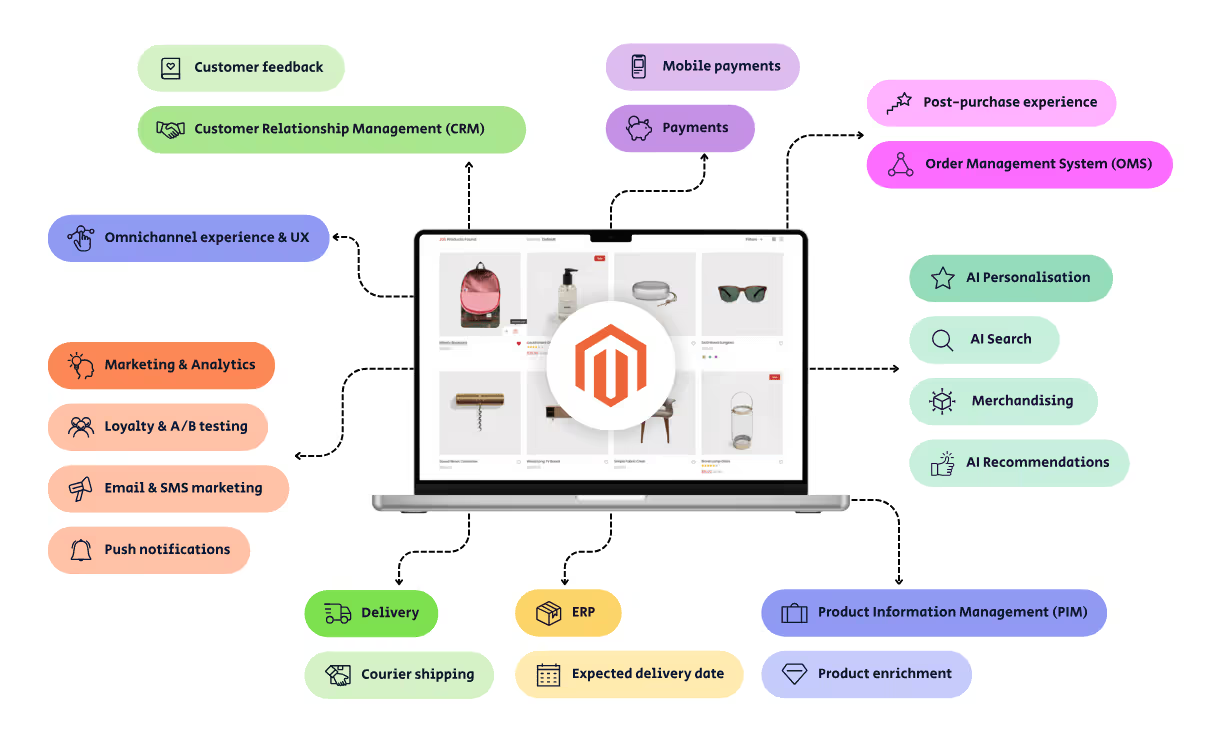
Ways to connect Magento and Infor
| Option | Type | Best for | Notes |
|---|---|---|---|
| Infor ION with an API Gateway connection point | Integration platform | Infor CloudSuite customers who already route integrations through Infor OS | An API Gateway connection point defines a connection from ION to any application with a REST interface registered in API Gateway, which must have Swagger 2.0 or OpenAPI 3 documentation. Input documents map to the API request, and the response can come back as an output document. |
| Infor SyteLine REST, SOAP, or IDO Request services | Custom API | SyteLine customers with custom order or stock logic | Infor lists synchronous inbound access by SOAP web service, REST service, .NET class, and documented XML schema, and asynchronous access by ION or IDO Request XML over HTTP. |
| Alumio iPaaS for Adobe Commerce and Infor | Integration platform | Teams that want visual mapping and other systems (PIM, WMS) in the same layer | Alumio describes flows that run on events, on a schedule, or both, and typical records such as orders, products, customers, inventory levels, prices, and status updates. The page does not name specific Infor products, so confirm yours is covered. |
| Custom middleware on the Magento REST API | Custom API | Stores where a shipping platform, PIM, or loyalty tool sits between Magento and Infor | You own idempotency, retries, and logging. Push physical quantities per source and let Magento's reservations handle what is already sold. |
What syncs between Magento and Infor
| Data | Direction | System of record | Timing |
|---|---|---|---|
| Orders | Magento to Infor | Magento at checkout, Infor for fulfillment | Near real time or batched |
| Customers | Magento to Infor | Infor for B2B accounts | With each order |
| Physical stock per source | Infor to Magento | Infor; Magento owns reservations and salable quantity | Scheduled push to a Magento endpoint |
| Prices | Infor to Magento | Infor | Scheduled |
| Shipments and tracking | Infor or the shipping platform to Magento | Infor or the shipping platform | Event-based, with a daily reconciliation |
| Store and offline orders | Infor to Magento | Infor | Scheduled import into separate tables |
How a Magento Infor integration project runs
- Identify the Infor product (SyteLine, M3, LN, or another CloudSuite) and whether integrations must go through ION or can call the ERP's services directly.
- Agree record ownership, including the rule that Infor sends physical stock and Magento keeps reservations.
- Document every endpoint with its fields and a sample payload, and share it with the ERP team before build.
- Make every write idempotent: unique keys for orders and shipments, and safe handling of repeated webhooks.
- Test on staging with bundles, batch orders, partial shipments, voided shipping labels, and each store view.
- Go live with a daily reconciliation of shipments and stock depletion between Magento and Infor.
Common problems and how to avoid them
The ERP tries to manage reservations
On a Magento and SyteLine build, the ERP side planned to send Magento both reserved stock and shipped stock. Magento already creates reservations when orders are placed and compensates them on shipment or cancellation. The ERP should push physical quantity per source and leave reservations to Magento.
Repeated shipment webhooks duplicate ERP lines
On the same store, the shipping platform sent the same shipment webhook three times within seconds, and Magento created duplicate shipment records for some bundle orders. Quantities in Magento stayed correct, but the duplicates reached SyteLine as repeated order and shipment lines. Make both the shipment endpoint and the ERP insert idempotent, keyed on order and tracking number.
Status changes that never deplete stock
After go-live on that build, an order completed and shipped in Magento did not trigger stock depletion in SyteLine, and in batch campaign orders only the first order received a shipment. Track these cases in a shared issue log and reconcile shipments against ERP depletion every day.
Importing ERP orders as native Magento orders
For a loyalty program, a retailer wanted orders placed in Infor to appear in Magento. Native Magento order items need tax class, per-unit tax and discount, applied rule IDs, and parent links for configurable products, which the ERP data did not hold. We proposed importing them into separate tables instead, scoped at 25 to 50 hours.
Binary files inside BODs
Infor states that BOD documents are XML and support only text, so a file read into a BOD is base64-encoded, and a target API that expects raw binary will fail. For binary uploads through an API Gateway connection point, Infor's documentation recommends an ANY document.
Why choose scandiweb to handle Magento integration for you?
How do you integrate Magento (Adobe Commerce) with Infor ERP without breaking during upgrades?
We use a versioned API-first layer and contract tests, so Magento and Infor can evolve independently with predictable releases.
What data objects can be synced between Magento (Adobe Commerce) and Infor ERP, and how is ownership defined?
Typical objects include products, price lists, inventory, customers, orders, shipments, invoices, and returns, with clear system-of-record rules per field.
Can a Magento to Infor integration support multi-website, multi-currency, and localization rules?
Yes, we map store views, warehouses, tax logic, and localized attributes so each market can run its own rules without duplicating integrations.
How do you handle near real-time inventory and price updates from Infor to Magento at scale?
We use incremental sync, queuing, and idempotent updates to prevent spikes, duplicates, and race conditions when feeds get heavy.
What happens when Infor is down or an API call fails in a Magento – Infor integration?
Retries, dead-letter queues, and alerting keep the pipeline stable, while failed messages are traceable and replayable without manual data edits.
Does Infor SyteLine have an API that Magento can use?
Yes. Infor lists synchronous access by REST service, SOAP web service, .NET class, and documented XML schema, and asynchronous access by ION or IDO Request XML over HTTP.
Can Infor ION connect directly to Magento?
ION can call a REST application through an API Gateway connection point, as long as the application is registered in API Gateway with Swagger 2.0 or OpenAPI 3 documentation and its endpoints are indexed.
Should Infor send reserved stock to Magento?
No. Magento creates and clears its own reservations as orders are placed, shipped, or canceled. Infor should send physical quantity per source.
Can in-store orders from Infor appear in Magento customer accounts?
Yes, but importing them as native Magento orders is error-prone because Magento expects tax, discount, and product data the ERP often lacks. Storing them in separate tables and reading them from the account pages is simpler.
What is a BOD in an Infor integration?
A Business Object Document, an XML document based on standards from the Open Application Group Integration Specification (OAGIS), used by Infor ION to move data between applications.
Sources
- Infor OS: API Gateway connection point
- Infor SyteLine: Integrating external applications
- Infor Developer Portal: Integration with ION
- Alumio: Adobe Commerce (Magento) to Infor integration
- Adobe Commerce: Reservations
Last updated by the scandiweb integration team.







Infor integration on other platforms
More Magento integrations
1. Submit your integration request
2. Join a free strategy & discovery call
We’ll review your business systems, identify key challenges, and uncover actionable opportunities.
3. Get a tailored proposal
Trusted by 700+ leading brands worldwide