


Magento (Adobe Commerce) + Acumatica integration for real-time ERP-driven inventory
Connect Magento 2 with Acumatica to sync products, pricing, customers, and orders reliably at scale, with scandiweb building and supporting the ERP layer your stack can grow on.








Magento and Acumatica integration in short
Acumatica's native commerce connectors cover Shopify, BigCommerce, and Amazon, and Acumatica connects to Magento (Adobe Commerce) through supported integrations instead. The main options are Kensium's Acumatica Magento Connector, which installs in both Acumatica and Magento, Celigo's Magento 2 and Acumatica template on integrator.io, or a custom build on Acumatica's contract-based REST API. Magento usually sends orders, customers, and cancellations, while Acumatica sends items, stock, shipments, invoices, and refunds back.
When order volume grows, the weak spot is usually the handoff between Magento (Adobe Commerce) and your ERP. Stock connectors time out, custom scripts become fragile, and small mismatches in tax, inventory, or customer data turn into backlogs, support tickets, and finance reconciliation work.
A Magento Acumatica integration connects storefront activity to ERP operations so orders, customers, products, pricing, and inventory move reliably between systems, even with multiple sites, currencies, and an ERP + PIM + middleware landscape. scandiweb builds and supports integrations that stay maintainable over years, with predictable performance and clear system ownership.
This setup fits if your team needs an Acumatica ERP integration for Magento that won’t buckle under peak traffic, high SKU counts, or complex back-office workflows.


• Magento order data is transformed to Acumatica sales order structures, including customer, addresses, payments, taxes, discounts, and shipment details, with field-level mapping and validation.
• Inventory availability and stock reservations are synchronized between Acumatica and Magento on a schedule or via event-driven triggers, with delta syncs sending only changed records.
• Product master data, pricing, and customer-specific price lists are imported from Acumatica into Magento, with optional routing via PIM or middleware when it is the system of record.
• Sync ownership is defined per entity, and conflict handling applies source-of-truth rules, idempotent writes, and retries to prevent duplicates and partial updates.
• API traffic is throttled and queued to respect Acumatica and Magento rate limits, with batching for large catalogs and peak order spikes.
• Integration events and failures are logged with correlation IDs across systems, enabling traceability, alerting, and safe reprocessing of stuck messages.
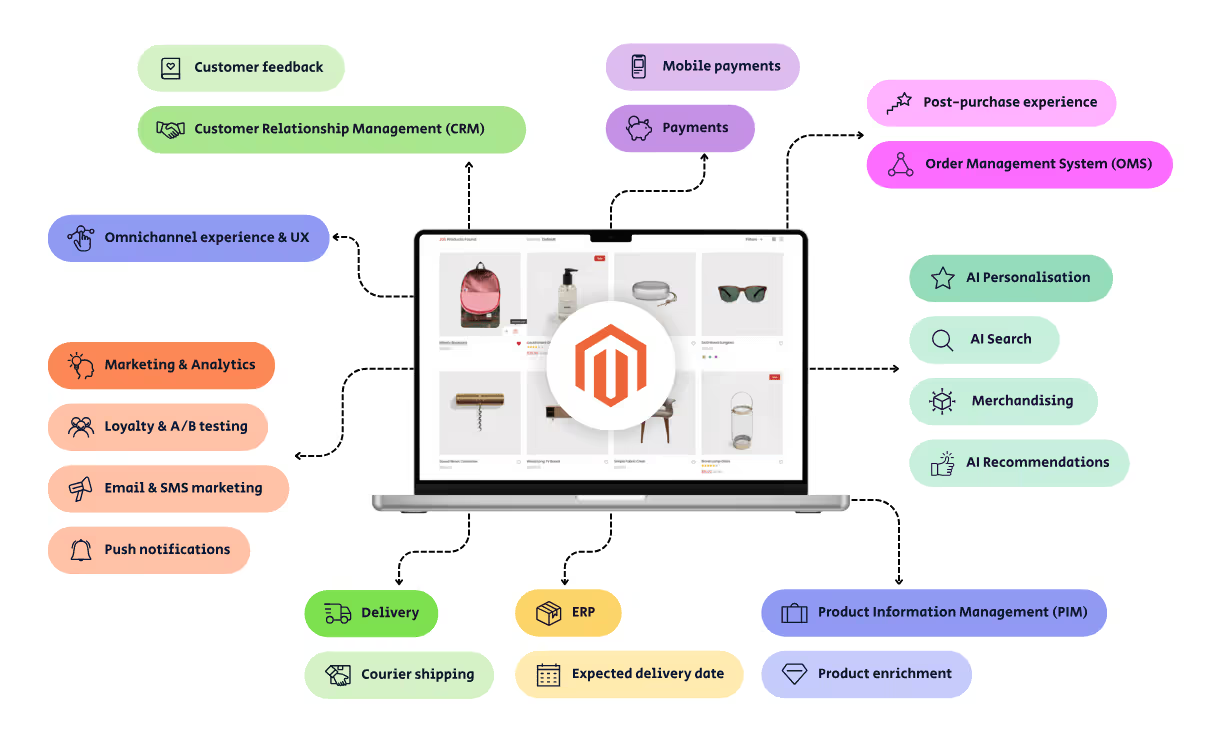
Ways to connect Magento and Acumatica
| Option | Type | Best for | Notes |
|---|---|---|---|
| Kensium Acumatica Magento Connector | Connector | Acumatica customers who want a packaged connector with Acumatica-side screens | Kensium's user guide covers products, categories, customers, customer groups, payment and shipping methods, warehouses, order statuses, orders, returns, gift cards, tax, and stores, with separate installation steps in Acumatica and in Adobe Commerce, and both real-time and batch processing. Kensium uses the names Magento Connector and Adobe Connector for the same product. |
| Celigo Magento 2 and Acumatica template | Integration platform | Teams that want editable flows and monitoring on Celigo's integrator.io | Magento 2 sends orders, customers, and order cancellations to Acumatica. Acumatica sends sales orders, customers, inventory receipts, items with inventory, shipments, sales invoices, order cancellations, and customer refunds to Magento 2. Custom flows can be added on the same platform. |
| Custom build on Acumatica's contract-based REST API | Custom API | B2B pricing, allocation, or order rules that packaged flows do not cover | Every Acumatica license caps the number of API users, concurrent API requests, and API requests per minute, visible on the License Monitoring Console (SM604000). On the Magento side, asynchronous REST endpoints queue inbound bulk updates and return a bulk UUID for status checks. |
What syncs between Magento and Acumatica
| Data | Direction | System of record | Timing |
|---|---|---|---|
| Sales orders | Magento to Acumatica | Magento at checkout, Acumatica once the sales order is created | Real time or batch, depending on the connector |
| Customers | Magento to Acumatica, and Acumatica to Magento | Acumatica for B2B accounts, terms, and credit | With each order, or scheduled |
| Items and products | Acumatica to Magento | Acumatica for stock items, units, and prices; Magento for web content | Scheduled |
| Inventory | Acumatica to Magento | Acumatica by warehouse | With item sync or on inventory receipts |
| Shipments and invoices | Acumatica to Magento | Acumatica | After shipment or invoice is released |
| Cancellations | Both directions | The system where the cancellation starts | Event driven or scheduled |
| Refunds | Acumatica to Magento | Acumatica | After the customer refund is processed |
How a Magento Acumatica integration project runs
- Confirm your Acumatica version and edition, your Magento version, and the API limits on your Acumatica license.
- Agree which system owns each record and field, and which Acumatica documents each Magento order, payment, cancellation, and refund becomes.
- Choose the Kensium connector, the Celigo template, or a custom build, and confirm it supports your Magento and Acumatica versions.
- Create a dedicated Acumatica API user and a Magento integration with only the resources it needs.
- Map SKUs to stock items, customer groups to price classes, store views to branches or warehouses, and tax, shipping, and payment methods.
- Test real cases end to end: partial shipments, cancellations from both sides, refunds, and gift cards, then go live with alerts on failed syncs and API throttling.
Common problems and how to avoid them
API license limits slow bulk syncs
Acumatica's integration guide explains that once requests in a minute reach half the license's per-minute limit, later requests are delayed in an internal queue, and in the 2020 R2 guide requests were declined when more than 20 were waiting or one had waited over 10 minutes. Spread catalog and price syncs over time and check the License Monitoring Console before go-live.
Sessions left open lock out other integrations
Each license also caps the number of API users. An integration that signs in but never signs out can use every API session and stop other applications from signing in, so the connector or custom code must close its sessions.
Magento is not one of Acumatica's native connectors
Acumatica lists native connectors for Amazon, Shopify, and BigCommerce, and puts Adobe Commerce among platforms connected through supported integrations. Agree who maintains the connector and retests it after every Magento upgrade and Acumatica release, because it is not one of Acumatica's built-in connectors.
Comparing the wrong stock numbers
Magento shows salable quantity, which is its stock quantity reduced by reservations held from order placement until shipment. If Acumatica already subtracts quantities on open sales orders, the same order is deducted twice until the shipment syncs back, so agree which system subtracts open orders.
A payment retry can stop the order export
On a Magento store we support, the order was canceled after a failed card payment and confirmed after the shopper paid again, but the ERP integration treated canceled as final and never sent the order. Whatever the ERP, test failed then successful payments before go-live.
Why choose scandiweb to handle Magento integration for you?
How do you integrate Acumatica ERP with Magento (Adobe Commerce) for high order volume?
We design an API-first sync with queues and retries so order, payment, and shipment updates stay consistent during peaks, not “eventually correct.” The goal is predictable throughput, not a brittle point-to-point script.
What data can a Magento (Adobe Commerce) + Acumatica integration sync, and how do you prevent mismatches?
Typical flows include products, pricing, customers, inventory, orders, invoices, and shipments, with strict ID mapping and validation rules. We also add monitoring so exceptions are visible before they become finance cleanup.
Can you support multi-website, multi-currency Acumatica sync in Magento 2?
Yes, we model site- and warehouse-level rules for stock, price lists, taxes, and customer groups, then validate them per store view. This keeps localization logic out of ad-hoc fixes and inside a maintainable integration layer.
Do you build custom Acumatica integrations for Magento when standard connectors fall short?
Yes, we build custom endpoints and middleware patterns when you need non-standard pricing, allocations, bundles, or complex fulfillment workflows. That is common in real ERP landscapes, and we plan for it upfront.
Who maintains the Magento Acumatica integration after go-live, and how do you handle changes safely?
scandiweb provides long-term support with versioned integrations, regression checks, and performance tuning as catalogs and order volume grow. We have delivered 2,100+ eCommerce projects since 2003, so “maintenance” is treated as a core capability, not an afterthought.
Does Acumatica have a native Magento connector?
No. Acumatica lists native connectors for Amazon, Shopify, and BigCommerce, and says Adobe Commerce connects through supported integrations, such as Kensium's connector or Celigo's template.
How many API calls can a Magento Acumatica integration make?
It depends on your Acumatica license, which caps API users, concurrent requests, and requests per minute. You can see the limits on the License tab of the License Monitoring Console (SM604000).
Can refunds made in Acumatica update Magento?
Yes. Celigo's template includes a flow from Acumatica customer refunds to Magento 2 refunds, and Kensium's guide covers returns.
What has to be installed for the Kensium connector?
Kensium's user guide has separate installation sections for Acumatica and for Adobe Commerce, so plan for components on both sides and include them in upgrade testing.
Sources
- Acumatica: Commerce connectors
- Kensium product docs: Acumatica Magento Connector user guide
- Celigo: Magento 2 and Acumatica integration template
- Acumatica ERP Integration Development Guide (2020 R2): license restrictions for API users
- Adobe Commerce docs: Reservations
- Adobe Commerce developer docs: Asynchronous web endpoints
Last updated by the scandiweb integration team.







Acumatica integration on other platforms
More Magento integrations
1. Submit your integration request
2. Join a free strategy & discovery call
We’ll review your business systems, identify key challenges, and uncover actionable opportunities.
3. Get a tailored proposal
Trusted by 700+ leading brands worldwide