


Magento SAP Business One integration for orders, stock, and price lists
Connect Magento (Adobe Commerce) with SAP Business One to sync orders, incoming payments, items, price lists, and warehouse stock through the Service Layer, with every web order traceable to its SAP document.








Magento and SAP Business One integration in short
Magento (Adobe Commerce) integrates with SAP Business One through a connector or integration platform, such as APPSeCONNECT or Webkul's SAP Magento 2 Connector, or through a custom Magento module that calls the SAP Business One Service Layer, SAP's OData-compliant REST API for Business One. Magento usually sends orders, customers, and payments to SAP Business One, and SAP Business One sends items, price lists, warehouse stock, shipments, and invoices back.
When Magento and SAP Business One run side by side without a link, web orders are keyed into SAP by hand, stock on the site lags behind the warehouse, and finance matches card payments to invoices one by one. The gap grows with B2B price lists, several warehouses, and seasonal peaks.
The Magento SAP Business One integration connects Magento (Adobe Commerce) to SAP Business One through the Service Layer, SAP's OData REST API for Business One, or through a connector built on it. Orders, customers, and payments move from Magento into SAP Business One, while items, price lists, stock, shipments, and invoices move back to the storefront.
This setup fits companies that run SAP Business One on Microsoft SQL Server or SAP HANA and sell through Magento to consumers, trade customers, or both.


• Magento connects to the SAP Business One Service Layer over HTTPS with a dedicated API user, using OData version 3 at /b1s/v1 or version 4 at /b1s/v2, and reuses sessions within the 30-minute idle timeout.
• Item codes, units of measure groups, warehouses, tax groups, and user-defined fields are mapped by their Service Layer property names, which differ from the SQL column names in the database.
• Stock is read from each item's warehouse information, and available quantity is calculated as in stock minus committed for the warehouses that serve the web store, with an optional live check before payment capture.
• Price lists and discounted prices with start and end dates flow from SAP Business One to Magento, including special prices for B2B business partners.
• Web orders are posted as sales orders, and A/R invoices and incoming payments are linked by their SAP document entry, so each invoice shows as paid in SAP Business One.
• Shipments and tracking numbers flow back to Magento, and each request and response is logged on the order so failed calls can be retried without duplicates.
• Large reads raise the page size with the B1S-PageSize header, because the Service Layer returns 20 records per page by default.
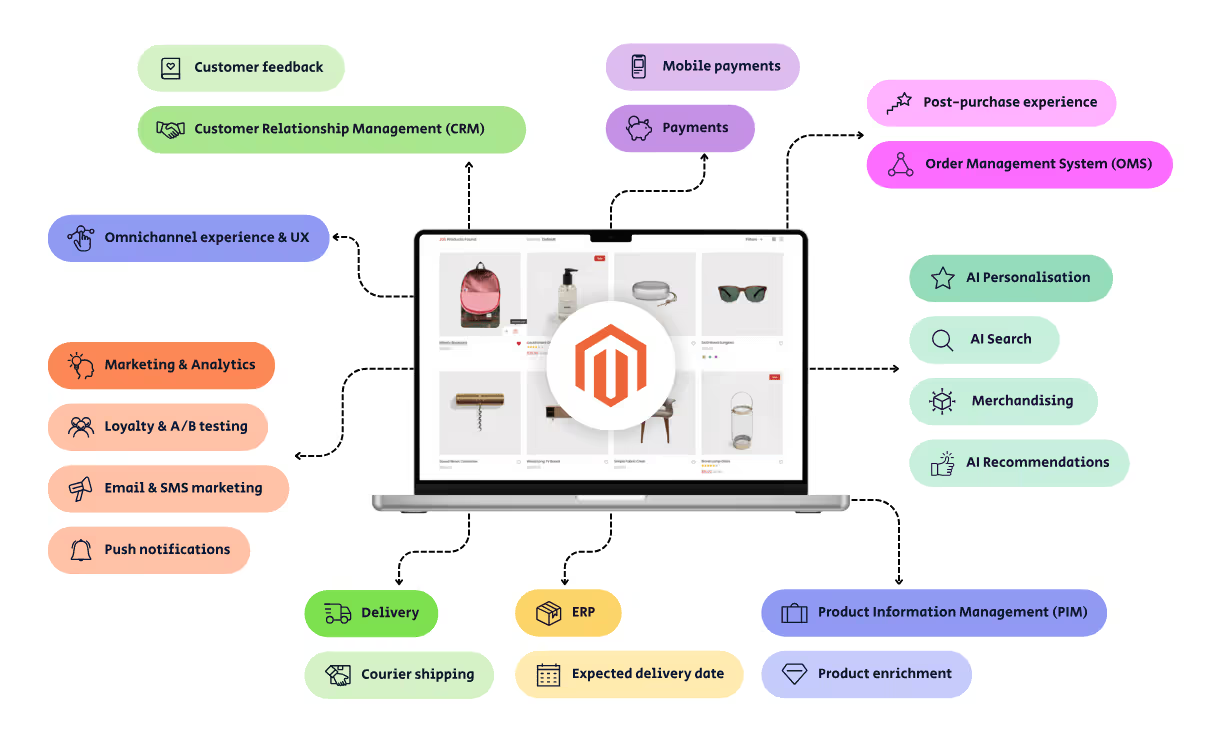
Ways to connect Magento and SAP Business One
| Option | Type | Best for | Notes |
|---|---|---|---|
| APPSeCONNECT SAP Business One and Magento integration | Integration platform | SAP Business One companies that want prebuilt two-way flows, including B2B accounts | Magento orders become SAP Business One sales orders and payments become incoming payments; items, warehouse stock by item code, price lists, shipments with tracking, and invoice status flow back; business partners and contacts sync to Magento company accounts. APPSeCONNECT notes that SAP Business One runs on Microsoft SQL Server or SAP HANA and that the connection method is confirmed per environment. The page shows a general starting price of $99 a month. |
| Webkul SAP Magento 2 Connector | Connector | Stores that only need web orders and customers pushed into SAP Business One | Costs $1,999 and runs inside Magento 2.4 with no third-party server, connecting to SAP Business One through the Service Layer. It exports categories, products, customers, and orders one way from Magento to SAP Business One; two-way sync is a customization. |
| Custom Magento module on the SAP Business One Service Layer | Custom API | Stores with B2B pricing, deposits, warehouse rules, or a PIM in the middle | The Service Layer supports OData version 3 at /b1s/v1 and version 4 at /b1s/v2, and is built on the same DI core as the older DI API, so objects and properties match. Sessions use a B1SESSION cookie with a default idle timeout of 30 minutes, queries return 20 records per page by default, and ETags guard against blind concurrent updates from SAP Business One 10.0 FP 2102. |
What syncs between Magento and SAP Business One
| Data | Direction | System of record | Timing |
|---|---|---|---|
| Sales orders | Magento to SAP Business One | Magento at checkout, SAP Business One once the order is posted | On order placement, queued with retries |
| Business partners and contacts | Magento to SAP Business One for new web customers, SAP Business One to Magento for B2B accounts | SAP Business One for B2B accounts, terms, and credit | With the first order, or scheduled |
| Items | SAP Business One to Magento, or PIM to SAP Business One when products start in a PIM | SAP Business One for item codes, units of measure groups, and tax groups | Scheduled, or when a product is flagged ready in the PIM |
| Price lists and discounted prices | SAP Business One to Magento | SAP Business One | Scheduled, including start and end dates for discounts |
| Stock | SAP Business One to Magento | SAP Business One, in stock minus committed for the web warehouse | Scheduled, plus an optional live check before payment capture |
| A/R invoices | Magento to SAP Business One, or SAP Business One to Magento, depending on which system invoices | Agreed with finance per project | When the order is invoiced |
| Incoming payments | Magento to SAP Business One | Payment provider for the capture, SAP Business One for clearing | With each invoice |
| Shipments and tracking | SAP Business One to Magento | SAP Business One | After delivery is posted |
How a Magento SAP Business One integration project runs
- Confirm your SAP Business One version, patch level, and database (Microsoft SQL Server or SAP HANA), and whether the Service Layer is installed and reachable from the integration over VPN or a whitelisted connection.
- Create a dedicated API user with the authorizations it needs in every company database, test and production.
- Agree the document chain with finance: sales order, A/R invoice, incoming payment, and credit memo, and which system creates each one.
- Map item codes, units of measure groups, warehouses, price lists, tax groups, and user-defined fields, using Service Layer property names rather than SQL column names.
- Build exports with retries that cannot create duplicates, and store the SAP DocEntry returned for each document on the Magento order.
- Test real cases in a fresh copy of production: partial captures, refunds, stock running out at checkout, and a company database refresh.
- Go live with alerts on failed documents and a daily check for Magento orders without an SAP DocEntry.
Common problems and how to avoid them
Service Layer names are not SQL column names
On a Magento project we support for a distributor, product payloads first used field names from the OITM and ITM10 database tables, and the Service Layer rejected them with errors such as 'Property ISCommCode of Item is invalid'. The right names were SalesItem, MinOrderQuantity, InventoryWeight, and an ItemIntrastatExtension block, so map against the Service Layer metadata, not the database.
User-defined fields must exist in every company database
SAP notes that Service Layer metadata varies by company database because each one has its own user-defined fields, tables, and objects. On the same project, a picture URL field the spec required was missing from the test database, so calls failed with 'Property U_Picture_URL of Item is invalid' until the SAP partner added it. Check every user-defined field in test and production before go-live.
Codes in the spec may not exist in SAP
The integration spec named an ECOMM warehouse for invoices, but SAP returned error -10 'Enter a valid value in Whse field' because no such warehouse existed; a new WH-WEB warehouse was created instead. Query /Warehouses and the other code lists from the Service Layer before building payloads.
One incoming payment per invoice
Finance wanted each Magento invoice followed by one IncomingPayments document for the full amount, linked to the invoice by its DocEntry, so the invoice shows as paid and the bank feed clears against a clearing account. Rules: no standalone payments, no payments for refunds, and retries that never create a second payment. The change was estimated at 16 to 20 development hours plus 2 hours of QA and project management.
Twenty records per page by default
The Service Layer returns 20 records per page unless you raise it with the B1S-PageSize header or Prefer: odata.maxpagesize, or change PageSize in b1s.conf. A full stock or price read at the default page size makes many more requests than it needs to.
SAP upgrades are integration events
After a weekend SAP Business One upgrade on one project, the Service Layer hostname changed and the endpoint was only reachable by IP over a site-to-site VPN, so syncs stopped until the network was updated. On another, a database upgrade queued the whole catalog again, tens of thousands of products, which was expected to take more than 30 hours to sync. Plan upgrades with the integration team and a rollback window.
Why choose scandiweb to handle Magento integration for you?
How does Magento connect to SAP Business One?
Through the SAP Business One Service Layer, an OData REST API, either with a connector such as APPSeCONNECT or Webkul's SAP Magento 2 Connector, or with a custom Magento module. The older DI API is a Microsoft COM interface for the Windows native environment.
What data does a Magento SAP Business One integration sync?
Orders, customers, and payments go from Magento to SAP Business One. Items, price lists, stock, shipments, tracking numbers, and invoice status come back to Magento.
Can Magento B2B show SAP Business One price lists and special prices?
Yes. Price lists and special prices for business partners can be synced to Magento customer groups or company accounts, so trade buyers see their SAP prices after they log in.
Does the integration support several warehouses or SAP company databases?
Yes. Magento stock can be mapped to the SAP Business One warehouses that serve each website, and each additional company database needs its own connection, API user, and user-defined fields.
Can the integration work with a PIM such as Pimcore?
Yes. On one project, products are created in Pimcore, sent to SAP Business One when they are flagged ready for ERP sync, and imported into Magento with stock and prices from SAP.
What is the SAP Business One Service Layer?
SAP's web API for Business One. It is OData-compliant and RESTful, built on the same DI core as DI API, and serves OData version 3 at /b1s/v1 and version 4 at /b1s/v2.
Can the Service Layer run with SAP Business One on Microsoft SQL Server?
SAP's Service Layer guide says it runs on SUSE Linux Enterprise and on Microsoft Windows as of SAP Business One 10.0 PL01, and refers to the administrator's guides for both the Microsoft SQL and SAP HANA versions. Check your version and patch level with your SAP partner.
How should Magento read SAP Business One stock?
On a project we support, Magento reads ItemWarehouseInfoCollection for each item, uses in stock minus committed for the web warehouse only, and checks SAP again before payment capture so an order SAP cannot fill is blocked.
How do Magento payments reach SAP Business One?
In the setups we have worked with, as incoming payments linked to the A/R invoice by its DocEntry, so the invoice shows as paid; APPSeCONNECT maps Magento payments to incoming payments too. Agree with finance whether partial captures, refunds, and bank transfers need their own handling.
Should a new integration use DI API or the Service Layer?
SAP describes DI API as derived from Microsoft COM and suited to the Windows native environment, DI Server as SOAP based, and the Service Layer as an OData service with high availability and load balancing. Webkul's connector and the Magento projects we support use the Service Layer.
Why do SAP Business One sessions expire during a sync?
The Service Layer's idle session timeout defaults to 30 minutes, so a session left unused between sync runs expires. Log in again when a call reports an expired session, and log out at the end of each run.
Sources
- SAP help: Working with SAP Business One Service Layer (user guide)
- APPSeCONNECT: SAP Business One and Magento integration
- Webkul: SAP Magento 2 Connector
Last updated by the scandiweb integration team.






SAP Business One integration on other platforms
More Magento integrations
1. Submit your integration request
2. Join a free strategy & discovery call
We’ll review your business systems, identify key challenges, and uncover actionable opportunities.
3. Get a tailored proposal
Trusted by 700+ leading brands worldwide